

A-Level Chemistry Marks Per Grade: 2025
A-level chemistry marks per grade for 2025: compare AQA, Edexcel, OCR and Eduqas raw marks, understand thresholds and check results with confidence today.
Results day can make one mark feel enormous. You see a total on a screen, but the letter beside it depends on a boundary that was not known when you sat the papers. If you are checking A-level chemistry marks per grade, the latest complete figures are the summer 202520252025 thresholds shown below. They are the minimum overall raw marks needed for each grade.
At the time of publication, summer 202620262026 boundaries are not yet available. Exam boards set them after marking and publish them on results day, so previous thresholds are useful reference points rather than predictions.
Quick results-day checklist
- Confirm your exam board and specification.
- Find your overall raw mark, not a percentage estimate.
- Use the boundary for the correct exam series.
- Remember that a boundary is the lowest mark receiving that grade.
- Ask your school or college if your result is unexpectedly close to a threshold.
You can also open MathsGenie's complete GCSE and A Level grade boundaries hub to compare subjects and years.
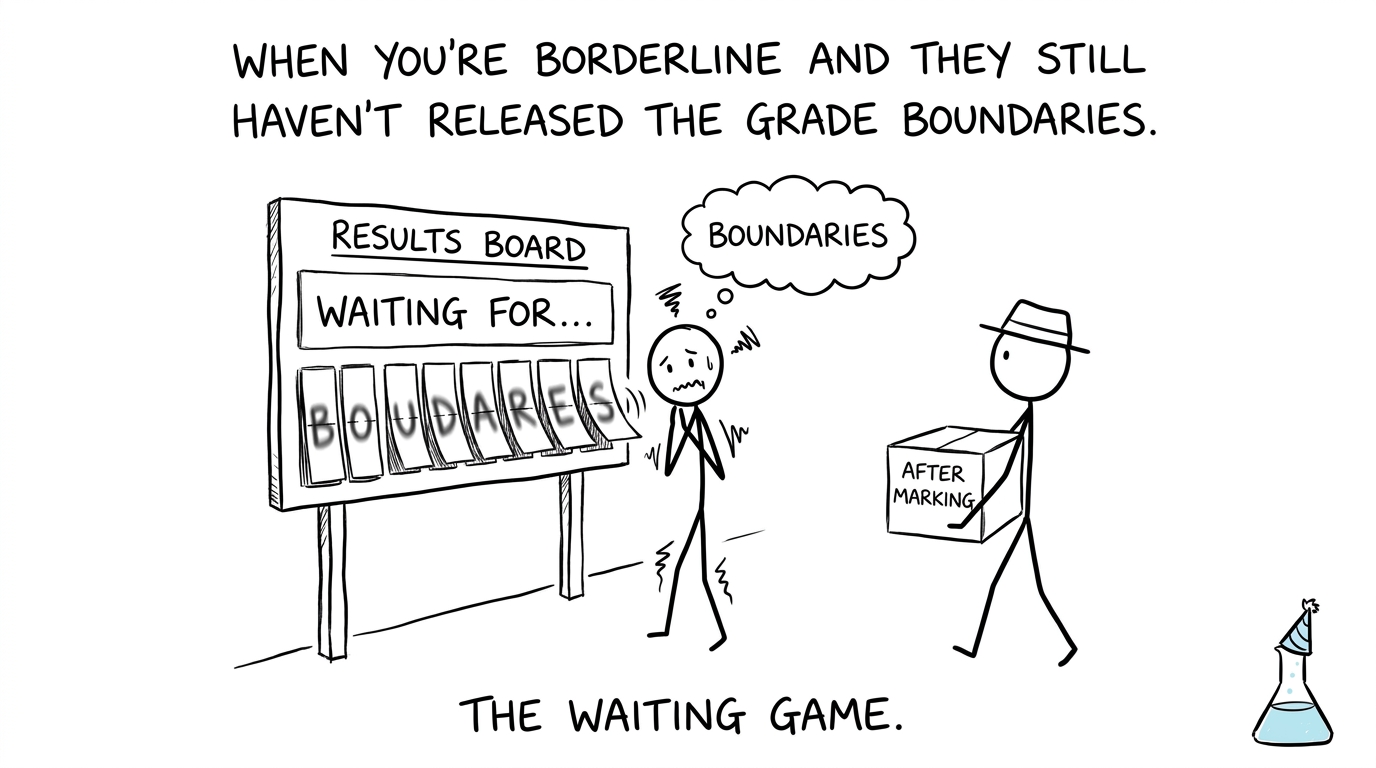 A student waiting for grade boundaries while an examiner carries a box labelled after marking
Latest A-level chemistry raw marks by grade
These are the confirmed summer 202520252025 whole-qualification boundaries published by the exam boards. Each figure is the minimum mark required.
| Exam board and specification | Maximum mark | A* | A | B | C | D | E |
|---|---|---|---|---|---|---|---|
| AQA Chemistry 7405 | 300300300 | 239239239 | 197197197 | 162162162 | 127127127 | 939393 | 595959 |
| Edexcel Chemistry 9CH0 | 300300300 | 246246246 | 207207207 | 170170170 | 133133133 | 969696 | 606060 |
| OCR Chemistry A H432 | 270270270 | 243243243 | 213213213 | 175175175 | 137137137 | 999999 | 616161 |
| OCR Chemistry B Salters H433 | 270270270 | 216216216 | 176176176 | 146146146 | 117117117 | 888888 | 595959 |
| Eduqas Chemistry A410QS | 300300300 | 215215215 | 187187187 | 159159159 | 132132132 | 105105105 | 787878 |
The boards use different papers, specifications and maximum marks. A raw total of 220220220 therefore has no meaning until it is matched to the correct qualification.
How A-level chemistry grade thresholds work
A raw mark is the mark awarded for the answers you wrote. For a linear A Level, the relevant paper marks are combined to produce the overall total used for grading.
If your raw mark is rrr and the boundary is bbb, you receive that grade when:
r≥br \geq br≥bFor example, the AQA A* threshold in 202520252025 was 239239239. A total below that but at least 197197197 received an A. This is simply an interpretation of the table, not a worked prediction for another year.
Individual papers may also have notional component boundaries. These help teachers interpret performance, but they do not award separate certificated grades. Your final Chemistry grade comes from the whole-qualification total. Practical endorsements are reported separately where the specification requires them and do not add raw marks to the written-exam grade.
MathsGenie's AQA Chemistry grade calculator and Edexcel Chemistry grade calculator let you enter paper marks and compare the total with historical boundaries.
Why boundaries move between years
Grade thresholds are not fixed percentages. Senior examiners and assessment specialists set them after the papers have been marked, using evidence about the demands of that exam series and the quality of students' work.
A more demanding paper may produce a lower raw boundary. A more accessible paper may produce a higher one. The aim is to preserve the standard represented by each grade, not to guarantee the same mark every summer. There is also no fixed quota limiting how many students can receive a particular grade.
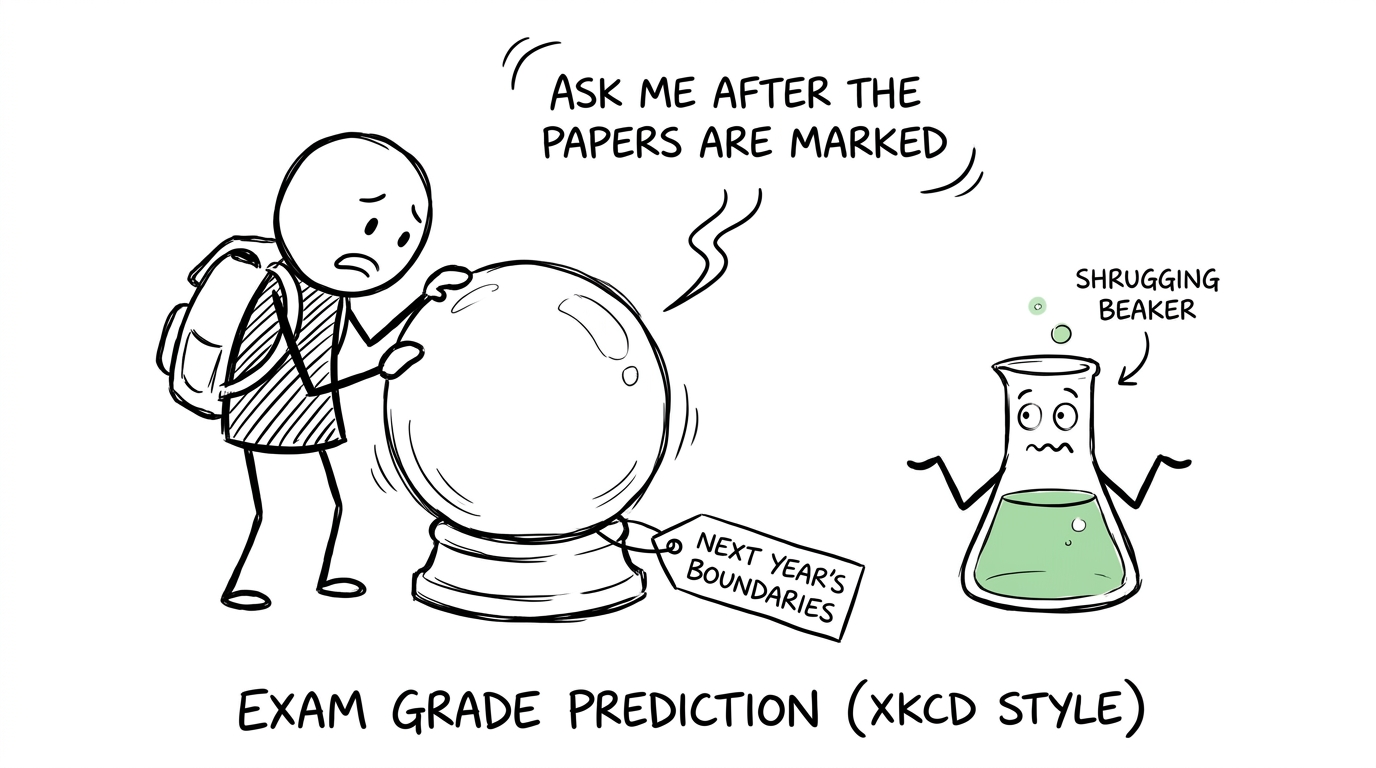 A crystal ball admits that next year's boundaries cannot be known until marking is complete
This is why predicted thresholds should be treated cautiously. Historical data can show a range, but it cannot reveal an unpublished boundary.
What GCSE students should notice now
If you are currently preparing for GCSE maths and considering A Level Chemistry, the table offers a useful lesson: small calculation errors accumulate. Rearranging formulae, ratios, standard form, graphs and unit conversions all support quantitative Chemistry.
Build those foundations through MathsGenie's Edexcel GCSE Maths revision lessons, then practise under pressure rather than only reading notes. At A Level, the AQA Chemistry revision hub and Edexcel Chemistry revision hub bring together questions, past papers and mark schemes.
Common mistakes when checking a Chemistry grade
Using the wrong board
OCR Chemistry A and OCR Chemistry B are different specifications with different thresholds. Check the code on your timetable or results information.
Treating last year's boundary as a promise
Past boundaries are evidence, not forecasts. Do not assume the same raw mark will produce the same grade in 202620262026.
Reading a paper boundary as the final grade
Component thresholds are usually notional. Add the relevant paper marks and use the overall subject boundary.
Comparing raw marks without checking the maximum
OCR totals are out of 270270270, while AQA, Edexcel and Eduqas totals in this table are out of 300300300. Direct comparisons can therefore mislead.
Turn the number into a revision decision
A boundary explains a result, but it cannot improve the next one. That happens when you identify where marks disappeared and practise those skills deliberately.
Start with MathsGenie's A-Level Chemistry grade boundaries, then move to revision lessons, practice questions, past papers and mark schemes for your board. Near the exam, use A Level predicted papers as focused practice rather than as a promise about what will appear. The threshold is decided at the end; the useful work happens long before it.










