A-Level Chemistry Grade Boundaries: Results Day 2026
A-level chemistry grade boundaries explained: learn how marks become grades, why boundaries change, and what to check on UK results day 2026.
Results morning has a peculiar kind of tension. The exams ended weeks ago, yet one number can still feel as though it is waiting behind a locked door. If you are searching for A-level chemistry grade boundaries, the essential answer is simple: a boundary is the minimum total mark needed for a particular grade, and the official 2026 boundaries will be published on results day.
A-level results day 2026 is Thursday 13 August 2026. Boundaries are not safely predictable in advance because exam boards set them after papers have been marked and the evidence has been reviewed.
 A nervous chemistry student waits for results day
A-level chemistry results day checklist
Before opening your results, know what you are looking at:
- Confirm your exam board and specification code.
- Find your overall Chemistry grade and total mark, if provided.
- Use the official boundary document for the correct specification.
- Compare your total qualification mark with the overall boundaries.
- Treat individual paper boundaries as notional unless your board says otherwise.
- Check your Practical Endorsement result where it applies.
- Speak to your school or college before requesting a review of marking.
If Chemistry is part of a wider STEM plan, MathsGenie's free A Level Maths revision hub can also help you keep the quantitative skills behind physical chemistry secure.
What are A-level chemistry grade boundaries?
A grade boundary is the lowest mark that earns a grade. If an official table gives an A boundary of 207207207, then 207207207 is an A, while 206206206 falls into the grade below.
For linear A Levels, the marks from the relevant written papers are normally combined into one overall subject mark. That total is compared with boundaries for A*, A, B, C, D and E. You do not usually receive a separate certificated grade for each paper.
This matters because an uneven set of papers can still produce a strong overall result. A difficult organic chemistry paper does not automatically decide your grade if marks gained in physical, inorganic or practical-context questions lift your total.
Students taking maths alongside Chemistry can see the same overall-boundary principle through the OCR A Level Maths grade boundary archive. The figures are for maths, not Chemistry, but they demonstrate how boundaries can move between exam series.
How chemistry A-level grade boundaries 2026 are set
Exam boards do not choose the boundaries before seeing how students performed. Once marking is nearly complete, senior examiners and assessment experts examine statistical evidence and samples of student work around possible boundary marks.
The purpose is comparability. If a paper was harder than the previous year's paper, its boundary may be lower. If it was easier, the boundary may be higher. A moving mark boundary does not mean the required standard has been casually changed; it is part of keeping that standard comparable between years.
There is also no fixed quota requiring a particular number of Chemistry students to fail or receive an A*. Your result depends on the quality of your work and where your total mark sits against the confirmed boundaries.
 A crystal ball refuses to predict the 2026 boundaries
Why previous boundaries cannot predict 2026 exactly
Past boundaries provide context, not a promise. Paper difficulty, assessment evidence and the performance of the cohort can differ each year. Predictions posted before results day are therefore estimates rather than official chemistry A-level grade boundaries 2026.
This is similar to using a past paper score during revision. It is useful evidence, but it is not a final grade. Maths students can build that distinction by completing Edexcel A Level Maths past papers and checking each attempt with its correct mark scheme and boundary set.
Worked boundary example
Consider a fictional A-level Chemistry specification with three papers. Suppose a student receives:
| Component | Mark |
|---|---|
| Paper 1 | 686868 |
| Paper 2 | 747474 |
| Paper 3 | 919191 |
The overall mark is:
68+74+91=233 68+74+91=233 68+74+91=233Now suppose the illustrative overall boundaries are:
| Grade | Minimum mark |
|---|---|
| A* | 244244244 |
| A | 207207207 |
| B | 171171171 |
Because
207≤233<244, 207\leq233<244, 207≤233<244,the student receives an A. The percentage is
233300×100≈77.7%, \frac{233}{300}\times100\approx77.7\%, 300233×100≈77.7%,but that percentage alone does not determine the grade. It must be compared with the correct boundary for that specification and exam series.
Notice that the paper marks were added before the grade was assigned. Published component boundaries may help explain performance, but for a linear qualification they are generally notional. They do not replace the overall subject boundary.
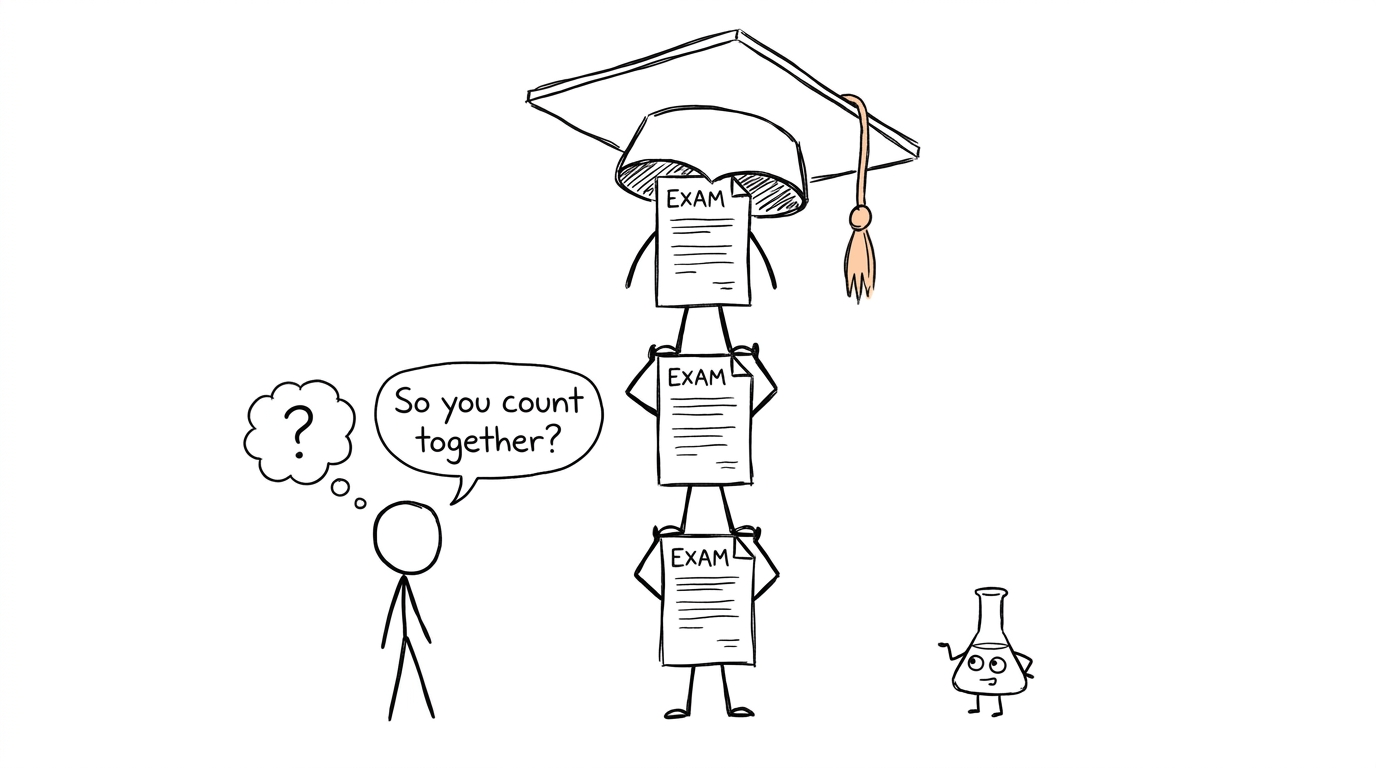 Three exam papers discover that their marks count together
What the Practical Endorsement means
On common English A-level Chemistry specifications, the Practical Endorsement is reported separately as Pass or Not Classified. It does not contribute numerical marks to the overall A-level grade.
That means a strong endorsement cannot raise a written grade from B to A, while the written paper total is still judged using the published subject boundaries. Check your own board's specification because arrangements can differ across qualifications and jurisdictions.
What to do when you receive your result
First, match the boundary document to your board: AQA, Pearson Edexcel, OCR or Eduqas/WJEC, as applicable. Similar subject names do not mean identical papers, maximum marks or boundaries.
If you are close to a boundary, speak to your exams officer or Chemistry teacher. Being one mark short does not mean a review will automatically gain a mark; marks can remain unchanged, increase or decrease. Your centre can explain access to scripts, clerical checks and reviews of marking, together with deadlines and fees.
Try not to compare raw totals with friends on another board. Instead, compare each result with the correct specification-level boundary.
Common mistakes on A-level chemistry results day
Adding notional paper grades
Three notional B grades do not mechanically create an overall B. Add the eligible marks and use the qualification boundary.
Using the wrong exam board's table
AQA, Edexcel, OCR and Eduqas/WJEC use different papers and mark totals. Always verify the specification code.
Treating a predicted boundary as official
No social-media estimate can confirm the boundary before publication. The official exam-board document is the one that matters.
Assuming a review is a free second attempt
A review checks whether the mark scheme was applied correctly. It is not a request for extra marks simply because a result is near a boundary.
Forgetting the maths behind Chemistry
Rates, logarithms, significant figures, graphs and proportional reasoning often make quantitative Chemistry feel harder than the underlying science. Students moving from GCSE can strengthen these foundations through the GCSE Maths revision hub, while sixth-form students can use Edexcel A Level Maths revision guides, AQA A Level past papers and OCR A Level past papers.
A result is information, not a verdict
A boundary turns marks into a grade; it does not measure every useful thing you learnt. On A-level chemistry results day, check the correct table, understand your overall mark and ask for informed help if the result affects your next step.
Then look forward. MathsGenie is the free place to rebuild or extend the mathematical skills that support science, using revision lessons, practice questions, video solutions, mini tests, predicted papers, past papers and mark schemes. Start with the A Level Maths revision resources, choose your exam board and turn the next uncertain mark into a skill you can control.