

A-Level Chemistry Grade Boundaries History
A-Level chemistry grade boundaries history from 2019 to 2025, comparing AQA, Edexcel and OCR trends and explaining what they mean for revision.
A grade boundary can feel like a finish line that moves while you are running towards it. One year, an A may require noticeably more marks than the year before. Yet the A-Level chemistry grade boundaries history shows something reassuring: boundaries respond to the difficulty of each examination series, not to an arbitrary attempt to make your year harder.
For students and teachers analysing recent results, the clearest conclusion is that boundaries fluctuated substantially between 201920192019 and 202520252025, especially around the pandemic transition. They should inform your revision, but they should never become a predicted target.
Grade boundary checklist
Before comparing years, remember:
- A boundary is the minimum mark needed for a grade in one examination series.
- Boundaries are confirmed after papers have been sat and marked.
- AQA and Edexcel Chemistry are marked out of 300300300; OCR Chemistry A is marked out of 270270270.
- The main summer examinations were cancelled in 202020202020 and 202120212021, so those years are not directly comparable.
- Raw marks should be converted into percentages before comparing boards.
- Past boundaries cannot reliably predict the boundary for your examination.
You can check the full datasets through MathsGenie's AQA A-Level grade boundaries, Edexcel Chemistry grade boundaries and OCR Chemistry grade boundaries.
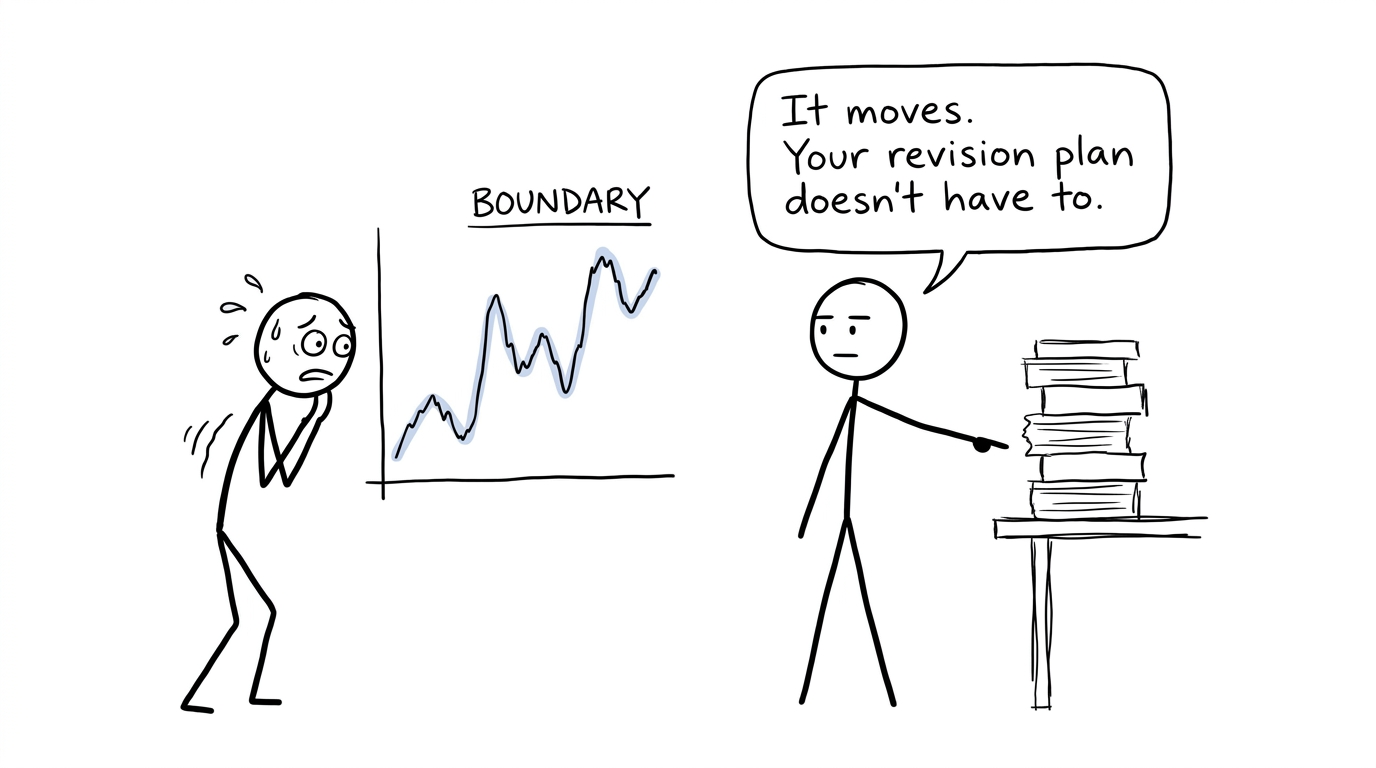 A student learns that boundaries move but a revision plan can remain steady
Past A-Level chemistry grade boundaries by year
The table compares overall qualification boundaries for AQA Chemistry, Edexcel Chemistry and OCR Chemistry A. Each cell gives the raw boundary for A* followed by the boundary for A.
| Examination year | AQA A* / A, out of 300300300 | Edexcel A* / A, out of 300300300 | OCR A A* / A, out of 270270270 |
|---|---|---|---|
| 201920192019 | 246246246 / 206206206 | 242242242 / 202202202 | 230230230 / 196196196 |
| 202220222022 | 237237237 / 196196196 | 235235235 / 192192192 | 213213213 / 168168168 |
| 202320232023 | 250250250 / 210210210 | 241241241 / 195195195 | 234234234 / 198198198 |
| 202420242024 | 239239239 / 198198198 | 252252252 / 216216216 | 243243243 / 212212212 |
| 202520252025 | 239239239 / 197197197 | 246246246 / 207207207 | 243243243 / 213213213 |
These are qualification-level boundaries, not notional boundaries for individual papers. OCR Chemistry B, also called Salters, is a separate specification and has different boundaries.
What changed each year?
The pre-pandemic reference point: 2019
The 201920192019 series offers a useful reference because it was the final normal summer series before the disruption caused by COVID-19. An A* required approximately 82%82\%82% for AQA, 81%81\%81% for Edexcel and 85%85\%85% for OCR A.
Those differences do not prove that one board was easier. Specifications, paper structures and candidate performances differ, while examiners use boundaries to maintain an appropriate standard for each qualification.
The transition year: 2022
Summer examinations returned in 202220222022. Ofqual described grading in England as a transition between the more generous outcomes of 202120212021 and pre-pandemic standards.
That context is visible in the raw boundaries. OCR A's A boundary fell to 168168168 out of 270270270, or about 62%62\%62%, while AQA's was roughly 65%65\%65% and Edexcel's 64%64\%64%. These lower figures should not be read as evidence that students needed less knowledge. Boundaries also reflect paper demand and the grading approach used for that cohort.
The return towards normal grading: 2023
In 202320232023, Ofqual returned to pre-pandemic grading standards, with protection for a cohort whose education had been disrupted. AQA's A* boundary rose to 250250250 out of 300300300, the highest AQA figure in this table. OCR A also increased sharply from its 202220222022 level.
This is an important lesson from the history: a change in raw boundaries does not automatically mean that standards changed by the same amount. Paper difficulty and cohort performance matter too.
Higher boundaries for some boards: 2024
The pattern diverged in 202420242024. AQA's A* boundary fell from 250250250 to 239239239, while Edexcel's rose to 252252252. OCR A reached 243243243 out of 270270270, equivalent to 90%90\%90%.
A student comparing only raw marks might miss this. The fair comparison is:
Percentage boundary=boundary markmaximum mark×100\text{Percentage boundary}=\frac{\text{boundary mark}}{\text{maximum mark}}\times 100Percentage boundary=maximum markboundary mark×100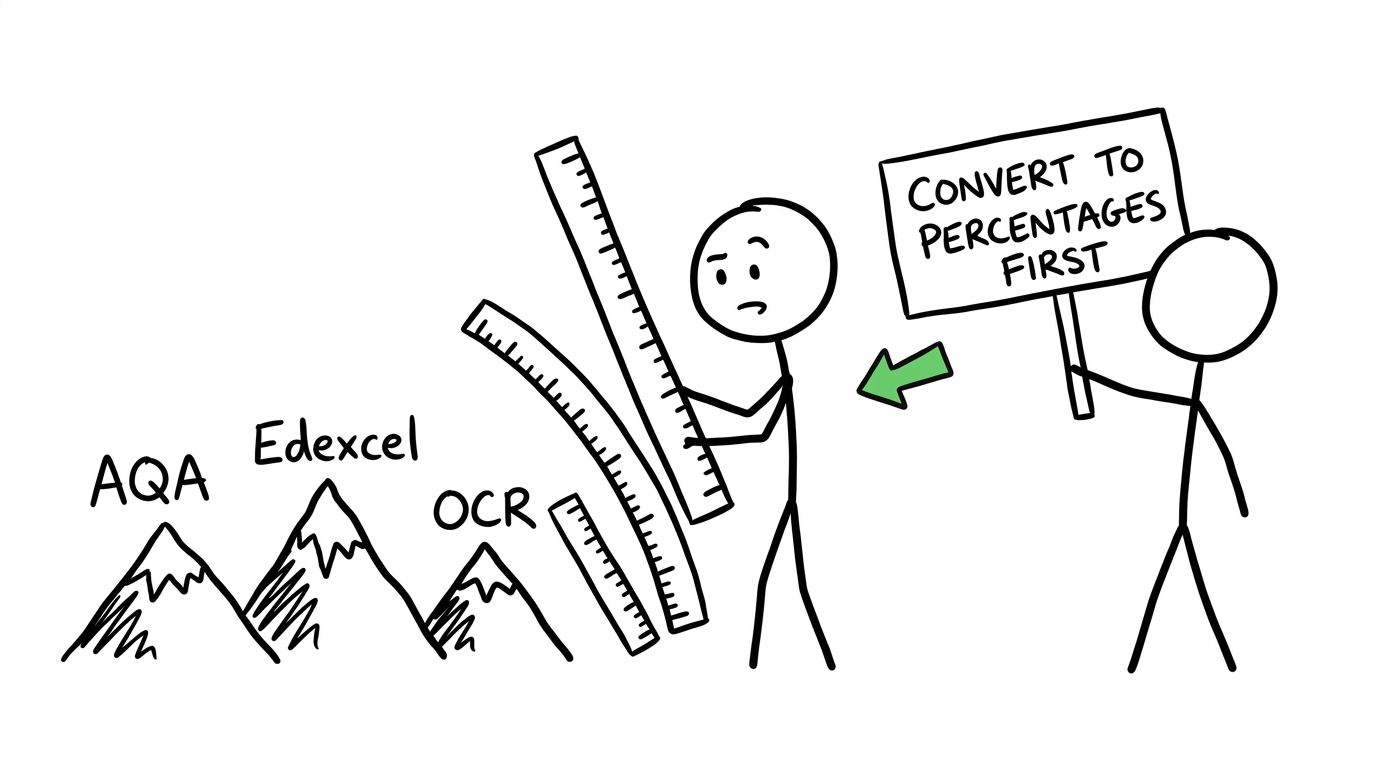 A student compares different exam boards using rulers with different scales
A mixed picture: 2025
In 202520252025, AQA's A* boundary stayed at 239239239, while its A boundary moved down by one mark to 197197197. Edexcel boundaries eased from their 202420242024 highs, but remained above their 202320232023 equivalents. OCR A's A* boundary remained at 243243243, while the A boundary rose by one mark.
The broader A-Level chemistry grade boundary trends are therefore uneven. There is no single upward or downward path shared by every board.
How to use grade-boundary trends sensibly
Treat past boundaries as context, not prophecy. A better revision strategy is to complete several papers under timed conditions, mark them strictly and record performance by topic.
Begin at the A-Level Chemistry revision hub, where resources are organised by exam board. Edexcel students can combine Edexcel Chemistry past papers with the wider Edexcel Chemistry revision resources. OCR students can use OCR A Chemistry past papers and then target weaker areas through the OCR A Chemistry question bank.
Aim above the highest recent boundary for your desired grade rather than revising to the lowest one. That creates room for an unfamiliar practical question, a calculation error or an unexpectedly demanding paper.
For GCSE students considering A-Level Chemistry, the same habit starts now: analyse marks, identify weak topics and practise applying knowledge rather than relying on a predicted boundary.
Common mistakes when analysing boundaries
- Comparing raw marks across different totals: 243243243 out of 270270270 is not equivalent to 243243243 out of 300300300.
- Treating 202020202020 and 202120212021 as ordinary summer series: the main summer examinations were cancelled and grades were awarded through exceptional arrangements.
- Mixing specifications: OCR Chemistry A and OCR Chemistry B have separate papers and boundaries.
- Using notional paper boundaries as final grades: A-Level grades are awarded for the qualification overall.
- Assuming a low historical boundary will return: future papers and cohort performance are unknown.
Build marks instead of predicting boundaries
The history of past A-Level chemistry grade boundaries is useful because it reveals uncertainty, not because it removes it. Boundaries move. Strong examination habits travel from one year to the next.
Use MathsGenie's free Chemistry revision lessons, past papers, predicted papers, practice questions, mini tests and mark schemes to turn each paper into a clear next step. Start with the A-Level Chemistry past-paper and revision hub, choose your board and practise for marks you can control.











