

A-Level Chemistry Career Paths After Results Day
A-level chemistry career paths explained: explore realistic degrees, apprenticeships and jobs, with calm next steps for every results-day outcome in the UK.
Results day can make one grade feel like a verdict on your whole future. It is not. A-level chemistry career paths include university degrees, degree apprenticeships, laboratory roles, healthcare, engineering and careers beyond the lab. Your result affects which route is available immediately, but it rarely decides the final destination.
For GCSE students considering Chemistry, this matters now. A strong foundation in science and maths can preserve options for sixth form, university and employment. For students opening A Level results, the useful question is not simply, “What grade did I get?” It is, “Which doors are open, and what is my best next step?”
Your results-day checklist
Before changing any plan, work through these steps:
- Check whether your university place has been confirmed in the UCAS Hub.
- Read the conditions carefully rather than judging the outcome from one grade.
- Speak to your firm or insurance university if its decision is unclear.
- Compare course content, accreditation and entry requirements before using Clearing.
- Contact an apprenticeship employer or training provider if you hold an offer.
- Keep foundation years, alternative courses and a planned resit year in view.
- Avoid declining a confirmed place until you understand the consequences.
Entry requirements vary significantly between institutions. Always check the current course page rather than assuming that one university’s rules apply everywhere.
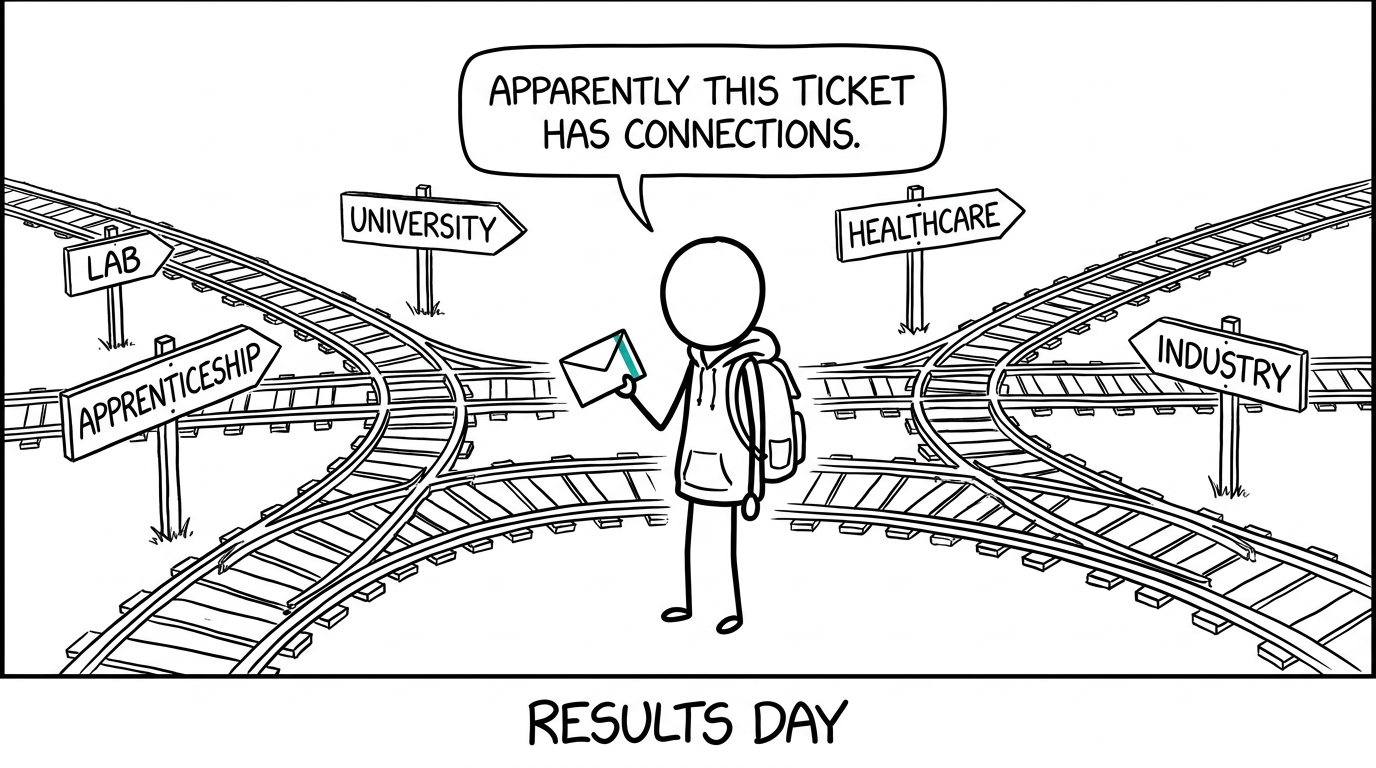 A student discovering that one results-day ticket has many career connections
A-level chemistry career paths by interest
Chemistry is not one narrow corridor lined with laboratory benches. It connects microscopic ideas about particles and bonding to medicines, manufacturing, energy, food, water and new materials.
Chemistry and medicinal chemistry
A Chemistry, Applied Chemistry or Medicinal Chemistry degree can lead towards analytical chemistry, pharmaceutical research, formulation, quality assurance, materials science or postgraduate research. Some programmes are offered as a BSc, while integrated master’s routes may be titled MChem or MSci.
Universities commonly require A Level Chemistry, and some ask for another science or Mathematics. Offers differ, while foundation-year courses may provide another route when direct entry requirements are not met.
Example pairing: Medicinal Chemistry degree: pharmaceutical analysis, drug development or research chemistry.
Pharmacy and healthcare
An MPharm is the university route towards becoming a pharmacist, followed by the required foundation training and professional registration process. Chemistry is normally central to entry, often alongside Biology, Mathematics or another science.
Chemistry can also support applications for biomedical science and other healthcare science courses. If your goal is to become a biomedical scientist, check that the degree and training route meet the relevant professional registration requirements. A course title alone is not enough.
Example pairing: MPharm: community, hospital or primary-care pharmacy.
Example pairing: Accredited Biomedical Science degree: biomedical scientist training in areas such as clinical biochemistry or microbiology.
Medicine, dentistry and veterinary science
Chemistry is required or strongly preferred by many UK medicine, dentistry and veterinary courses, usually with another specified science. Requirements are not identical across universities, so students should check each institution individually.
A strong Chemistry result does not secure entry by itself. These competitive routes may also consider other grades, admissions tests, interviews and evidence that you understand the profession.
Example pairing: Medicine degree: doctor, followed by postgraduate clinical training.
Chemical engineering and sustainable industry
Chemical engineering applies chemistry, physics and mathematics to processes operating on an industrial scale. It can lead towards energy, pharmaceuticals, food production, water treatment, manufacturing and sustainable process design.
Mathematics is commonly required for chemical engineering degrees, with Chemistry or Physics also requested by many providers. GCSE students interested in this route should therefore protect both their science and maths foundations. The GCSE Maths revision hub covers the algebra, graphs, ratio and numerical fluency that later scientific courses depend upon.
Example pairing: Chemical Engineering degree: process engineer, manufacturing engineer or energy-sector roles.
 A chemistry flask conducting a surprisingly serious careers interview
Apprenticeships and technical careers
University is not the only credible route. The National Careers Service identifies apprenticeships alongside degrees as entry routes into chemical science. Current pathways include laboratory technician, technician scientist, laboratory scientist and research scientist apprenticeships at different levels.
Vacancies and requirements change by employer. Some degree apprenticeships combine paid employment with a Chemistry-related degree, while advanced or higher apprenticeships may lead into laboratory testing, manufacturing, quality control or environmental monitoring.
Example pairing: Laboratory Scientist degree apprenticeship: paid laboratory work alongside degree-level training.
Careers beyond the laboratory
Chemistry graduates also work in teaching, scientific publishing, regulation, patent work, data analysis, technical sales, policy and science communication. These routes value the habits Chemistry develops: handling evidence, interpreting data, spotting uncertainty and explaining complex ideas carefully.
The qualification opens possibilities, but later experience matters too. Placements, projects, communication skills and digital confidence can shape where the subject eventually takes you.
What your Chemistry grade may mean
You met your offer
Confirm the place, read the joining instructions and prepare for the transition. Previewing the A Level Chemistry revision collection can help you identify topics worth refreshing before a Chemistry-based degree.
You narrowly missed your offer
Do not assume rejection before checking UCAS. A university may still accept you. If not, compare your insurance choice, Clearing vacancies and foundation-year alternatives. Look beyond the headline entry grade to modules, laboratory time, placement opportunities and accreditation.
Your result was stronger than expected
You may explore alternatives through Clearing, but a higher entry requirement does not automatically mean a better course. Compare what you will learn and where it leads before declining a confirmed place.
You are reconsidering Chemistry
Changing direction is legitimate. Your Chemistry A Level can still support courses in environmental science, natural sciences, education, business and other analytical fields. A planned gap year, employment or resit can also be sensible when it serves a clear goal.
 A reassuring pile of alternative plans after results day
Why maths still matters for chemistry careers
Chemistry becomes increasingly quantitative. Students meet ratios, formula rearrangement, logarithms, graphs, rates, uncertainty and data interpretation. Those skills matter in laboratories, engineering, healthcare and university study.
If you are still at GCSE, use the Edexcel GCSE Maths revision resources or select your board from the main hub. Build confidence through topic questions before testing it with GCSE predicted papers and Edexcel GCSE Maths past papers.
Students taking Mathematics alongside Chemistry can also explore the A Level Maths revision hub. The two subjects reward the same quiet discipline: show your reasoning, check units and treat mistakes as information.
Common mistakes when choosing a route
- Assuming one grade permanently closes a career. Foundation years, apprenticeships, resits and related degrees can create alternative routes.
- Choosing only by university name. Course modules, accreditation, laboratory experience and placements may matter more.
- Confusing related professions. A chemist, chemical engineer, pharmacist and biomedical scientist follow different training routes.
- Ignoring GCSE requirements. Some courses consider GCSE English, Maths and Science alongside A Levels.
- Panicking in Clearing. A quick decision can still be a researched decision. Prepare questions and compare written information.
- Neglecting maths. Weak algebra, graphs or units can make Chemistry harder long before university.
Your next step with MathsGenie
A result is a snapshot, not a map of your entire working life. The best response is to identify the routes still available, check their requirements and strengthen the skills the next stage will demand.
Start with MathsGenie’s free AQA A Level Chemistry resources. Use the AQA Chemistry revision guides to repair individual topics, then move to AQA A Level Chemistry past papers with mark schemes. Revision lessons, practice questions, flashcards, mini tests and predicted papers turn an uncertain ambition into something practical: the next piece of work you can complete today.










