

A-Level Business Resit UCAS Application Guide
A-level Business resit UCAS application guidance: declare your retake correctly, explain it positively and show universities your plan for improvement.
An A-level Business resit UCAS application does not need to read like an apology. Universities mainly need three things: an accurate record of your qualifications, a clear reason for your course choice and credible evidence that you are better prepared this time.
That matters after results day, when one disappointing grade can feel larger than it is. A resit is part of your academic history, but it is not the whole story. Explain it briefly, focus on what changed and show how your new approach supports your readiness for university.
Your resit application checklist
Before submitting your application:
- declare both the achieved Business grade and the pending retake;
- check every university's current resit policy for your chosen course;
- ask your referee to provide a predicted grade for the pending qualification;
- describe specific changes to your revision and exam technique;
- keep explanations of difficult circumstances factual and proportionate;
- connect Business knowledge to the course you want to study;
- support your claims with recent academic work, employment or wider reading.
Resit policies vary between universities and courses. Most importantly, never assume that a general university policy applies to every degree. Check the individual course page and contact admissions if the wording is unclear.
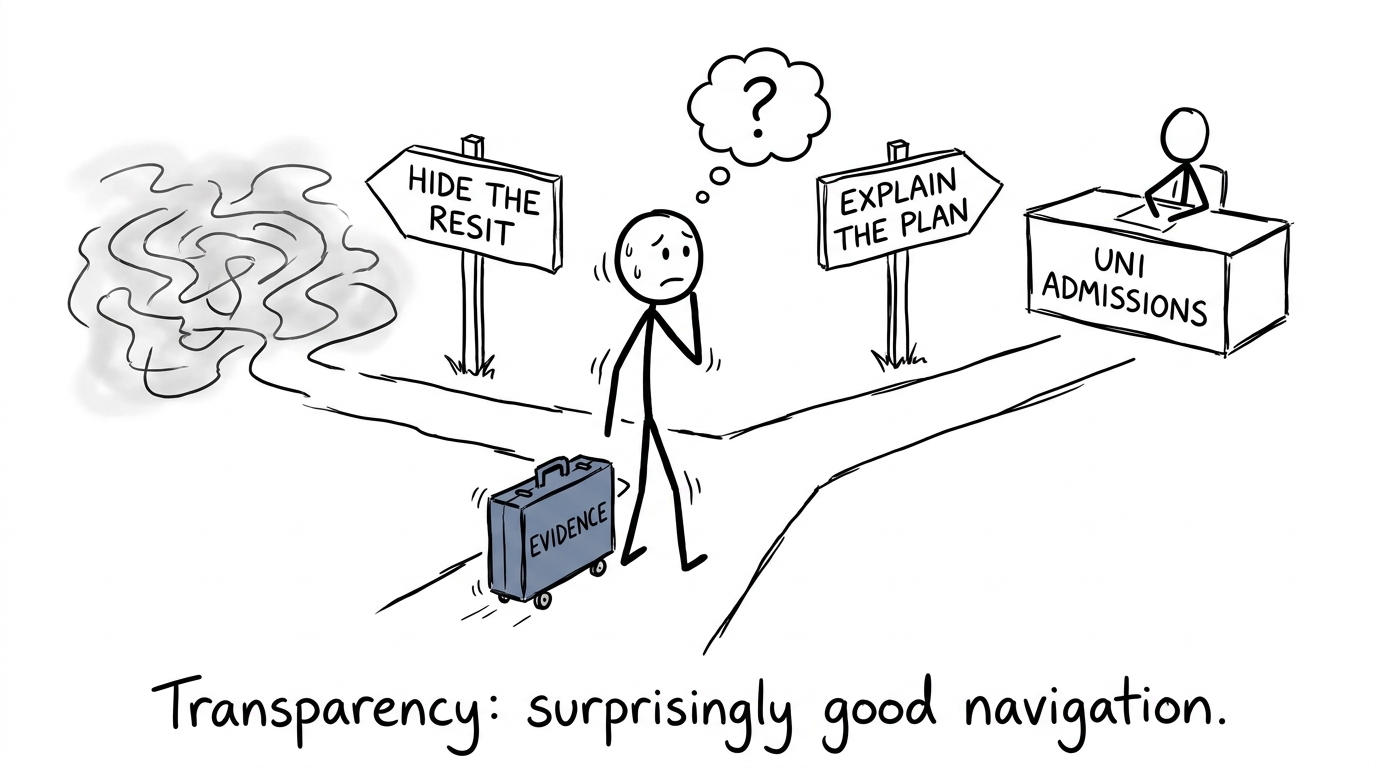 A student choosing the clear route of explaining a resit honestly
Declare your A-level Business retake correctly
UCAS requires applicants to enter all previous and current qualifications from secondary education onwards. That includes unsuccessful grades and every sitting of a retaken examination.
For a Business retake, enter the qualification twice in the Education section:
- once with the grade you have already achieved;
- once as a pending qualification with the expected examination date.
Your referee should then add a predicted grade for the pending qualification through the appropriate application process. Speak to your school, college or examination centre early so that everyone understands what evidence will support that prediction.
Trying to conceal the first result creates a much greater problem than the result itself. Accuracy signals maturity. It also allows admissions staff to assess your application in its proper context.
How to explain a resit on your UCAS application
The current UCAS personal statement format asks three questions about your course motivation, academic preparation and preparation outside education. You do not need to make the retake the centre of every answer.
A useful structure is:
Outcome, reflection, action, evidence, relevance.
State the outcome without drama. Identify what you learnt. Explain the action you have taken. Give evidence that your method has changed. Finally, connect that improvement to university study.
Keep the explanation brief
Admissions teams do not need a long defence of your previous grade. One or two purposeful sentences are usually stronger than a paragraph of justification.
Example wording:
My original A-level Business result did not reflect the standard I wanted to achieve, so I chose to retake the qualification. Reviewing my performance showed that I needed more timed practice and more precise evaluation, and I have rebuilt my revision around those areas.
This works because it accepts the result while moving quickly towards action.
Show what is different now
Saying that you will “work harder” is too vague. Explain the system you are following.
For example:
I now complete timed case-study questions each week, compare my responses with mark schemes and rewrite conclusions where my judgement is not sufficiently supported by context.
That is credible because it describes observable behaviour. You can build this routine using Edexcel A-level Business revision, including lessons, practice questions, mini tests and papers.
If content knowledge is the main weakness, work systematically through the Edexcel Business revision guides. For examination evidence, use AQA A-level Business past papers if AQA is your board. Always revise against the specification for the exam board you are actually sitting.
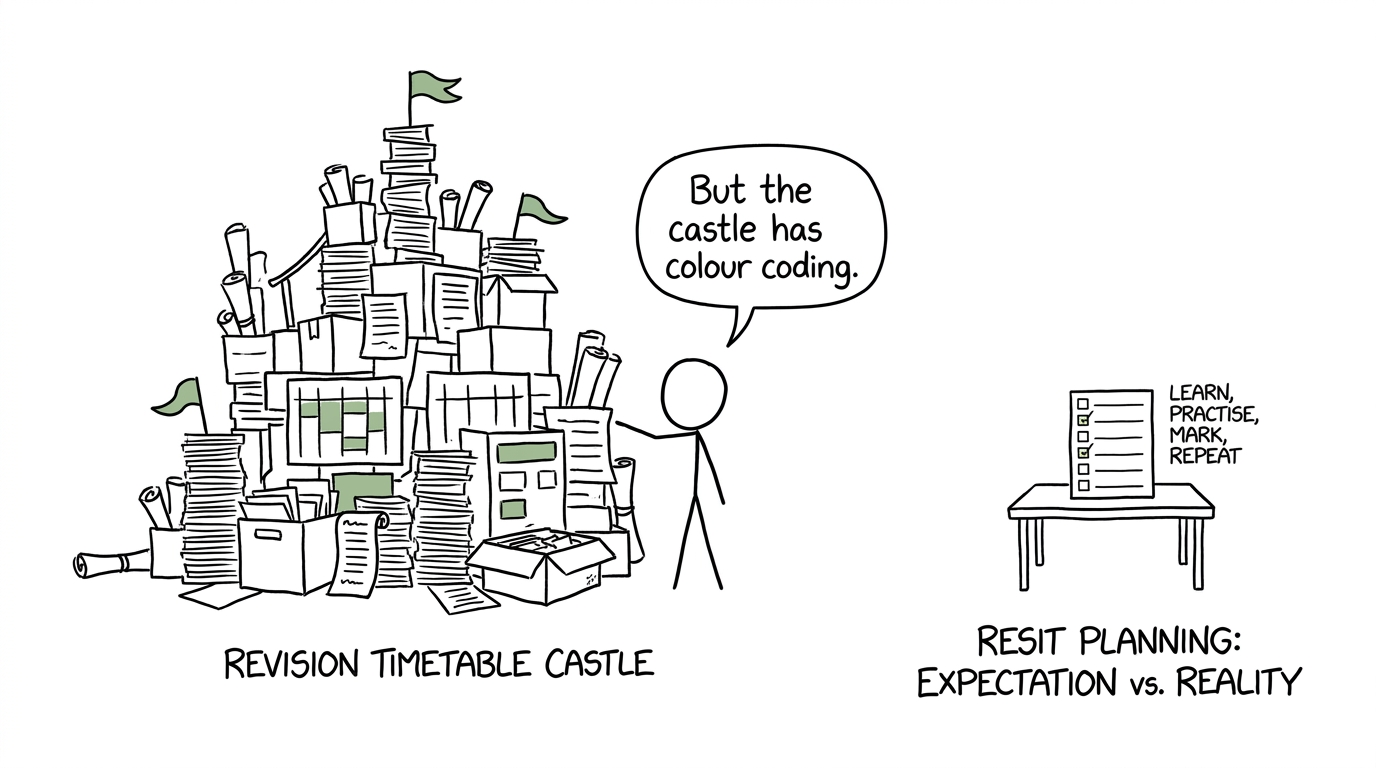 A student choosing between an enormous timetable castle and a practical revision checklist
Frame the resit as academic development
A positive explanation is not forced optimism. It is evidence that you can diagnose a problem and respond intelligently.
Business itself involves reviewing performance, identifying weaknesses and changing strategy. Your resit can demonstrate the same disciplined process. Perhaps you have improved how you apply theory to a case study, interpret financial information or build a balanced judgement.
Be precise:
Preparing for the retake has strengthened my ability to distinguish between generic analysis and recommendations shaped by a firm's objectives, finances and competitive environment.
If financial analysis is part of your improvement plan, MathsGenie's Business finance revision guide can help you connect calculations and financial evidence to business decisions. The business planning revision guide is also useful for developing contextual analysis. Check that the terminology matches your own specification.
Where extenuating circumstances belong
If illness, bereavement, caring responsibilities or another serious disruption affected your examinations, tell your referee. UCAS provides space in the reference for relevant extenuating circumstances, but individual universities may also require a separate form, evidence or direct notification.
Keep your own wording factual:
My examinations were affected by documented circumstances during the assessment period. Since then, I have established consistent academic support and a structured retake plan.
Do not disclose sensitive detail merely to make the explanation sound persuasive. Ask each university how it wants circumstances reported, because procedures differ.
Build evidence before reapplying
The strongest explanation is supported by what you do between results day and submission.
Use the MathsGenie revision planner to schedule topic review, timed essays and full papers. Keep a simple record of marks lost, the reason for each loss and the correction you made. Ask a teacher or tutor to review enough recent work to make your predicted grade defensible.
You can also mention relevant employment, volunteering, wider reading or independent research. Explain what it taught you rather than listing activities. A part-time retail role, for instance, may deepen your understanding of customer service or operations, but only include that connection if it genuinely reflects your experience.
Common mistakes when explaining a resit
Hiding the original grade
UCAS expects your complete qualification history. Declare both the achieved result and pending retake accurately.
Blaming the exam board or teacher
Even where teaching was disrupted, an accusatory tone weakens your reflection. Describe circumstances factually, then concentrate on your response.
Promising improvement without evidence
“Working harder” does not explain how improvement will happen. Name the practice, feedback and review process you now use.
Giving the resit too much space
Your application still needs to answer why you want the course and why you are prepared for it. The retake is context, not your entire identity.
Ignoring course-specific policies
A university may accept resits generally while applying different rules to a particular competitive course. Verify the requirements before using a UCAS choice.
Turn results day into a starting point
A disappointing Business result closes one route through the year, not every route towards university. Declare the retake honestly, explain the change calmly and let sustained work provide the proof.
Start with MathsGenie's Edexcel A-level Business revision resources. Use the revision lessons to rebuild knowledge, practise case-study questions, complete mini tests and past papers, and study mark schemes to understand where stronger analysis and evaluation earn marks. A resit becomes persuasive when the application and the revision plan tell the same story: you understood the gap, changed the process and kept going.










