A-Level Business Remark: Results Day Guide
A-level business remark guidance for results day: understand reviews of marking, 2026 deadlines, risks, costs and when challenging a grade makes sense.
Results day can turn a small mark difference into a very large decision. If your Business grade is below what you expected, an A-level Business remark may be worth considering, particularly when you are close to a grade boundary or a university place depends on the outcome.
The immediate answer is simple: speak to your exams officer, check your component marks against the correct boundaries, and ask whether your marked scripts can be reviewed by a Business teacher. Do not submit a request merely because the grade feels disappointing. A review can leave the mark unchanged, raise it or lower it.
Your results-day decision checklist
Before requesting a review of marking, ask:
- How many marks am I below the next overall grade boundary?
- Which Business paper produced the unexpected mark?
- Has a teacher examined the marked script against the mark scheme?
- Is there evidence of missed credit, a clerical error or unreasonable application of academic judgement?
- Could a lower mark put my current grade at risk?
- Is a university or apprenticeship offer waiting on the result?
- What is my centre's internal deadline and fee policy?
Start with the relevant AQA A-Level Business grade boundaries or Edexcel A-Level Business grade boundaries. Use the boundary for your exact exam series and specification rather than comparing your result with a previous year.
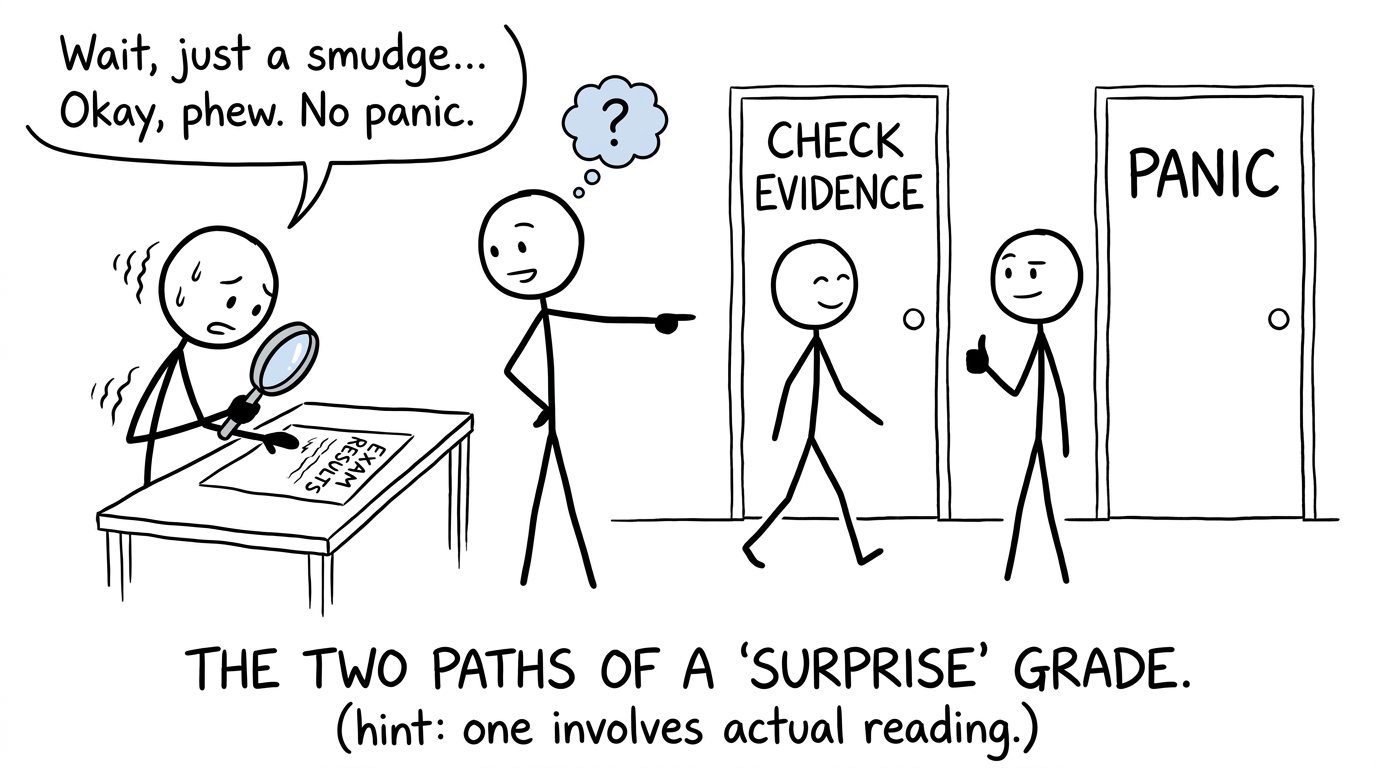 A student calmly choosing evidence over panic on results day
What an A-level Business remark actually involves
The phrase “re-mark” is widely used, but the official service is normally called a review of marking. The reviewer does not mark your paper again from the beginning simply to produce a second opinion. They check whether the original mark scheme was applied correctly and whether any administrative or marking errors occurred.
A standard Service 2 review includes clerical checks such as confirming that responses were marked and marks were totalled correctly. A reviewer can also correct a failure to apply the mark scheme or an unreasonable exercise of academic judgement.
That distinction matters in Business. Longer answers involve analysis, evaluation, use of context and a supported judgement. Two reasonable examiners do not have to award identical marks. A change is made when the original marking contains an error, not merely because another mark might also appear plausible.
The A-level Business re-mark process step by step
Check the overall boundary and paper marks
Find your total mark and the boundary for the grade above. Your distance from it is:
marks required=next grade boundary−current total mark\text{marks required}=\text{next grade boundary}-\text{current total mark}marks required=next grade boundary−current total markBeing close is relevant, but it is not proof of an error. Look at the separate paper marks too. One unexpectedly low component may be a more sensible candidate for review than every paper.
AQA students can use the AQA Business predicted grade calculator to understand how component marks combine. Students following another specification should use their board's official result information and the corresponding boundaries, including the available Eduqas A-Level grade boundaries.
Ask for access to your marked script
Where timing permits, ask your school or college to obtain the script. A Business teacher can compare your responses with the mark scheme and examiner guidance, paying particular attention to:
- sections that appear unmarked;
- incorrect mark addition or recording;
- accurate calculations or definitions that received no credit;
- chains of analysis that satisfy the assessment criteria;
- evaluative conclusions that use the case context and answer the question.
A script review turns a feeling into evidence. If a university place is pending, however, do not allow the script request to make you miss the priority-review deadline.
Choose between standard and priority review
For the June 2026 series, A-level results are issued on 13 August 2026. The JCQ deadline for an A-level Priority Service 2 review is 20 August 2026, and the target completion time is within 15 calendar days. This service is intended for cases such as a pending higher-education place.
The standard review deadline is 24 September 2026, with completion normally within 20 calendar days. Your school may impose an earlier internal deadline so it can collect consent, payment and evidence. Act on results day rather than treating the official deadline as your personal deadline.
Give written consent and confirm the risk
Your centre normally submits the request to the exam board. It must obtain your written consent because your mark and grade can go down as well as up. Fees vary by board, service and component, while centres may have their own charging arrangements. Ask your exams officer for the current amount before agreeing.
Private candidates should contact the centre that entered them or follow the awarding organisation's instructions for private candidates.
Read the outcome carefully
The reviewed mark may increase, decrease or remain unchanged. Even when a mark changes, the overall grade may stay the same. Check both the component result and qualification grade rather than assuming that any extra mark creates an automatic grade rise.
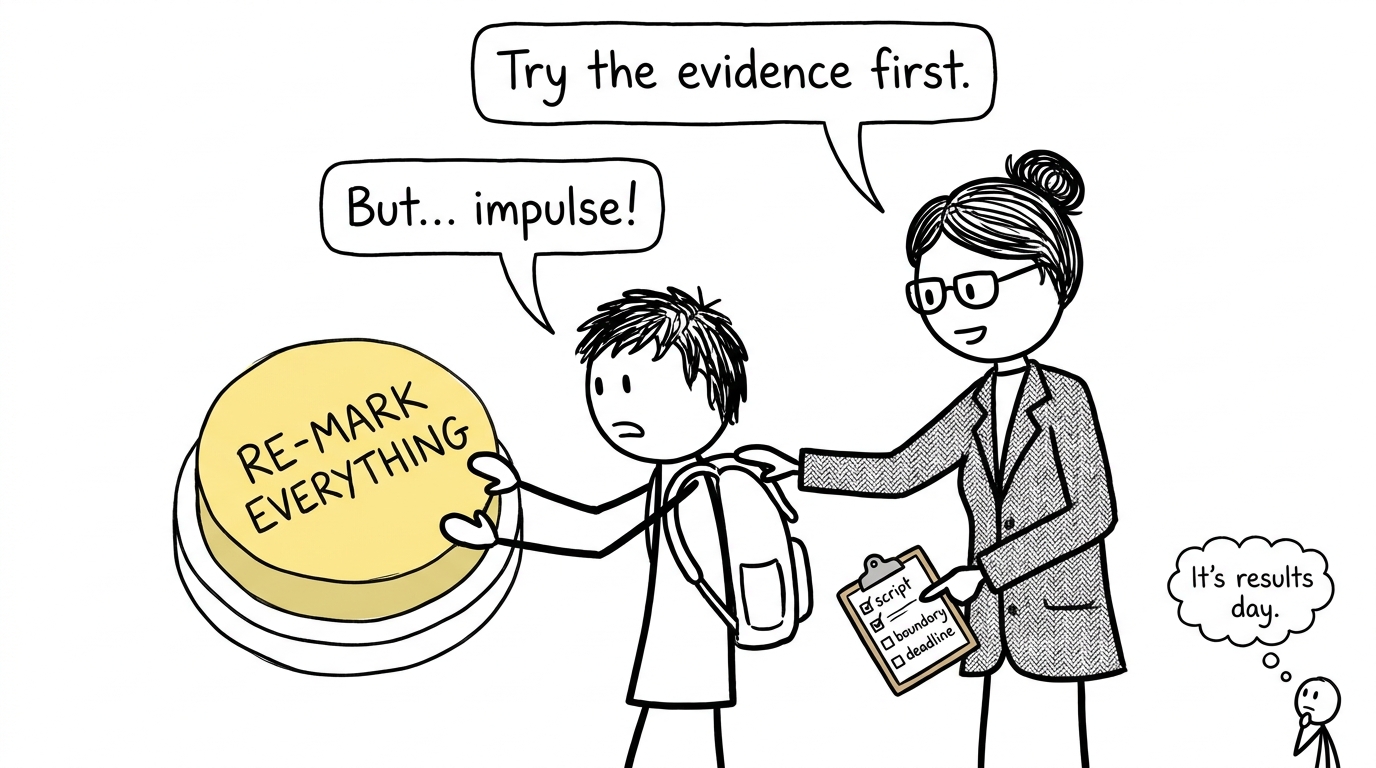 A giant re-mark button being replaced by a sensible evidence checklist
When requesting a Business review makes sense
A request is strongest when a teacher identifies a specific possible marking error, a response appears to have been missed, or your performance on one paper is seriously inconsistent with well-established evidence.
It may also be reasonable when you are close to the next boundary and the script contains credible areas for additional credit. The closer you are, the fewer corrected marks are needed; but probability is not certainty.
Be more cautious when the request rests only on a predicted grade, previous mock results or the belief that a long answer “deserved more”. Predictions describe expectations; they do not establish marking errors.
Appealing an A-level Business grade
A review of marking comes before an appeal. If concerns remain after the review, your school or college may appeal on permitted grounds, including a procedural failure or a marking error that remains uncorrected. An appeal is not a general opportunity to negotiate a higher grade.
If your centre refuses to request a review, it must provide a route for you to appeal its decision internally. Ask for its published post-results policy immediately. Further stages can include the awarding body's appeal process and, only after that process is complete, Ofqual's Exam Procedures Review Service.
Common mistakes to avoid
- Calling the service a guaranteed re-mark rather than a review for errors.
- Looking at last year's boundary instead of the correct exam series.
- Reviewing every paper without identifying the component of concern.
- Missing a centre's earlier deadline while waiting for more reassurance.
- Forgetting that marks can decrease.
- Assuming closeness to a boundary proves that marking was wrong.
- Trying to appeal before completing the review stage.
- Failing to tell a university that a priority review is underway.
Make the decision with evidence, not panic
An A-level Business remark is most useful when three things meet: you are close enough for a change to matter, the script provides a credible reason for concern, and the request reaches the board on time. Begin by checking the A-Level Business grade boundaries for AQA or Edexcel Business grade boundaries, then speak to your teacher and exams officer.
Whatever the outcome, the same habit matters in future exams: use evidence, mark schemes and careful review. MathsGenie supports that approach with a free A-Level Maths revision hub, GCSE Maths revision resources, predicted papers and mini tests, and a practical revision planner. Choose your next step calmly, then take it promptly.