

A-Level Business Career Paths After Results Day
A-level business career paths explained: compare university, apprenticeships and entry-level work, then build a confident, practical results-day plan today.
Results day can make one letter feel larger than it really is. You open the envelope, see your grade and immediately wonder what it has decided for you. The short answer is reassuring: a-level business career paths are not controlled by one result alone. Your overall grades, GCSEs, interests, experience and chosen route all matter.
A Level Business can support progression into university, higher or degree apprenticeships, school-leaver schemes and entry-level employment. Relevant fields include marketing, finance, human resources, business analysis, operations, project management and enterprise. The task on results day is not to identify one perfect career. It is to choose the most useful next step.
Your results-day checklist
Before making a decision:
- Check your UCAS application status rather than assuming the outcome from your grades.
- Read the entry requirements for each course, apprenticeship or job carefully.
- Speak to your school or college adviser if an offer remains pending.
- Compare course content, costs, location and work experience opportunities.
- Keep your GCSE Maths and English grades available because employers and course providers may request them.
- Avoid declining an accepted university place until you understand the consequences.
For students still choosing A Levels, this is useful too. Business does not lead to one narrow occupation. It introduces ideas used across almost every organisation: finance, marketing, people, operations, strategy and decision-making.
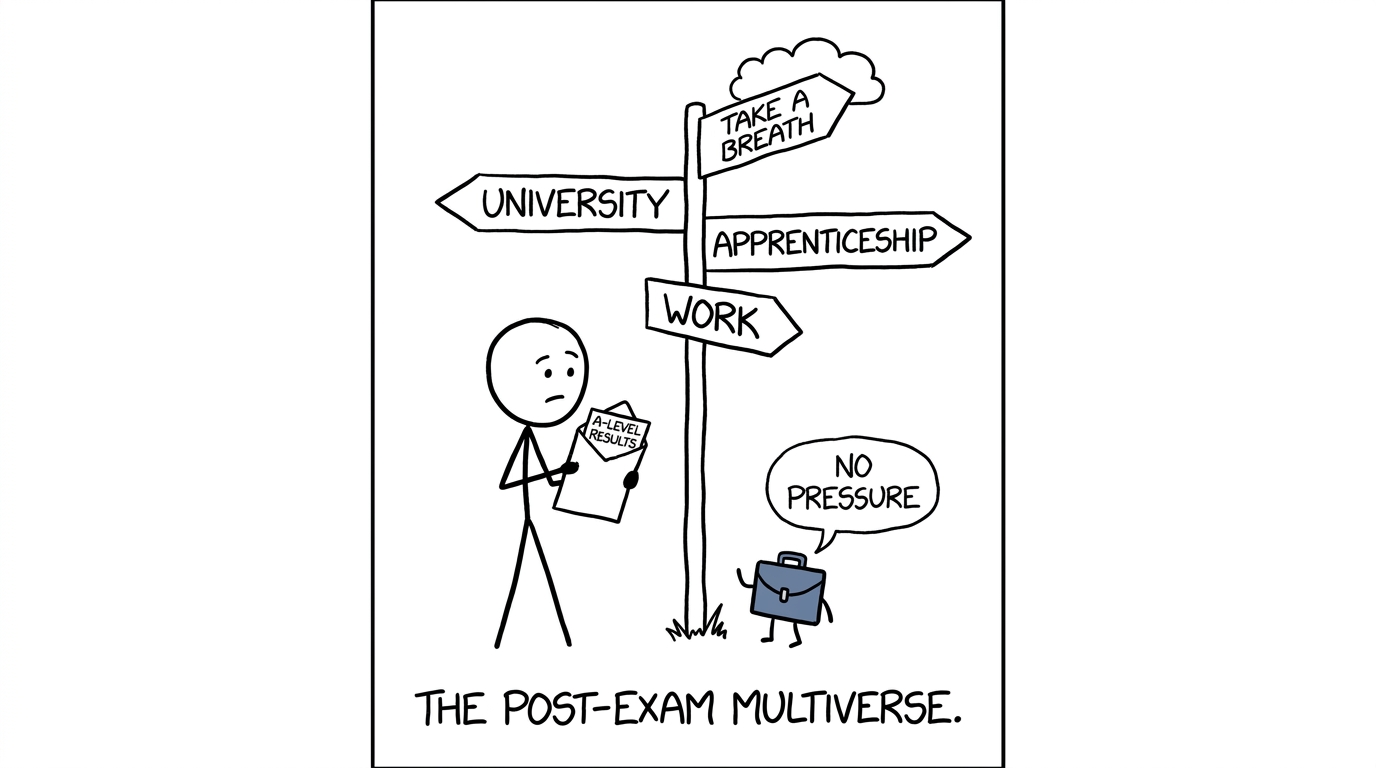 A student choosing between university, an apprenticeship, work and taking a breath
What does an A Level Business grade actually open up?
An A Level is a Level 333 qualification. It can contribute towards entry to higher education, an apprenticeship or a school-leaver programme, but it is not a professional licence. A strong grade demonstrates subject knowledge and the ability to apply evidence, analyse consequences and form justified conclusions.
That distinction matters. An employer is unlikely to hire someone as a marketing manager simply because they earned an A in Business. The qualification helps them enter the route through which experience and specialist knowledge are built.
If you studied Edexcel, the free Edexcel A Level Business revision hub reflects that broad skill set. Its coverage of marketing, people, finance, operations and strategy is also a useful map of possible career interests.
Example career and course pairings
There is no compulsory pairing. These are realistic starting points rather than promises, and requirements vary between providers and employers.
| Career direction | Possible course route | Possible work-based route |
|---|---|---|
| Marketing | Marketing, business management or communications degree | Marketing apprenticeship, marketing assistant or customer insight role |
| Accounting and finance | Accounting and finance, economics or business degree | Accountancy apprenticeship, payroll assistant or accounts trainee role |
| Human resources | Human resource management, psychology or business degree | HR support apprenticeship or HR administrator role |
| Business analysis | Business analytics, information systems or management degree | Level 444 business analyst apprenticeship or junior project role |
| Project management | Business management or project management degree | Project management apprenticeship or project support role |
| Operations and enterprise | Operations management, logistics or entrepreneurship degree | Business administration apprenticeship, operations assistant or sales role |
Marketing and customer insight
Marketing suits students who enjoy understanding customers, interpreting evidence and communicating ideas. University courses can develop research, digital marketing and campaign planning, while apprenticeships combine training with real workplace responsibility.
The strongest preparation is broader than creativity. Marketers also use percentages, budgets, graphs and performance data. Revisiting GCSE Maths revision resources can therefore strengthen a practical skill that employers value.
Finance and accountancy
Finance may appeal if you liked cash flow, profit, budgets and investment appraisal. Routes include accounting and finance degrees, professional apprenticeships and trainee roles in accounts or payroll. Some careers require later professional qualifications, so investigate the complete training path rather than looking only at the first job title.
Maths requirements differ considerably. Some business-related degrees ask primarily for GCSE Maths, while more quantitative finance or economics courses may require A Level Maths. Students considering that route can explore the A Level Maths revision area before making assumptions about the subject.
Business analysis and project management
Business analysts examine problems and recommend improvements. Project professionals organise people, time, budgets and risks. Official careers guidance identifies university and apprenticeship routes into business analysis, including a Level 444 higher apprenticeship; project management also has degree-apprenticeship routes.
These careers reward structured thinking. The ability to turn evidence into a clear recommendation is already practised in Business essays, although technical, digital and data skills may also be required.
Human resources, operations and enterprise
Human resources focuses on recruitment, development, performance and workplace relationships. Operations deals with how goods or services are delivered reliably. Enterprise is concerned with recognising opportunities and organising resources under uncertainty.
If that final route interests you, MathsGenie's enterprise and business activity guide offers a clear refresher on risk, reward and adding value. The finance revision guide is equally useful for understanding why ideas need financial control as well as enthusiasm.
University, apprenticeship or employment?
A degree offers extended academic study and may include placements or a year in industry. Business-related degrees commonly consider applicants with two or three A Levels, but grades and required subjects vary widely. Always check the live course page.
Apprenticeships are paid jobs with structured training. In England, advanced apprenticeships are Level 333, higher apprenticeships cover Levels 444 to 777, and degree apprenticeships are at Levels 666 or 777. Entry criteria belong to each employer, so possessing A Levels does not guarantee a place.
Jobs after A Level Business can include junior roles in administration, sales, customer service, payroll, marketing support or operations. Direct employment may suit someone ready to build experience, but compare the training, progression and qualifications offered rather than judging a role by its starting title.
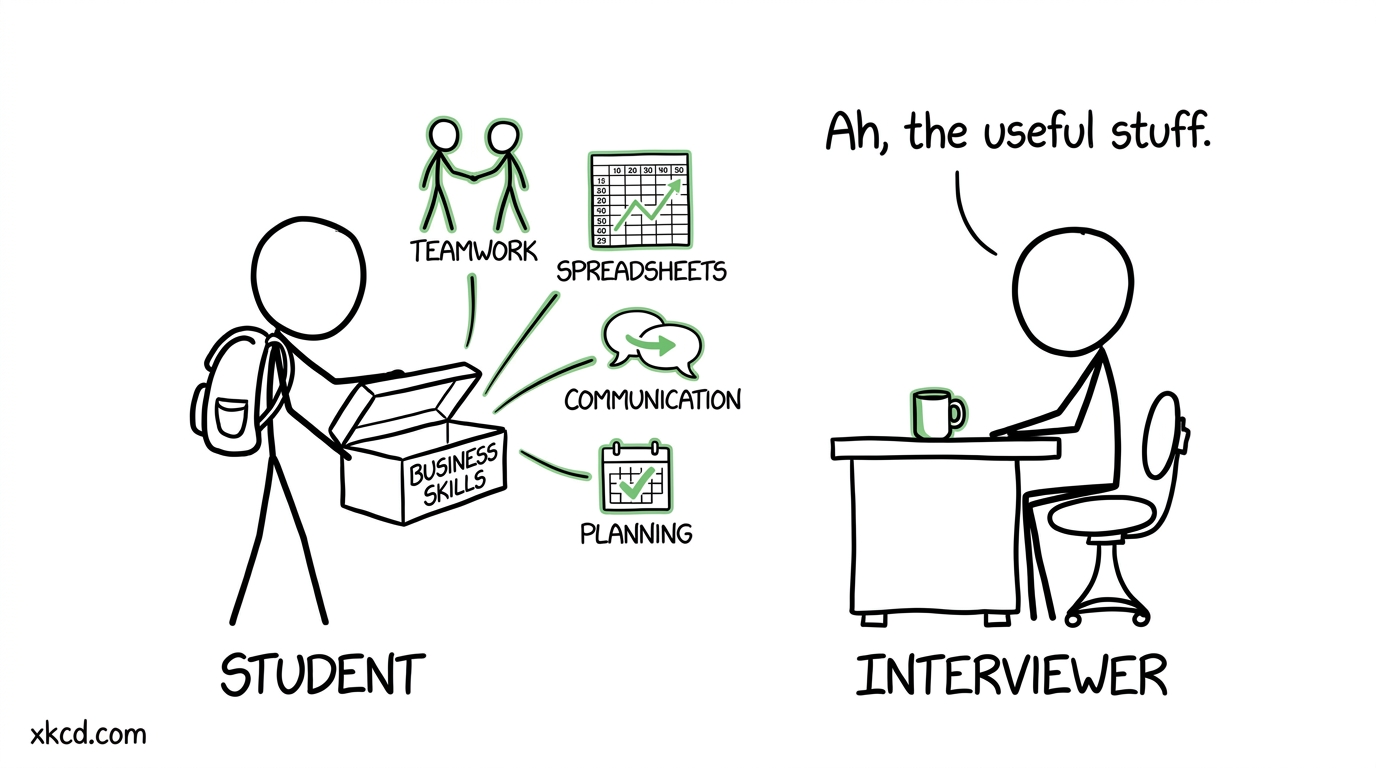 A student revealing communication, planning and spreadsheet skills at an interview
What to do if the grade was unexpected
If you met your university conditions, confirm the place shown in your application and follow the provider's instructions. If you missed them, do not presume rejection: the university may still be considering you. If neither your firm nor insurance choice accepts you, Clearing can help you find courses with vacancies.
A higher-than-expected result also deserves thought. You can keep your existing place, explore alternatives or consider apprenticeships. Better grades create choices; they do not create an obligation to select the route with the grandest name.
Common mistakes when choosing a route
Treating the grade as a career verdict
One Business result is evidence, not identity. Consider your full subject combination, skills and preferred working environment.
Assuming every business course has identical requirements
Course names can look similar while their content and entry criteria differ. Check modules, placement options, GCSE requirements and any required A Level subjects.
Ignoring maths
Business careers often involve financial information, percentages, forecasts and data. If your foundations need attention, use the Edexcel GCSE Maths revision hub or the correct page for your exam board.
Choosing only by salary or prestige
Progress depends partly on whether you can sustain the work required. Compare daily tasks, training and progression, not just the headline role.
Turn your result into a next step
A result becomes useful when it leads to informed action. Choose two or three career areas, compare their degree and apprenticeship routes, then note the qualifications and skills each requires.
If you are preparing for A Level Business, start with MathsGenie's topic-by-topic Business revision guides. Build confidence through lessons and practice, then use A Level Business past papers and mark schemes to improve timing, application and judgement. Revision lessons, predicted papers, mini tests and exam-style questions make the next step concrete. and concrete steps are how uncertain career ideas become realistic plans.










