

A-Level Biology Remark: Results Day Guide
A-level biology remark guidance for results day: check scripts, deadlines and risks, then decide whether a review of marking or appeal is justified in 2026.
Results day can turn a single grade into the only thing you can see. If your Biology result is below expectations, an A-level Biology remark may be worth considering, but only after checking your marks, the grade boundary and, where time allows, your marked scripts.
The official service is called a review of marking, not a re-mark. A reviewer checks whether the original examiner applied the mark scheme correctly. Your mark can rise, remain unchanged or fall, so the best decision is based on evidence rather than disappointment alone.
Your results-day checklist
- Confirm your exam board, specification and component marks.
- Check the correct Biology grade boundary for your exam series.
- Work out how many marks separate you from the next grade.
- Ask your Biology teacher to review your marked scripts if time permits.
- Identify specific possible marking errors.
- Tell your exams officer immediately if a university place is at risk.
- Read the consent form and understand that marks can go down.
- Check your school or college's internal deadline and fee.
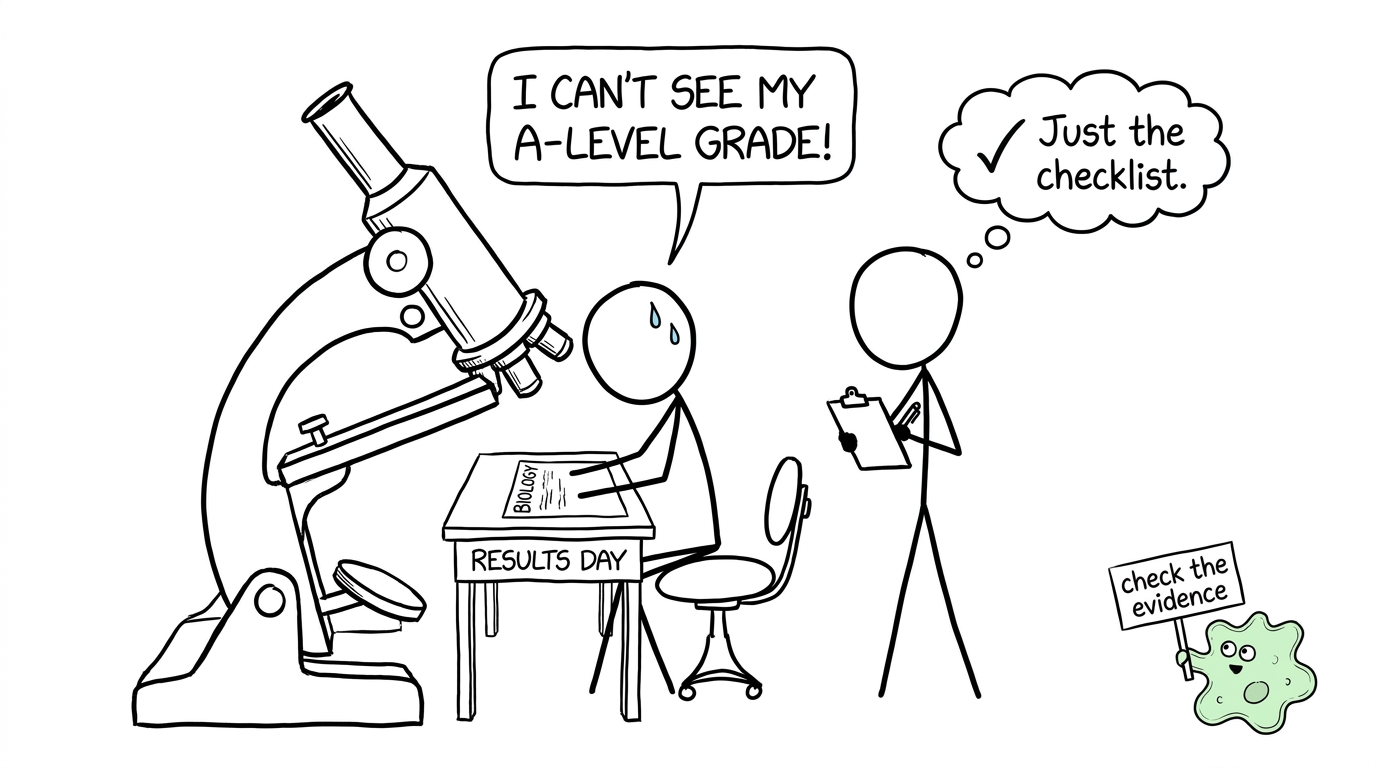 A student examining a results slip through an enormous microscope while an exams officer holds a checklist
How the A-level Biology re-mark process works
A review of marking is requested through your school, college or exam centre. You normally cannot submit the request directly to AQA, Pearson Edexcel, OCR or Eduqas unless you are a private candidate and the board permits direct applications.
The reviewer does not mark the entire paper again from a blank starting point. They check the original marking and correct errors, including failures to apply the mark scheme properly or unreasonable exercises of academic judgement. The service also includes clerical checks, such as confirming that responses were marked and marks were recorded correctly.
For the June 2026 series, the key JCQ deadlines are:
| Service | Purpose | Awarding body deadline | Maximum turnaround |
|---|---|---|---|
| Clerical re-check | Checks recording, addition and unmarked responses | 24 September 2026 | 10 calendar days |
| Standard review of marking | Checks whether the mark scheme was applied correctly | 24 September 2026 | 20 calendar days |
| Priority review of marking | Faster A-level service where progression is at stake | 20 August 2026 | 15 calendar days |
A-level results are issued on 13 August 2026, leaving only a short window for a priority request. Your centre may impose an earlier internal deadline, so speak to its exams officer rather than treating the JCQ date as your personal deadline.
When requesting a Biology review makes sense
Biology papers combine questions with relatively fixed answers and longer responses requiring scientific judgement. A review is most persuasive when a teacher can identify where a creditworthy point, calculation, graph, conclusion or extended response may not have received marks that the published mark scheme allows.
Start by checking the correct boundary. MathsGenie provides subject-specific pages for AQA A-level Biology grade boundaries, OCR A-level Biology grade boundaries and Eduqas A-level Biology grade boundaries. Students taking Pearson specifications can check the Biology section within the Edexcel A-level grade boundaries.
A review may be reasonable when:
- you are close to the next overall grade boundary;
- one component is unexpectedly weak compared with the others;
- your teacher finds a specific apparent marking error;
- an answer appears consistent with an accepted marking point;
- the potential grade change affects university admission or another confirmed progression requirement.
Being close to a boundary does not itself prove an error. Exam boards cannot award extra marks because a student narrowly missed a grade or received a lower result than predicted.
Requesting scripts before making the decision
If no university decision is urgent, ask whether your centre can obtain your marked scripts first. A Biology teacher can compare them with the mark scheme and examiner guidance, focusing on places where the scientific content may have been credited inconsistently.
Do not simply count every phrase resembling the mark scheme. Biology mark schemes can include linked statements, acceptable alternatives, contradictions and limits on how marks are awarded. Teacher judgement is useful because the question, command word and complete response all matter.
When a university place depends on the result, waiting for scripts may consume too much of the priority window. Contact the exams officer and university immediately, then follow their advice.
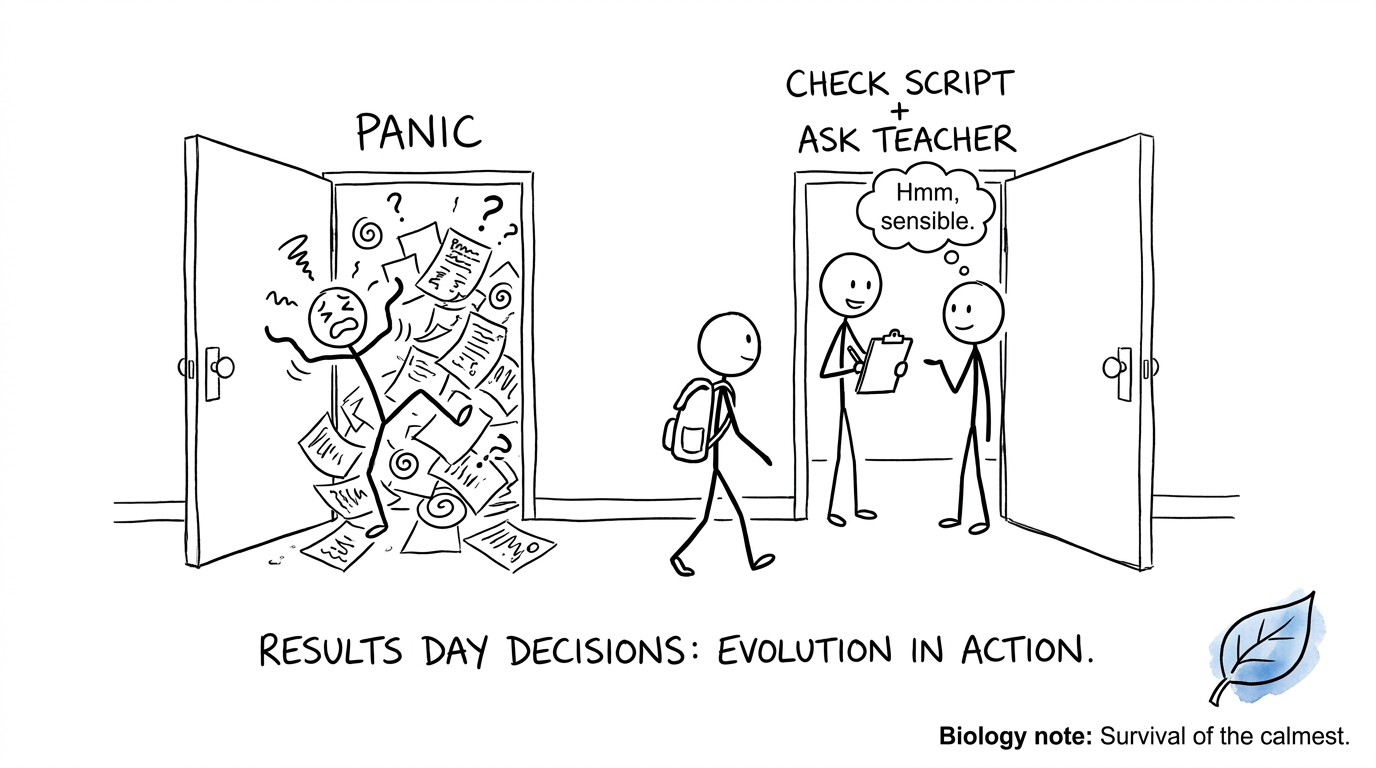 A student choosing the calm check-script door instead of the panic door
Decision checklist: should you request a review?
Answer these questions in order:
- Would a higher mark change the overall grade? A mark increase without a grade change may not affect your next step.
- Is there evidence of an error? Ask your teacher to identify particular questions, not merely an unexpectedly low total.
- Could a lower mark create a problem? Written consent is required because the reviewed result replaces the original result, even when it is lower.
- Is your university place pending? If so, ask about Priority Service 2 immediately and notify the university.
- Can you meet the centre's deadline and fee rules? Charges vary by board and centre. Ask whether the fee is waived or refunded if the overall grade changes.
Appealing an A-level Biology grade
An appeal is not the first step. Your centre must normally request and receive the outcome of a review of results before appealing an A-level Biology grade.
An appeal can challenge an unresolved marking error or argue that the awarding organisation failed to follow its procedures properly, consistently or fairly. Under the 2026 JCQ process, appeals must generally be submitted within 30 calendar days of the review outcome. Candidate consent is needed because the result may rise, stay unchanged or fall.
The grade boundary itself cannot be appealed. Dissatisfaction with the difficulty of a paper is also different from evidence that your own work was marked incorrectly.
Common mistakes to avoid
- Calling the process a guaranteed re-mark or assuming a different examiner will award more marks.
- Requesting every paper without identifying which component offers credible grounds.
- Comparing your raw mark with the wrong board, specification or exam series.
- Missing an early centre deadline while waiting for the awarding body's final date.
- Assuming a predicted grade proves that the awarded grade is wrong.
- Forgetting that the mark and overall grade can decrease.
- Treating an appeal as an alternative to the initial review of marking.
Make the next decision calmly
A disappointing result deserves attention, but not an automatic challenge. Check the boundary, inspect the evidence, speak to your Biology teacher and act quickly if a university place depends on the outcome. That turns an emotional decision into a measured one.
Start with MathsGenie's AQA, Edexcel, OCR or Eduqas A-level Biology grade boundaries. If you are still preparing for future exams, build the same evidence-led habits through MathsGenie's free GCSE Science revision resources and GCSE Maths revision hub, including revision lessons, practice questions, past papers, predicted papers, mini tests, mark schemes and video solutions.











