A-Level Biology Lower Grade Than Expected?
A-Level Biology lower grade than expected? Follow a calm plan for reviews of marking, Clearing, university calls and a focused Biology resit.

Opening an envelope can take seconds. Adjusting to what is inside may take longer. If you received an A-Level Biology lower grade than expected, your immediate task is not to decide what the result says about you. It is to establish what the grade changes, what can still be recovered and which option deserves your attention first.
Check UCAS Hub, speak to your school or college, contact any university whose decision is unclear, and ask promptly about post-results services. At the same time, investigate Clearing and consider whether a Biology resit would serve your longer-term plans. These routes can run alongside one another while deadlines approach.
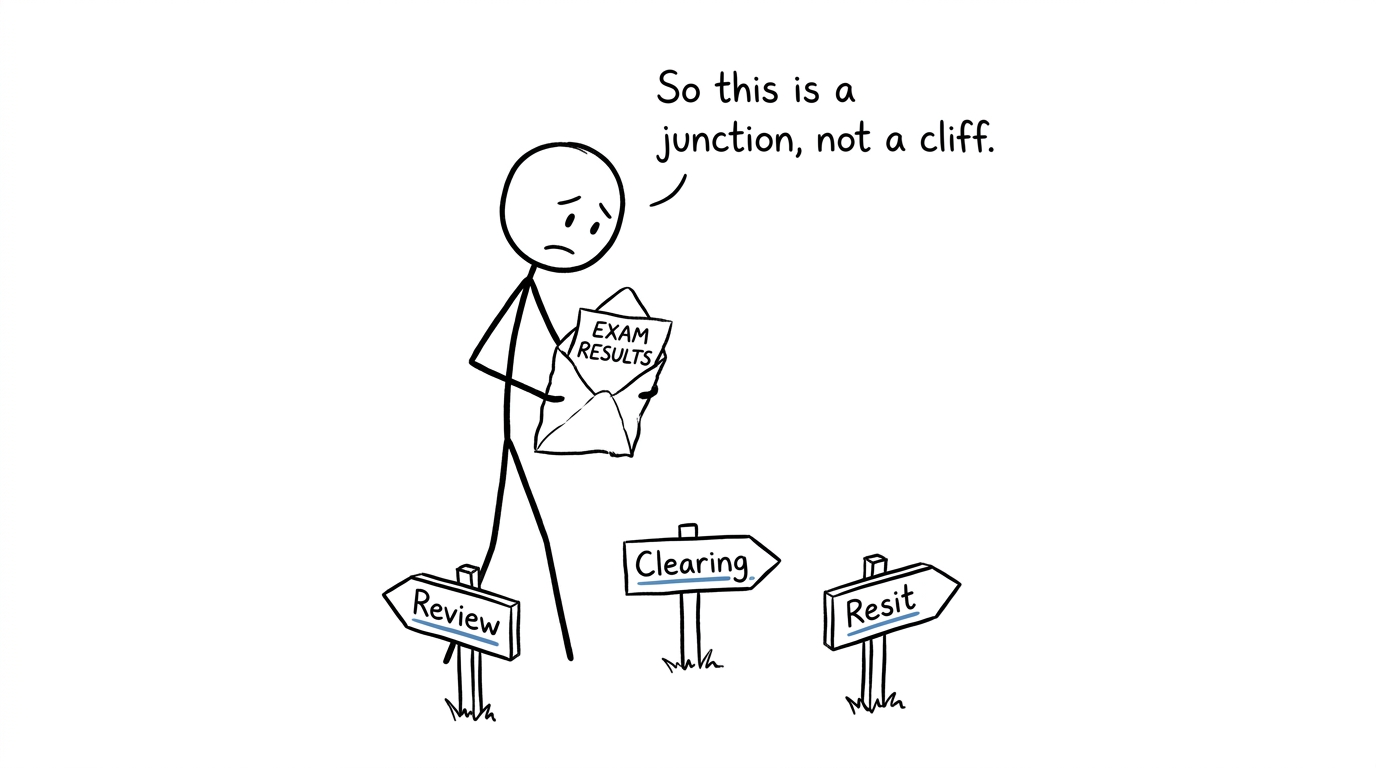 A student realises that disappointing results lead to a junction rather than a cliff
Your A-Level Biology next steps checklist
Use this order on results day:
- Check your actual Biology grade and component marks.
- Sign in to UCAS Hub before assuming that you have lost your place.
- Speak to a teacher, examinations officer or careers adviser.
- Contact your firm or insurance university if its decision is pending.
- Ask whether accessing your scripts or requesting a review is sensible.
- Search Clearing without waiting for a review outcome.
- Consider a resit only after checking university entry policies and practical arrangements.
For 2026, A-level results day is Thursday 13 August. Schools can impose internal post-results deadlines earlier than the published exam-board deadlines, so ask for dates and fees immediately.
Check what the result actually changes
A disappointing grade and a lost university place are not automatically the same thing. UCAS Hub may show that your firm choice has accepted you, that your insurance place is confirmed, that a decision is pending, or that you can use Clearing.
If the university has not decided, contact admissions. Have your UCAS Personal ID, grades, course details and any relevant information ready. Ask a direct question: is your application still under consideration, and is there anything the admissions team needs from you?
Do not decline a confirmed place impulsively. Releasing yourself into Clearing is a significant decision, particularly when accommodation, course content and financial arrangements may change.
Should you request a Biology remark?
Students often say “remark”, but the formal service is normally a review of marking. A reviewer checks whether the original mark scheme was applied correctly; the paper is not simply marked again from scratch because the grade feels surprising.
Ask your centre about access to scripts first. A Biology teacher can compare your responses with the mark scheme and identify whether there is a credible marking issue. Reviews are most worth considering when specific answers appear to have been assessed incorrectly, rather than merely because your mark was close to a boundary.
Your grade can stay the same, rise or fall. Your centre therefore needs your written consent, and a fee may apply.
For the June 2026 series, the JCQ deadline for a priority A-level review of marking is 20 August 2026. This service is intended for cases where a higher education place depends on the outcome. The standard review deadline is 24 September 2026, although your school or college is likely to set an earlier internal deadline.
If the review does not resolve a suspected marking or procedural error, your centre can explain the formal appeals process. An appeal usually comes after the relevant post-results review; it is not a substitute for disliking the academic judgement.
Use Clearing while a review is considered
Clearing is how universities and colleges fill courses that still have places. For 2026, it runs from 2 July to 19 October. If neither your firm nor insurance place is confirmed, search for suitable vacancies and speak directly to providers.
Create a shortlist based on more than the lowest entry requirement. Check:
- course modules and assessment methods;
- laboratory and placement opportunities;
- professional accreditation where relevant;
- location, accommodation and travel costs;
- whether the course supports your intended career or postgraduate route.
Contact each university before adding a Clearing choice. You will need your Clearing number and Personal ID. Ask whether the department will accept your achieved grades and whether there are conditions attached to the informal offer. Only add a choice in UCAS after the provider has given you permission; you can add only one Clearing choice at a time.
An A-Level Biology disappointing result can make the first available course feel unusually attractive. Pause long enough to ask whether you would still choose it on an ordinary day.
Decide whether an A-Level Biology resit is worthwhile
A resit can be a strong option when Biology is essential for your intended course and suitable alternatives do not meet your goals. It is less useful when you are resitting only to erase disappointment, without a clear destination that requires the improved grade.
Before committing, ask prospective universities whether they accept resits and whether they impose particular grade or timing conditions. Admissions policies vary by institution and course, especially for highly competitive programmes.
Reformed A levels are linear. A Biology resit generally requires you to take all examined components in the relevant summer series, not only the paper on which you performed least well. If you previously achieved the Practical Endorsement, its most recent outcome can normally be carried forward, including between JCQ awarding bodies. Your examination centre must make the correct entry, so confirm this rather than assuming it will happen automatically.
Start by choosing your exact specification on the free A-Level Biology revision hub. AQA students can use the AQA A-Level Biology revision resources, including topic questions, revision guides, past papers, mark schemes and mini tests.
Build a resit plan from evidence
A resit year should not be a longer version of the same revision. It should be a more accurate version.
Request your scripts where possible and classify lost marks into four groups:
- Knowledge: missing biological facts or processes.
- Application: difficulty using knowledge in unfamiliar contexts.
- Data: errors interpreting graphs, calculations or experimental results.
- Communication: vague terminology, missed command words or incomplete extended answers.
Then use specification-matched resources. For example, review AQA DNA replication, strengthen microscopy foundations with the OCR A cell structure guide, or revisit the Edexcel A natural selection guide. The exam board matters because content organisation and question style differ.
A reliable weekly cycle is simple: retrieve the topic from memory, answer exam questions, mark them precisely, record each lost mark and retest the weakness later. Use full past papers only when you are ready to diagnose timing and performance across the specification. Predicted papers and mini tests are useful pressure checks, not replacements for complete content coverage.
If A-Level Maths is also part of your route, keep that work separate and use the A-Level Maths revision hub for board-specific lessons, practice questions and papers.
 A calm student sorts results-day tasks while the panic monster waits outside
Common mistakes after a disappointing Biology result
Waiting for a review before exploring Clearing
Post-results services and Clearing can proceed together. Researching alternatives does not weaken your review request.
Assuming one mark guarantees a higher grade
Being close to a boundary does not prove that marking was incorrect. Ask a teacher to inspect the script and evaluate particular responses.
Choosing a resit without checking admissions policies
Confirm how your target courses treat resits before paying examination-centre fees or planning a year around them.
Re-reading the whole course from the beginning
Use scripts, mark schemes and timed papers to identify the exact reasons marks were lost. Diagnosis should shape the plan.
Treating the grade as a judgement of ability
A result is evidence from one assessment series. It may alter the route, but it does not choose the destination.
Turn the result into a workable next step
Your options are not limited to accepting the outcome or pretending it did not matter. You can check the decision, pursue a justified review, contact universities, use Clearing or prepare a deliberate resit. The right route depends on what the grade changes and what your intended course genuinely requires.
Begin with MathsGenie’s free A-Level Biology revision resources. Choose your exam board, inspect the specification, and turn weak areas into a measured routine using revision lessons, practice questions, mark schemes, past papers, predicted papers and mini tests. A lower grade can close one version of the plan. It does not prevent you from building a better-informed one.