A-Level Biology Grade Boundaries History: 2017-2025
A-level biology grade boundaries history explained with a year-by-year AQA table, trend analysis and advice for interpreting past paper marks wisely.

A grade boundary can feel like a fixed target. It is not. It moves after each exam series, reflecting the demand of the papers and the standard of work produced. That is the central lesson from A-level biology grade boundaries history: past figures provide context, but they cannot predict your exact future boundary.
For students, teachers and GCSE pupils considering A Level Biology, the useful question is not simply whether boundaries have risen. It is why they changed, how large the movement was and what that means for revision.
A quick guide to reading the trends
Before comparing years, remember:
- a boundary is the minimum total mark required for a grade;
- boundaries are specific to an exam board and specification;
- percentages are more useful than raw marks when maximum marks differ;
- summer exams were cancelled in England in 202020202020 and 202120212021;
- a higher boundary does not automatically mean that the subject became harder;
- no future boundary is confirmed before the papers have been sat and marked.
The table below follows AQA specification 740274027402, which has a maximum of 260260260 marks. You can explore the complete figures on the AQA A Level Biology grade boundaries page.
Past A-Level Biology grade boundaries by year
| Exam series | Maximum | A* | A | B | C | D | E | Commentary |
|---|---|---|---|---|---|---|---|---|
| June 2017 | 260260260 | 174174174 | 147147147 | 124124124 | 101101101 | 787878 | 565656 | First award of the reformed linear specification. |
| June 2018 | 260260260 | 166166166 | 138138138 | 116116116 | 949494 | 727272 | 505050 | Boundaries fell across every grade. |
| June 2019 | 260260260 | 178178178 | 149149149 | 125125125 | 101101101 | 777777 | 535353 | The final summer series before pandemic disruption. |
| Summer 2020 | N/A | N/A | N/A | N/A | N/A | N/A | N/A | Summer exams were cancelled, so there was no normal summer boundary. |
| Summer 2021 | N/A | N/A | N/A | N/A | N/A | N/A | N/A | Summer exams were again cancelled and grades were teacher assessed. |
| June 2022 | 260260260 | 173173173 | 142142142 | 115115115 | 898989 | 636363 | 373737 | Exams returned during a transitional grading year. |
| June 2023 | 260260260 | 180180180 | 153153153 | 125125125 | 989898 | 717171 | 444444 | Grading returned broadly to pre-pandemic standards. |
| June 2024 | 260260260 | 192192192 | 165165165 | 140140140 | 115115115 | 919191 | 676767 | A clear rise at every grade compared with 202320232023. |
| June 2025 | 260260260 | 192192192 | 165165165 | 139139139 | 113113113 | 888888 | 636363 | Top boundaries held steady while lower ones eased slightly. |
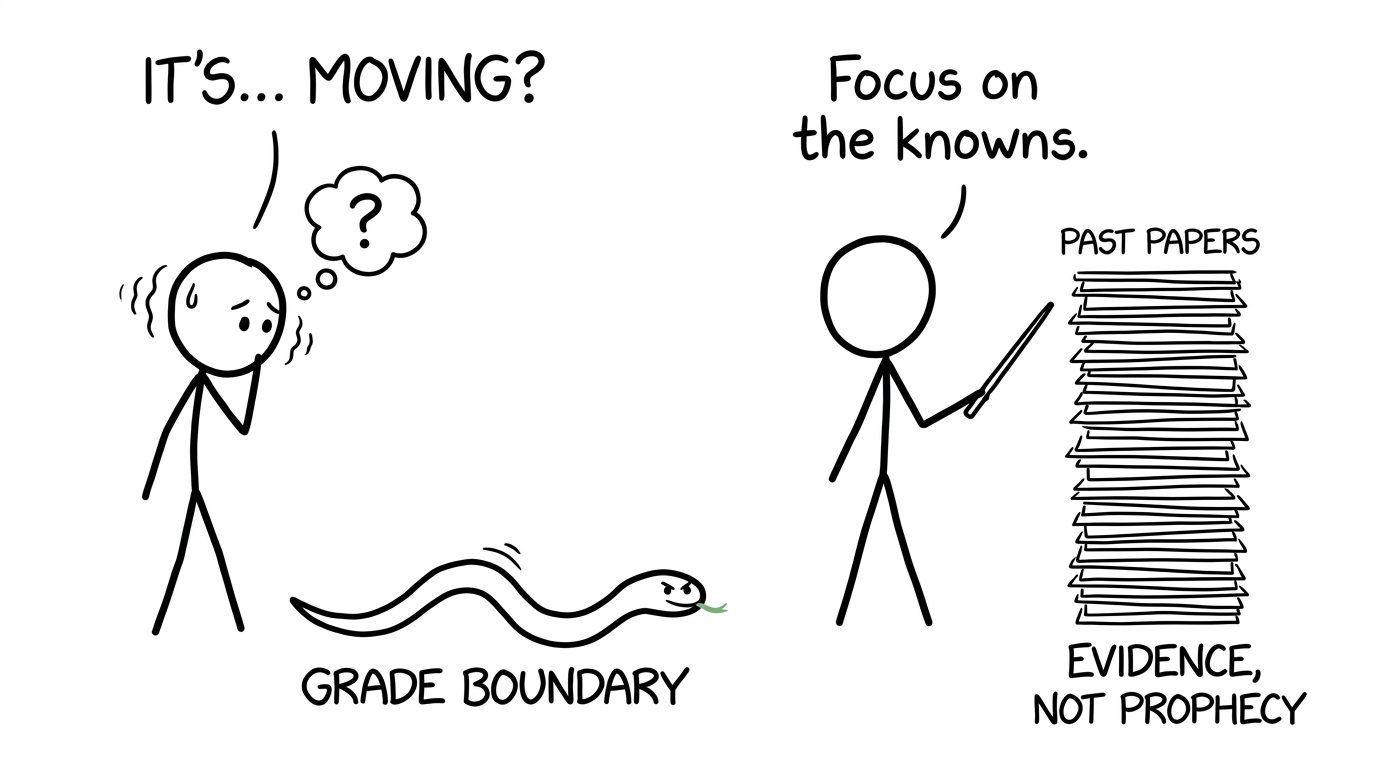 A biology student discovers that grade boundaries are evidence rather than prophecy
What the A-Level Biology grade boundary trends show
Boundaries moved before the pandemic too
It is tempting to explain every change through pandemic grading, but the earlier figures show natural variation. The A* boundary dropped from 174174174 in 201720172017 to 166166166 in 201820182018, then rose to 178178178 in 201920192019.
That movement is normal. Senior examiners set boundaries after reviewing student work and evidence about paper demand. The purpose is to maintain a comparable grade standard, not to preserve the same raw-mark threshold every year.
The pandemic years require careful interpretation
England did not hold its normal summer A Level exams in 202020202020 or 202120212021. Although autumn exam series took place, their cohorts and circumstances were different. Treating those boundaries as direct replacements for ordinary summer data can create a misleading trend.
The 202220222022 series was deliberately transitional. Ofqual aimed for grading outcomes between the unusually high results of 202120212021 and pre-pandemic standards. In 202320232023, grading returned broadly to the pre-pandemic standard, with protection for students where national performance was slightly weaker.
AQA boundaries rose noticeably after 2022
For AQA Biology, the A* threshold increased from 173173173 in 202220222022 to 192192192 in 202420242024, where it remained in 202520252025. As a proportion of the available marks, that is approximately:
173260×100≈66.5%\frac{173}{260}\times 100 \approx 66.5\%260173×100≈66.5%compared with:
192260×100≈73.8%\frac{192}{260}\times 100 \approx 73.8\%260192×100≈73.8%This does not prove that Biology became easier. It shows that more raw marks were required to represent the same grade standard on those particular papers.
Why exam boards cannot be compared mark for mark
AQA, Edexcel, OCR and Eduqas use different specifications, paper structures and total marks. A boundary of 192192192 on an AQA paper cannot be placed beside 187187187 on OCR Biology A without converting both to percentages and considering the assessment structure.
Use the correct board-specific data. MathsGenie provides separate pages for OCR A Level Biology boundaries and Eduqas A Level Biology boundaries. Students taking Edexcel should also check whether they study Biology A or Biology B before analysing results.
GCSE students can build the data skills behind this comparison through GCSE Statistics revision and the MathsGenie averages lesson. These skills matter in science too: a trend is evidence, not certainty.
How to use past boundaries in revision
Use the last several years to create a sensible performance range rather than one precise prediction. If your target grade has recently required between 150150150 and 165165165 marks, aiming only for 150150150 leaves no protection against a higher boundary, an awkward paper or ordinary exam mistakes.
A stronger routine is:
- complete a paper under timed conditions;
- mark it accurately using the official mark scheme;
- record lost marks by topic and question type;
- compare your total with several relevant boundaries;
- repair weaknesses using topic questions and mini tests;
- repeat the process with an unseen paper.
The AQA A Level Biology revision hub brings together past papers, mark schemes, exam-style questions, predicted papers and revision tools. If you are still preparing for grades 999-111, use AQA GCSE Biology past papers to build the same attempt, mark, repair habit early.
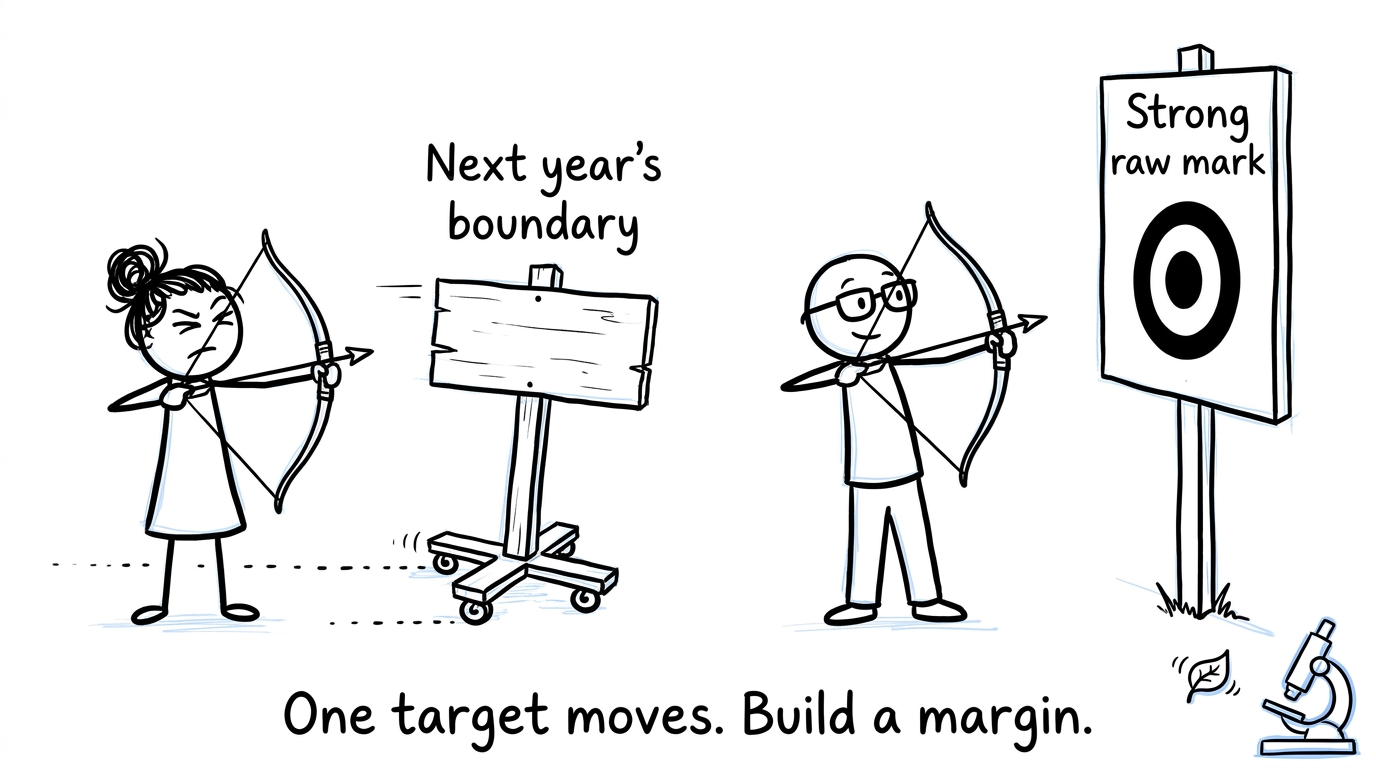 A student chooses a strong raw-mark target instead of chasing a moving boundary
Common mistakes when analysing grade boundaries
Assuming next year's boundary will match last year's. Paper demand changes, so the final threshold can move in either direction.
Comparing raw marks across exam boards. Different maximum marks and specifications make direct comparisons unreliable.
Treating a boundary as a safe target. Reaching an old boundary exactly leaves no margin for variation.
Using component boundaries as final grades. Notional paper boundaries can be informative, but the qualification grade normally depends on the overall weighted total.
Ignoring the pandemic break. The absence of normal summer exams in 202020202020 and 202120212021 means the historical sequence is not continuous.
Build marks rather than predict boundaries
The history of past A-Level Biology grade boundaries is useful because it teaches humility. Boundaries move. Your revision decisions do not have to move with them.
Choose your specification, complete authentic papers and aim comfortably above the recent range for your target grade. Start with MathsGenie's A Level past papers, then use the Biology revision lessons, practice questions, mark schemes, video support, predicted papers and mini tests to turn every lost mark into a specific next step.