

A-Level After GCSE Geography: What Next?
A-Level after GCSE Geography: compare related subjects, check typical grade thresholds and choose an option that fits your interests and strengths.
Results day can make a familiar subject feel like a new decision. You know your GCSE Geography grade, but does it mean you should continue? If you are considering an A-Level after GCSE Geography, the short answer is this: choose A-Level Geography if you enjoy explaining real places, interpreting evidence, completing fieldwork and writing balanced arguments. Your grade matters, but your interest in the work matters too.
There is no universal national entry grade. Schools and colleges set their own requirements, often asking for around grade 555 or 666 in GCSE Geography, sometimes alongside suitable English and Maths grades. Check the prospectus for your sixth form before treating any threshold as fixed.
Your results-day decision checklist
Before confirming an option, ask:
- Do I enjoy both physical and human geography?
- Am I comfortable interpreting maps, graphs and numerical data?
- Can I write extended answers supported by evidence?
- Did I enjoy fieldwork and evaluating methods?
- Does my sixth form require a particular Geography, English or Maths grade?
- Does the course content offered by its exam board interest me?
- Does Geography complement my other two subjects?
If most answers are yes, progressing from GCSE Geography to A-Level is a sensible possibility. You can preview the subject through MathsGenie's AQA A-Level Geography overview, including its lessons, questions and past papers.
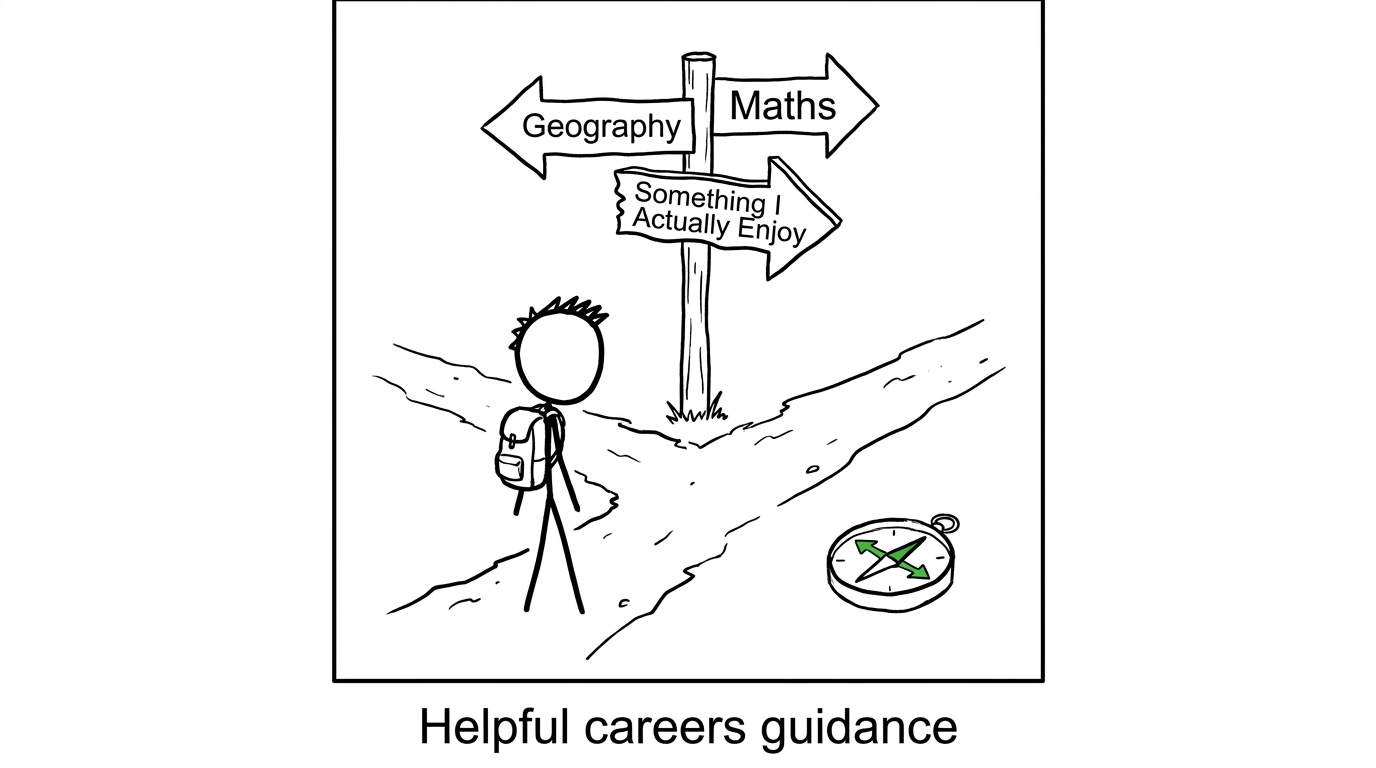 A student meets unusually unhelpful signposts while choosing A-Levels
What grade do you need for A-Level Geography?
AQA states that its specification has no formal previous-learning requirement, although it recommends knowledge and skills associated with GCSE Geography. In practice, individual schools and colleges control admission.
Use this table as decision support, not as a national admissions rule:
| GCSE Geography result | Sensible next step |
|---|---|
| Grade 777 to 999 | You are likely to have a strong starting foundation, but still inspect the course content and assessment style. |
| Grade 666 | This commonly meets published entry thresholds, although you must check your chosen sixth form. |
| Grade 555 | Some providers accept it and others require grade 666. Ask whether your overall profile and Maths or English grades are considered. |
| Grade 444 or below | Speak directly to the department. Consider whether resits, an alternative Level 333 course or another related A-Level would suit you better. |
A grade tells you how one set of assessments went. It does not tell you whether you will enjoy two more years of the subject. Equally, enthusiasm cannot remove an entry requirement. You need both pieces of information.
If you are still awaiting results, use the AQA GCSE Geography revision hub to strengthen the knowledge and skills that will carry forward.
What changes from GCSE Geography to A-Level?
Choosing A-Level Geography is not simply choosing a longer GCSE. The ideas become more connected, evidence is examined more critically and conclusions need greater qualification.
Across UK specifications, students study physical and human geography, use qualitative and quantitative evidence, undertake fieldwork and complete an individual investigation. The precise topics and assessment structure vary between AQA, Edexcel, OCR and Eduqas, so read the specification used by your school.
National subject content requires quantitative skills to account for at least 10%10\%10% of A-Level Geography assessment. It also requires at least four days of fieldwork. You may encounter averages, percentages, ratios, measures of dispersion, correlation, sampling and statistical significance.
That is why a student who likes geography but dislikes every form of data analysis should investigate the course carefully before enrolling. Maths does not replace geographical reasoning; it helps you test whether the evidence supports it.
Useful preparation includes MathsGenie's guides to GCSE Geography numerical skills, statistical skills and fieldwork.
Which A-Level should you choose after GCSE Geography?
A-Level Geography
Choose Geography when you want to continue studying places, environments, global systems and the relationship between people and landscapes. It suits students who can move between data, case studies, field evidence and extended writing.
It combines naturally with sciences, humanities and social sciences. The best combination is not the one that looks most impressive on paper. It is the one in which the subjects reinforce your interests while leaving future routes open.
Maths or Core Maths
A-Level Maths can support interests involving data, modelling, economics, environmental analysis or geospatial work. However, it is a substantial step beyond GCSE Maths and usually has a higher subject-specific entry threshold. If your school requires grade 666 or 777, a foundation-tier result may not meet that condition because foundation tier is capped at grade 555.
Core Maths may be available as an alternative Level 333 qualification for students who want to continue useful mathematical and statistical work without taking the full A-Level. Availability and how it fits your timetable depend on your provider.
To judge your current position honestly, use GCSE Maths revision resources for all major boards or focus on GCSE Statistics revision.
Biology, Environmental Science or Geology
These options may suit students drawn towards ecosystems, climate, landscapes and physical processes. Geography often provides the broad spatial picture, while a science subject examines mechanisms in greater depth. Check availability because not every sixth form offers Environmental Science or Geology.
Economics, Sociology or Politics
These subjects connect with development, inequality, migration, governance and changing places. They are worth considering if human geography was the part of GCSE you found most compelling. Expect substantial reading, argument and evaluation rather than assuming they are easier alternatives.
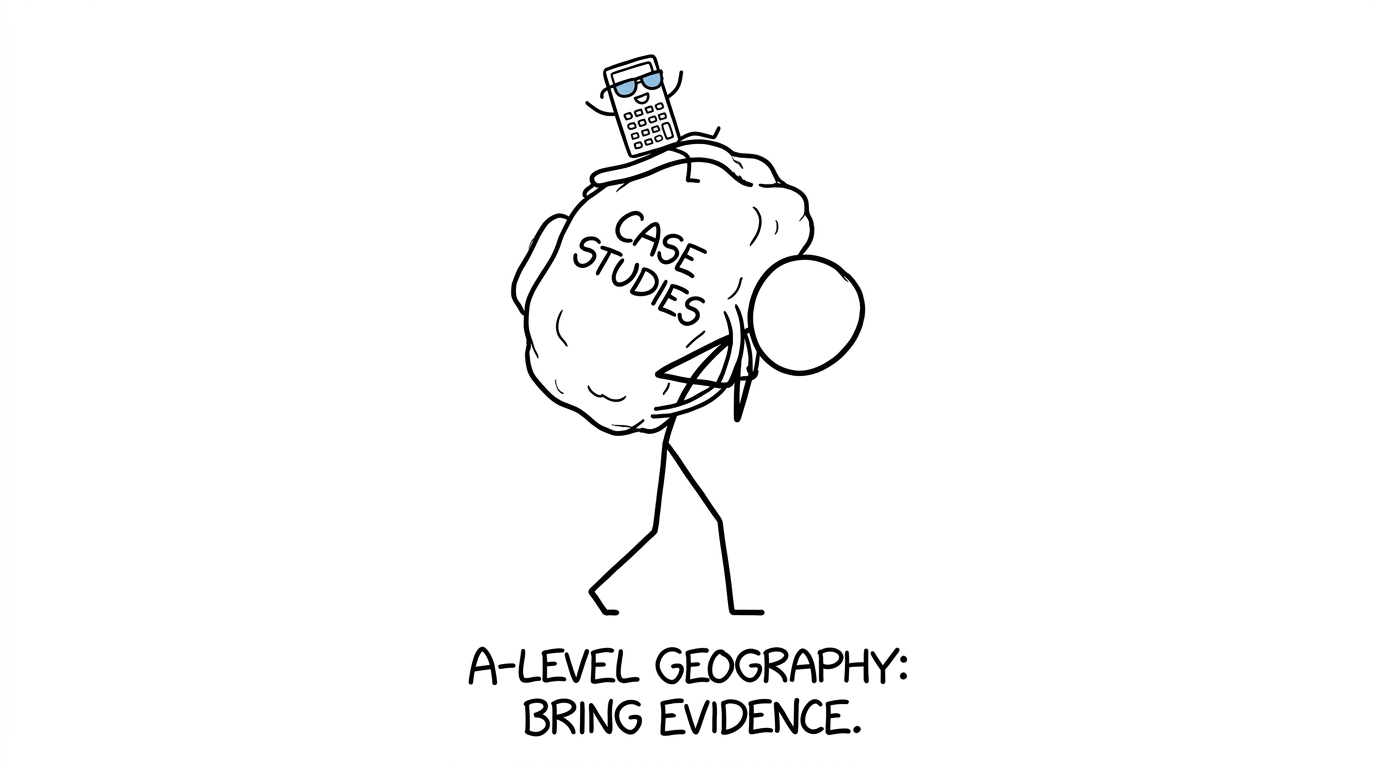 A student carries case studies while a calculator enjoys the journey
How to build a balanced subject combination
Think in terms of workload as well as topic overlap. Geography includes extended writing, case-study knowledge, data interpretation, fieldwork and an independent investigation. Combining it with two heavily essay-based subjects creates a different weekly workload from combining it with Maths and a laboratory science.
Ask the department three practical questions:
- Which exam board and optional topics do you teach?
- What are the exact entry requirements?
- How are fieldwork and the independent investigation organised?
Then inspect actual assessment materials. Past papers reveal the course more honestly than a short subject description. MathsGenie's AQA A-Level Geography resources let you see the questions, mark schemes and expected depth before committing.
Common mistakes when choosing A-Levels
Choosing only because you achieved a high grade. Success is useful evidence, but two years is a long time to spend with a subject you no longer enjoy.
Assuming Geography contains little maths. Quantitative skills are part of every regulated A-Level Geography specification. Strengthen weak foundations rather than avoiding them.
Ignoring the exam board. AQA, Edexcel, OCR and Eduqas share national requirements, but their topic choices and assessment structures differ.
Treating an entry threshold as a prediction. Meeting grade 666 does not guarantee a particular A-Level result. It only means you have met that provider's starting condition.
Picking three subjects separately. Consider the combined reading, coursework, fieldwork, practical and examination demands.
Make the next decision with evidence
Moving from GCSE Geography to A-Level is a good choice when curiosity survives beyond results day. Look at the specification, check the local grade threshold, inspect real questions and decide whether you want the daily work, not merely the subject name.
Start with MathsGenie's A-Level Geography overview. Then use the revision lessons, practice questions, past papers and mark schemes to understand what the course demands. If quantitative skills need attention first, return to the GCSE revision guides, mini tests and predicted papers. A thoughtful choice now gives your future revision a much stronger direction.










