1EN2 vs 1EN0: Which English GCSE Are You Sitting?
1EN2 vs 1EN0 explained: compare Edexcel English Language papers, timings, texts and questions, then check which specification you are entered for.
A resit student can revise diligently for weeks and still prepare for the wrong paper. The problem is not effort. It is identification.
The 1EN2 vs 1EN0 distinction matters because Pearson offers two separate Edexcel GCSE English Language specifications. 1EN0 is GCSE English Language, first taught from 2015, while 1EN2 is GCSE English Language 2.0, first taught from 2021. Both lead to a GCSE graded 9-1, but their paper structures, source texts and question sequences differ.
The quickest answer is simple: check the qualification code on your exam entry statement or ask your school or college exams officer. Do not assume that “Edexcel English Language” automatically means 1EN0.
The 1EN2 vs 1EN0 checklist
Before choosing revision materials, confirm these details:
- 1EN0 means Pearson Edexcel GCSE English Language.
- 1EN2 means Pearson Edexcel GCSE English Language 2.0.
- Both qualifications have two externally examined papers.
- Both assess reading and writing across the qualification.
- The papers do not use identical sections or question sequences.
- 1EN0 includes nineteenth-century fiction and a studied non-fiction anthology.
- 1EN2 separates non-fiction and contemporary texts more clearly between its two papers.
- Your exams officer, entry statement and candidate timetable are the reliable ways to confirm your entry.
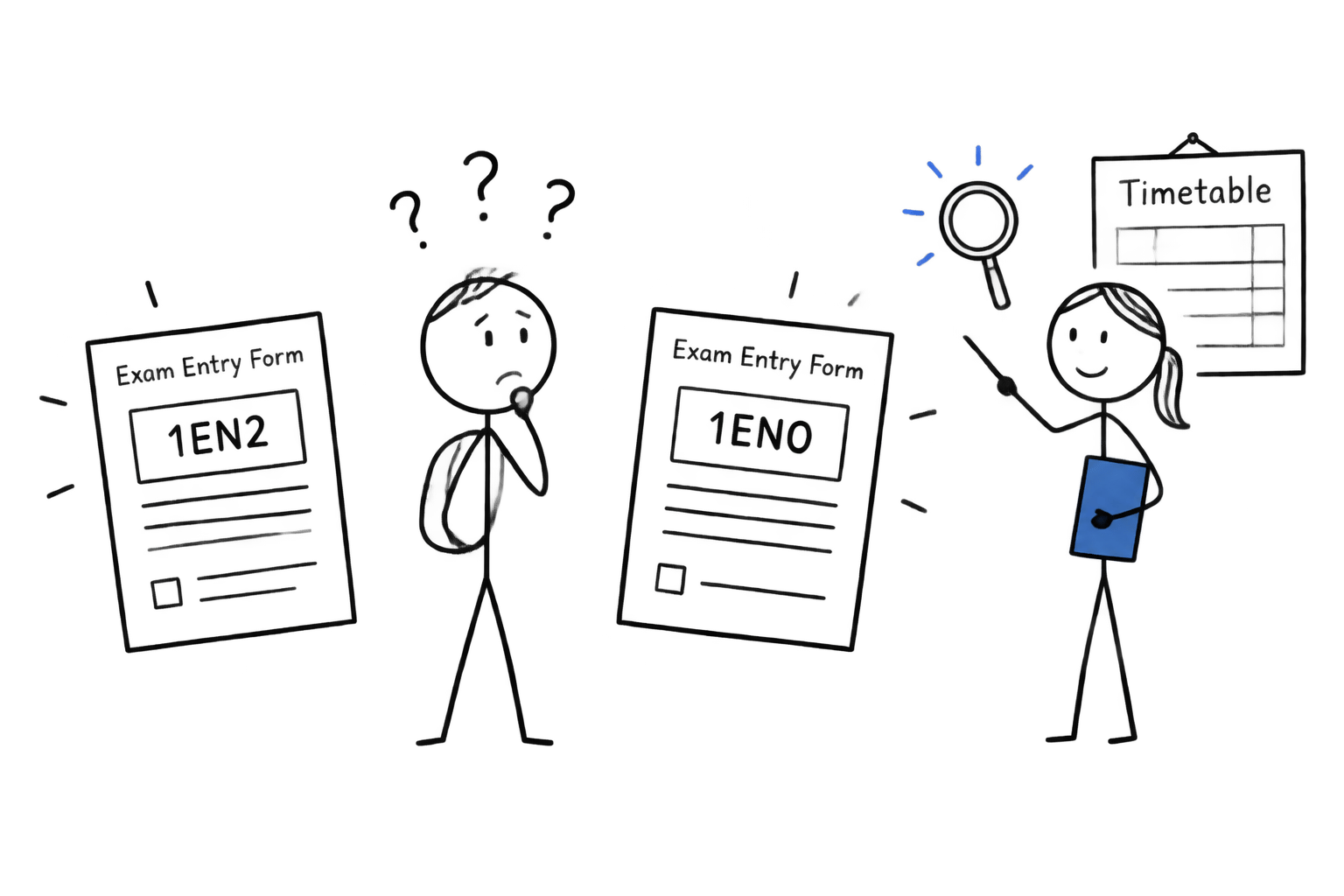 A student checking whether their exam code is 1EN2 or 1EN0
Edexcel English Language 2.0 vs 1EN0 at a glance
The names can make 1EN2 sound like a replacement that every centre must now use. It is better to think of it as a different Pearson specification. A school, college or resit centre may choose which qualification it enters.
| Feature | 1EN0 English Language | 1EN2 English Language 2.0 |
|---|---|---|
| Qualification code | 1EN0 | 1EN2 |
| Number of written papers | Two | Two |
| Paper 1 | Fiction and imaginative writing | Non-fiction texts and transactional writing |
| Paper 2 | Non-fiction and transactional writing | Contemporary texts and creative writing |
| Paper 1 length | 111 hour 454545 minutes | 111 hour 555555 minutes |
| Paper 2 length | 222 hours 555 minutes | 111 hour 555555 minutes |
| Marks per paper | 646464 on Paper 1 and 969696 on Paper 2 | 808080 on each paper |
| Total written marks | 160160160 | 160160160 |
| Spoken language | Separately reported endorsement | Separately reported endorsement |
The total assessment is balanced differently. For 1EN0, Paper 2 carries more marks and takes longer. For 1EN2, the two papers have equal marks and equal timings.
Always use the current Pearson specification and the materials issued by your centre when planning revision. Paper details can be misunderstood when resources shorten the qualification names.
What is on the 1EN0 papers?
1EN0 Paper 1: Fiction and Imaginative Writing
Paper 1 lasts 111 hour 454545 minutes and is worth 646464 marks. It is divided into reading and writing.
The reading section is based on an unseen extract from a nineteenth-century fiction text. Questions move from retrieving information towards analysing language, structure and the writer’s methods. Students therefore need to do more than identify a quotation. They must explain how the evidence creates meaning or affects the reader.
The imaginative writing section offers a choice of tasks. Students produce one extended response, using description, narrative or a combination of both as the task requires.
This paper rewards control. A clear, developed piece with purposeful paragraphing is usually a safer aim than an elaborate plot that cannot be completed.
1EN0 Paper 2: Non-fiction and Transactional Writing
Paper 2 lasts 222 hours 555 minutes and is worth 969696 marks. Its reading section uses two non-fiction texts. One comes from the Pearson Edexcel non-fiction anthology and the other is unseen. The texts are drawn from different periods, and students are asked to analyse and compare them.
That anthology detail is crucial. If your lessons involve preparing named non-fiction texts such as speeches, articles, letters or memoir extracts from a Pearson anthology, you may be following 1EN0. It is an indication, not proof of entry.
The transactional writing section asks students to communicate for a particular audience, purpose and form. Possible forms include an article, speech, letter or review. The task assesses the ability to shape an argument or viewpoint, organise ideas and write accurately.
What is on the 1EN2 papers?
1EN2 Paper 1: Non-Fiction Texts
Paper 1 lasts 111 hour 555555 minutes and is worth 808080 marks. It combines non-fiction reading with transactional writing.
Students respond to unseen non-fiction texts and answer questions testing comprehension, analysis, evaluation and comparison. The exact wording matters: identifying information, analysing a method and evaluating an idea are different jobs. Strong revision therefore focuses on what each command word requires, rather than memorising one paragraph formula for every response.
The writing section asks for a transactional response shaped around a stated audience and purpose. Successful answers establish a clear viewpoint, maintain an appropriate register and use paragraphs to guide the reader.
1EN2 Paper 2: Contemporary Texts
Paper 2 also lasts 111 hour 555555 minutes and is worth 808080 marks. Its reading material is contemporary, which makes this paper structurally different from 1EN0 Paper 1 and its nineteenth-century fiction focus.
Students answer questions on unseen texts before completing a creative writing task. Reading questions assess skills such as inference, analysis and evaluation. In the writing section, students need to develop a coherent response while controlling vocabulary, sentences, spelling and punctuation.
The equal weighting of 1EN2 papers changes the revision calculation. Neither paper can be treated as the smaller component. Each contributes half of the written marks.
Comparing the texts and question types
An Edexcel English spec comparison becomes clearer when you look beyond the word “English” and ask what you will actually read and write.
| Skill or material | 1EN0 | 1EN2 |
|---|---|---|
| Nineteenth-century fiction | Central to Paper 1 reading | Not the defining Paper 1 format |
| Studied non-fiction anthology | Used on Paper 2 | Not assessed through the same 1EN0 anthology model |
| Unseen non-fiction | Paper 2 | Paper 1 |
| Contemporary reading texts | May appear within the specification’s text range | Central to Paper 2 |
| Imaginative or creative writing | Paper 1 | Paper 2 |
| Transactional writing | Paper 2 | Paper 1 |
| Comparison | Non-fiction reading on Paper 2 | Assessed within the non-fiction reading paper |
The location of a skill matters. If you practise excellent transactional writing but expect it on the wrong paper, your revision plan and timed practice will be distorted. Label every practice task with the full code and paper number, such as 1EN2/01 or 1EN0/02.
How to check which qualification you are entered for
Your teacher may teach the course, but the exams officer controls and confirms entries. Use this order:
Check your statement of entry
Your centre should provide entry information before the examinations. Look for the qualification code 1EN0 or 1EN2, not merely “English Language”. Keep a copy and raise any apparent error promptly.
Ask the exams officer directly
Use a precise question: “Am I entered for Pearson Edexcel GCSE English Language 1EN0 or English Language 2.0 1EN2?”
This avoids confusion with paper numbers, English Literature entries or informal course names.
Check your examination timetable
The paper code should appear beside the date and session. For example, a code beginning 1EN2 belongs to English Language 2.0. Check both papers rather than relying on a shortened subject title.
Match your official practice papers
Look at the front cover of the papers supplied by your centre. The qualification and component code should be printed there. Materials labelled 1EN0 are not interchangeable with 1EN2 papers, even when they practise overlapping reading skills.
Pearson’s official GCSE English Language 2.0 qualification page provides the specification and assessment materials for 1EN2. Once you know your code, revise only from resources that clearly match it.
A practical revision approach for resit students
Resitting often creates a misleading sense that you should simply repeat last year’s revision. First confirm that your new centre has entered the same specification. Moving from a school to a college can mean changing exam board or qualification code.
Then complete one paper under the correct timing. Mark it by question type, not just total mark:
- retrieval and inference;
- language or structure analysis;
- evaluation;
- comparison;
- organisation and communication in writing;
- vocabulary, sentence control, spelling and punctuation.
Choose the weakest category and practise it in short, focused sessions. Full papers reveal stamina and timing problems, but targeted questions fix individual skills. Alternate between the two.
MathsGenie is best known as a free GCSE and A Level maths revision resource. If English is one of several resits, use the GCSE revision resources, GCSE past papers and revision planner to organise your maths alongside English. Keeping each subject’s specification code on your plan prevents the same entry-code mistake elsewhere.
For students also resitting maths, MathsGenie’s Foundation GCSE revision, Higher GCSE revision and predicted papers provide structured practice with questions, mark schemes and video solutions.
Common mistakes to avoid
Assuming 2.0 means a higher tier. It does not. English Language is not divided into foundation and higher tiers. The name identifies a different specification.
Using only the subject name. “Edexcel English” is too vague. Confirm the code, paper number and qualification title.
Revising 1EN0 anthology texts for 1EN2. General analytical skills transfer, but specification-specific preparation must match your actual entry.
Using the wrong timing. A difference of ten or twenty minutes changes how you pace the paper. Practise using the timing printed on the correct official paper.
Treating writing as an extra. Writing forms a substantial part of both qualifications. Plan time to practise complete responses, not only reading questions.
Trusting an old folder over a current entry statement. Your previous school’s specification does not prove what your resit centre has entered this year.
Know the code before you revise
The most useful revision decision may take less than a minute: find the code.
If it says 1EN0, prepare for fiction and imaginative writing on Paper 1, then non-fiction and transactional writing on Paper 2. If it says 1EN2, prepare for non-fiction and transactional writing on Paper 1, then contemporary texts and creative writing on Paper 2.
Once that uncertainty is removed, revision becomes calmer and more precise. Ask your exams officer, download the matching Pearson specification and label every paper clearly. Then use MathsGenie to keep the rest of your GCSE resit plan structured, free and focused on the papers you will actually sit.