An offshore exploration company operates an environmental monitoring system consisting of two identical scientific sensors connected in parallel to a stable DC power supply located on a marine platform.
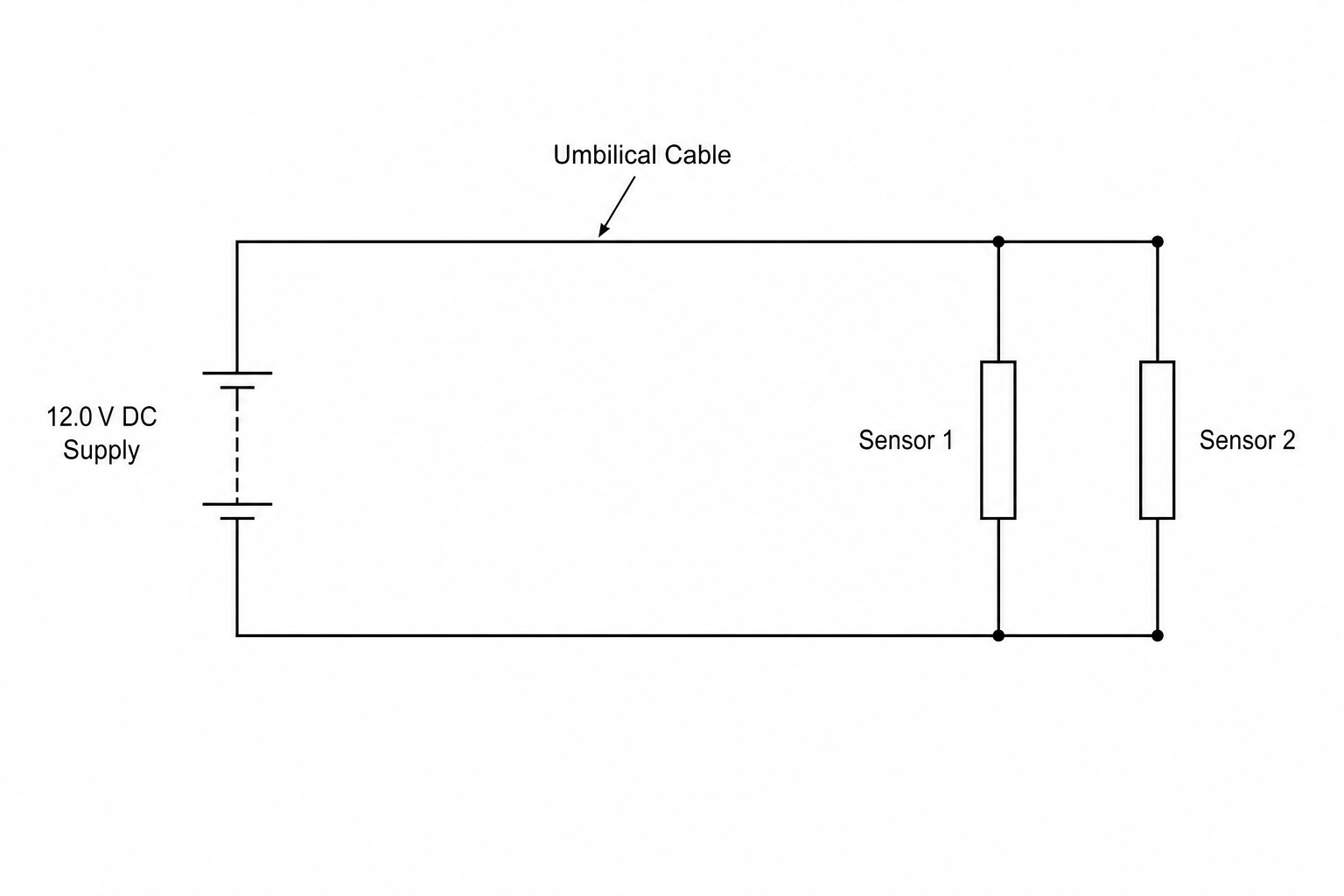
The power supply has an emf of 12.0 V12.0\text{ V}12.0 V and negligible internal resistance. Each of the two identical sensors is rated at 12.0 V12.0\text{ V}12.0 V, 3.6 W3.6\text{ W}3.6 W.
Show that the resistance of one of the sensors when operating at its rated voltage is 40 Ω40\ \Omega40 Ω.
Initially, the DC supply is connected directly to the parallel sensor array using short copper connections of negligible resistance. Calculate the total current delivered by the power supply.
The short connections are replaced with a twin-core umbilical cable to submerge the sensors. This umbilical cable consists of two identical long wires (one for the supply path and one for the return path). Show that the resistance of each length of wire in this umbilical cable is about 25 Ω25\ \Omega25 Ω.
- length of each wire = 8.0 m8.0\text{ m}8.0 m
- diameter of each wire = 0.40 mm0.40\text{ mm}0.40 mm
- resistivity of the wire material = 3.9×10⁻⁷ Ω m3.9 \times 10^{-7}\ \Omega\text{ m}3.9×10⁻⁷ Ω m
For the telemetry system to function, each sensor requires at least 0.60 W0.60\text{ W}0.60 W of electrical power to transmit data successfully. Discuss whether the system will operate successfully when using the long umbilical cable instead of the short connection. Support your answer with suitable calculations.