This question is based on a practical method to determine the resistivity of a metal wire, Y.
The diameter of wire Y is measured using a micrometer screw gauge. The main scale has a resolution of 0.50 mm0.50\text{ mm}0.50 mm. The edge of the thimble has passed the 0.50 mm0.50\text{ mm}0.50 mm mark on the main scale, and the 303030th division on the thimble scale is aligned exactly with the horizontal datum line. Each division on the thimble represents 0.01 mm0.01\text{ mm}0.01 mm.
State the diameter ddd of wire YYY in mm.
In an experiment to find the resistance per unit length of wire Y, a series resistor of resistance 3.3 Ω3.3\ \Omega3.3 Ω is connected in series with a cell, a switch, and wire Y.
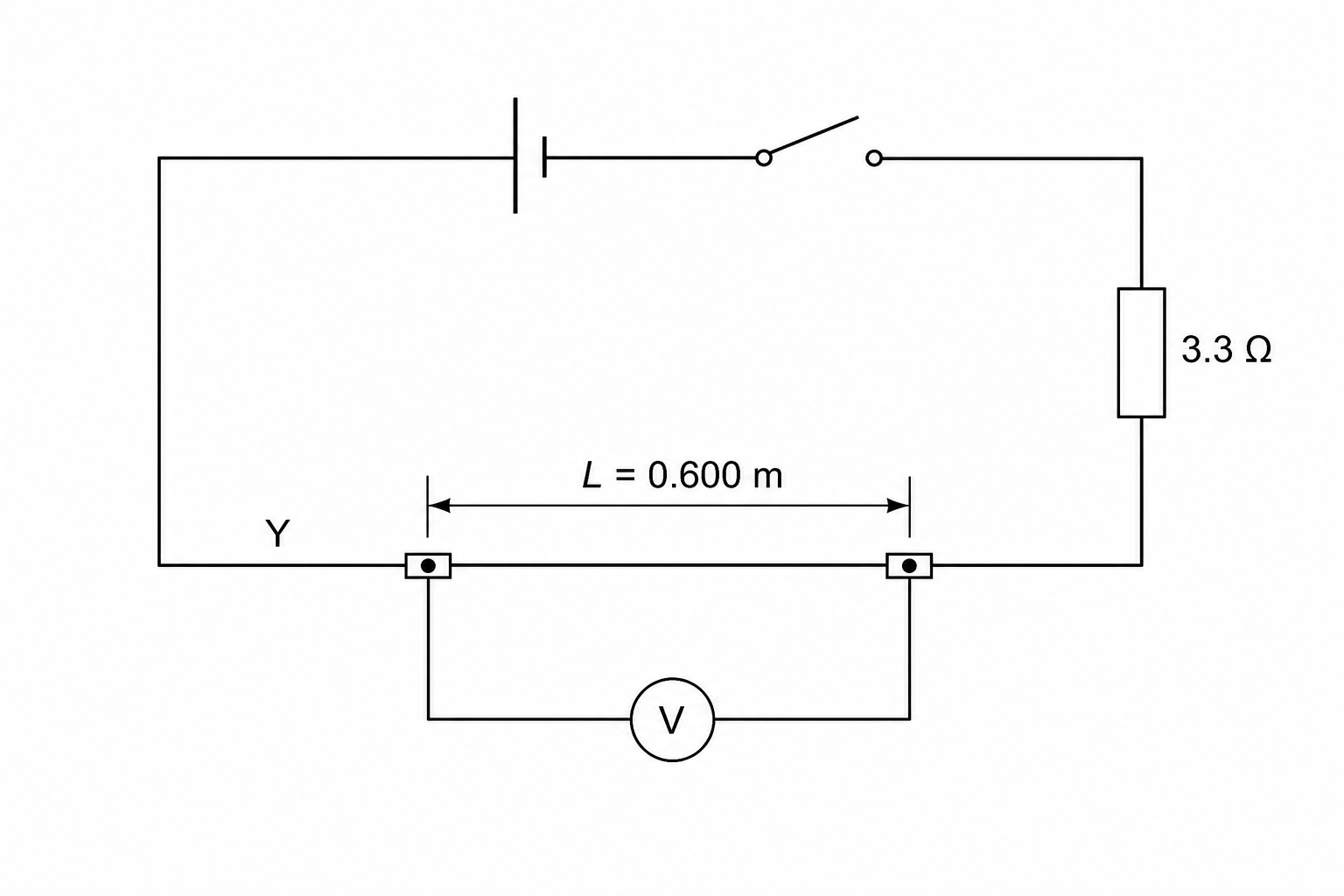
- With the switch closed, the potential difference across the 3.3 Ω3.3\ \Omega3.3 Ω resistor is 1.80 V1.80\text{ V}1.80 V.
- The switch is opened, and the voltmeter is reconnected across a length L=0.600 mL = 0.600\text{ m}L=0.600 m of wire Y.
- When the switch is closed again, the potential difference across this length of wire YYY is 0.72 V0.72\text{ V}0.72 V.
Show that the resistance RRR of the wire between the voltmeter clips is approximately 1.3 Ω1.3\ \Omega1.3 Ω.
The student determines the resistance RRR for several different lengths LLL of wire Y and plots a graph of RRR against LLL. The gradient of this graph (the resistance per metre of wire Y) is 2.15 Ω m−12.15\ \Omega\text{ m}^{-1}2.15 Ω m−1.
Table 1 shows the manufacturer's values for the resistance per metre of four different metals at various wire diameters ddd.
| Diameter ddd / mm | Copper / Ω m−1\Omega\text{ m}^{-1}Ω m−1 | Tungsten / Ω m−1\Omega\text{ m}^{-1}Ω m−1 | Constantan / Ω m−1\Omega\text{ m}^{-1}Ω m−1 | Nichrome / Ω m−1\Omega\text{ m}^{-1}Ω m−1 |
|---|---|---|---|---|
| 0.250.250.25 | 0.3460.3460.346 | 1.141.141.14 | 9.989.989.98 | 22.422.422.4 |
| 0.500.500.50 | 0.08660.08660.0866 | 0.2850.2850.285 | 2.502.502.50 | 5.605.605.60 |
| 0.800.800.80 | 0.03380.03380.0338 | 0.1110.1110.111 | 0.9750.9750.975 | 2.192.192.19 |
(i) Identify the metal used for wire Y. (ii) Determine the resistivity ρ\rhoρ of this metal. State an appropriate SI unit for your answer.
The student adds error bars for RRR and LLL to each plotted point. She estimates that:
- each value of RRR has a percentage uncertainty of 6%6\%6%
- each value of LLL has an absolute uncertainty of 5 mm5\text{ mm}5 mm
Compare her error bars for the point at L=150 mmL = 150\text{ mm}L=150 mm (where R=0.33 ΩR = 0.33\ \OmegaR=0.33 Ω) with her error bars for the point at L=600 mmL = 600\text{ mm}L=600 mm (where R=1.32 ΩR = 1.32\ \OmegaR=1.32 Ω).