Figure 1 shows a light-monitoring circuit designed by a student to control a greenhouse ventilation system.
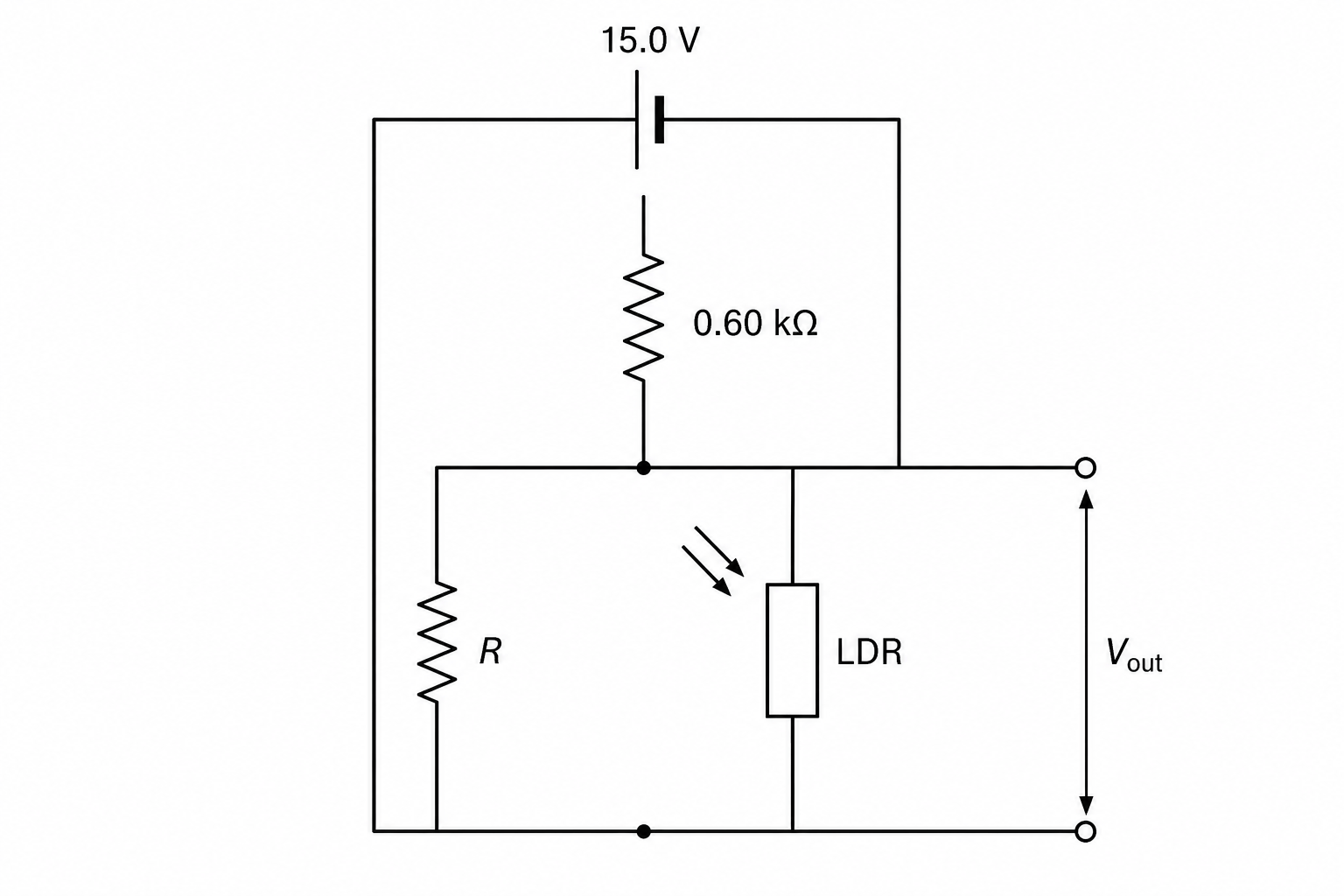
The power supply has a constant potential difference of 15.0 V15.0\text{ V}15.0 V and negligible internal resistance. The light dependent resistor (LDR) has a resistance of 1800 Ω1800\ \Omega1800 Ω under standard daylight conditions. The student wants the output potential difference (pd), VoutV_{\text{out}}Vout, to be 9.0 V9.0\text{ V}9.0 V under standard daylight conditions.
The 0.60 kΩ0.60\text{ k}\Omega0.60 kΩ resistor is made of 120 turns of wire that is wound around a non-conducting cylinder of diameter 4.0 mm4.0\text{ mm}4.0 mm. Resistivity of the wire =2.4×10⁻⁷ Ω m= 2.4 \times 10^{-7}\ \Omega\text{ m}=2.4×10⁻⁷ Ω m. Determine the cross-sectional area of the wire used for this resistor.
The student selects a resistor rated at 0.50 W0.50\text{ W}0.50 W for the 0.60 kΩ0.60\text{ k}\Omega0.60 kΩ resistor. Determine whether this resistor is suitable.
Determine the resistance of the resistor RRR that the student should select. Give your answer to an appropriate number of significant figures.
State and explain the effect on the output pd of increasing the light intensity incident on the LDR.