An apparatus used to demonstrate electrical power transmission consists of a parallel arrangement of lamps connected to a dc power supply.
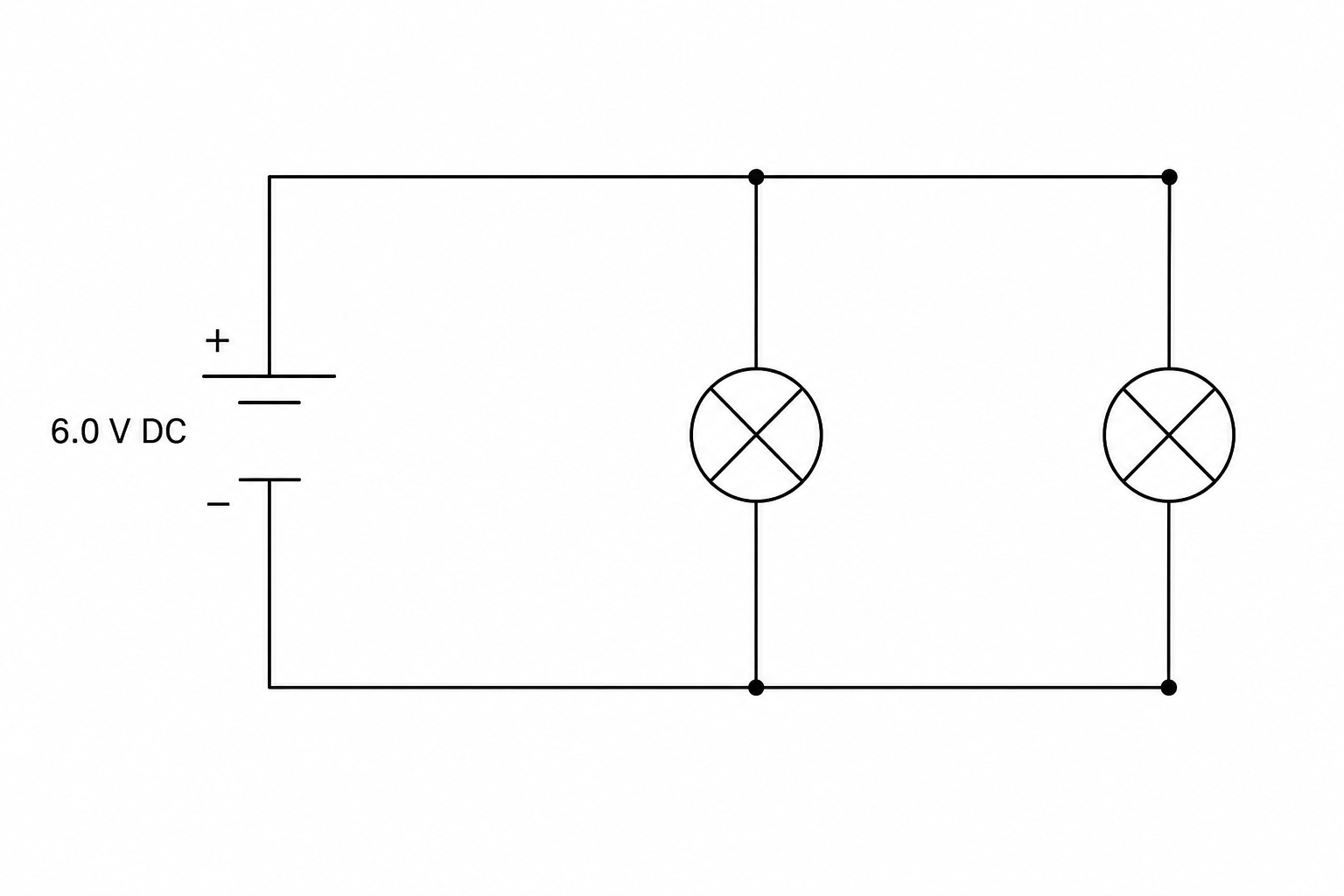
A power supply of emf 6.0 V6.0\text{ V}6.0 V and negligible internal resistance is connected to two identical 6.0 V6.0\text{ V}6.0 V, 1.2 W1.2\text{ W}1.2 W lamps in parallel.
Show that the resistance of one of the lamps when it is operating at 6.0 V6.0\text{ V}6.0 V is about 30 Ω30\ \Omega30 Ω.
Initially, the power supply is connected to the lamps using two short copper wires of negligible resistance. Calculate the total current in the power supply.
The two short copper wires are replaced with two long nichrome wires. Show that the resistance of each length of nichrome wire is about 16 Ω16\ \Omega16 Ω.
- length of each nichrome wire = 1.0 m1.0\text{ m}1.0 m
- diameter of nichrome wires = 0.30 mm0.30\text{ mm}0.30 mm
- resistivity of nichrome = 1.1×10⁻⁶ Ω m1.1 \times 10^{-6}\ \Omega\text{ m}1.1×10⁻⁶ Ω m
The demonstration is intended to show that the lamps are significantly dimmer when connected using the long nichrome wires than when using the short copper wires. Discuss whether the demonstration achieves this. Support your answer with suitable calculations.