This question is about waves.
The diagram represents a wave on a string at an instant in time.
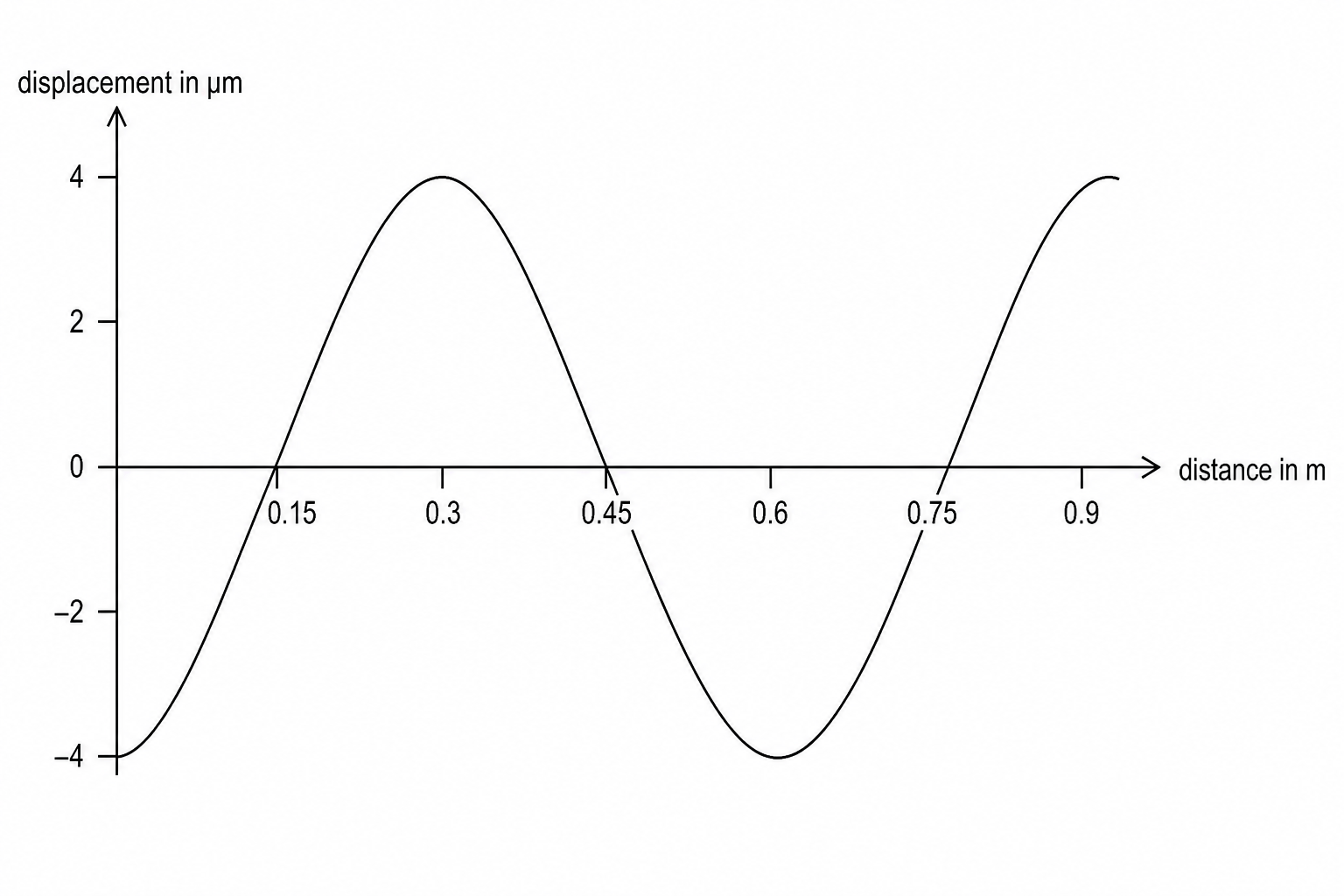
(i) What is the wavelength of the wave?
A 0.3 m0.3\text{ m}0.3 m
B 0.6 m0.6\text{ m}0.6 m
C 0.9 m0.9\text{ m}0.9 m
D 1.2 m1.2\text{ m}1.2 m
(ii) What is the amplitude of the wave?
A 2 μm2\ \mu\text{m}2 μm
B 4 μm4\ \mu\text{m}4 μm
C 8 μm8\ \mu\text{m}8 μm
D 16 μm16\ \mu\text{m}16 μm
Describe how particles in the medium vibrate relative to the direction of energy transfer for both transverse and longitudinal waves.
Aside from being transverse, state two properties that are the same for all electromagnetic waves.
Some waves have medical and diagnostic applications.
(i) Which type of electromagnetic wave is used by standard household remote controls to transmit signals to a television?
A infrared
B ultraviolet
C radio waves
D X-rays
(ii) High-speed communication systems use optical fibres. To minimise signal attenuation, standard telecommunication systems transmit digital signals through optical fibres using which type of wave?
A radio waves
B ultraviolet
C infrared
D gamma rays
(iii) Sterilising lamps in laboratories emit high-intensity ultraviolet (UV) radiation to destroy bacteria. Explain why laboratory workers must avoid direct skin and eye exposure to this radiation.

