A student uses a toy spring (slinky) to demonstrate different types of waves.
Describe how the student must move their hand to create a longitudinal wave along the spring.
Give one example of a longitudinal wave.
A wave energy generator uses a float that is constrained to slide vertically up and down on a vertical guide pole. As water waves pass, the float rises and falls.
The diagram below shows the profile of a water wave at a certain instant.
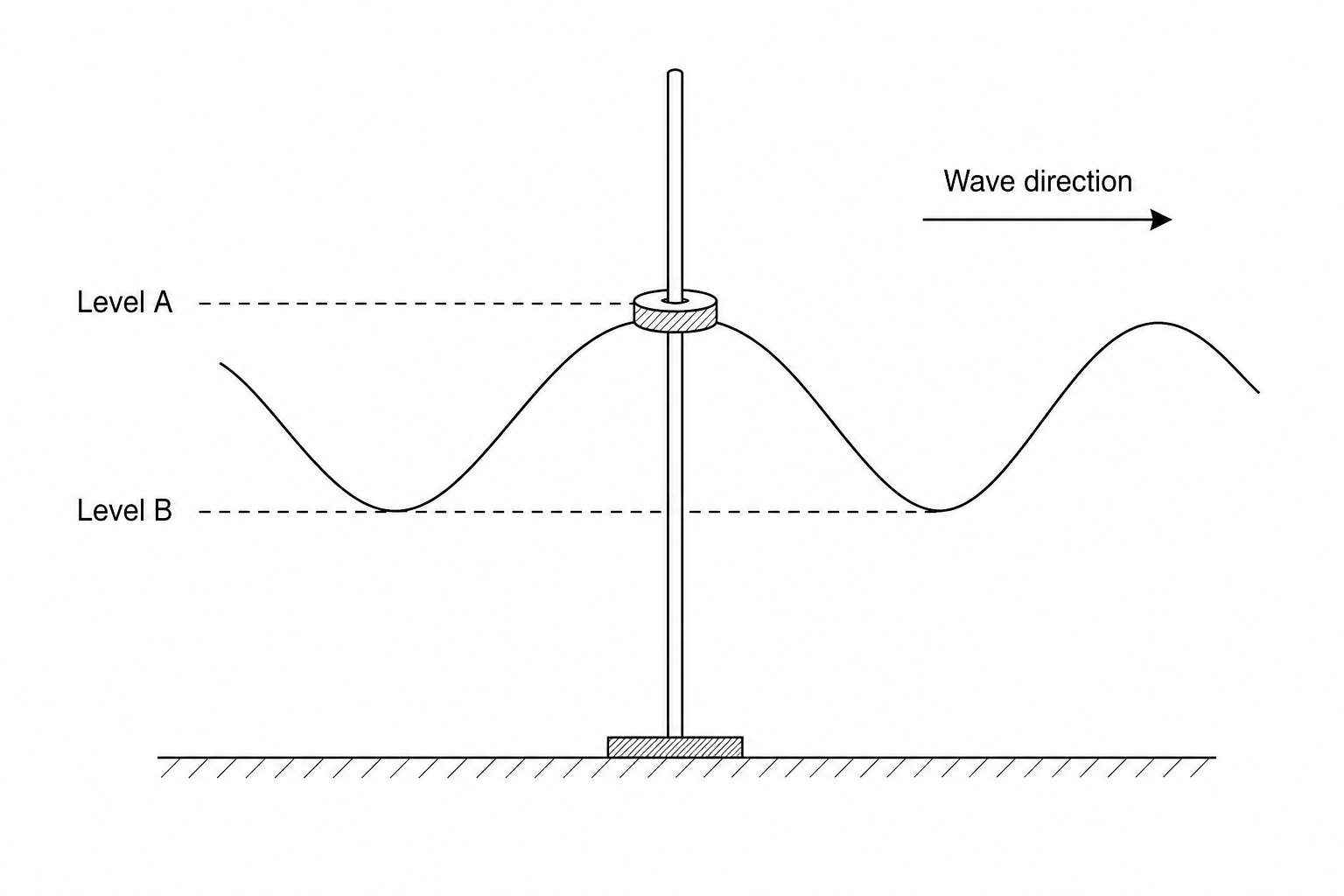
State the definition of the term wavelength.
The vertical distance between the crest at level A and the trough at level B is 1.2 m1.2\text{ m}1.2 m. Determine the amplitude of the wave.
The float reaches the highest position, level A, every 8.0 s8.0\text{ s}8.0 s. Calculate the frequency of the wave. State the unit.
Explain how the motion of the float demonstrates that the water wave is a transverse wave.
Give one example of a transverse wave other than a water wave.

