Waves can travel on surfaces, through media, or in a vacuum.
The diagram shows the side-view of a water wave travelling in a ripple tank. Each square on the grid represents 5 mm×5 mm5\text{ mm} \times 5\text{ mm}5 mm×5 mm.
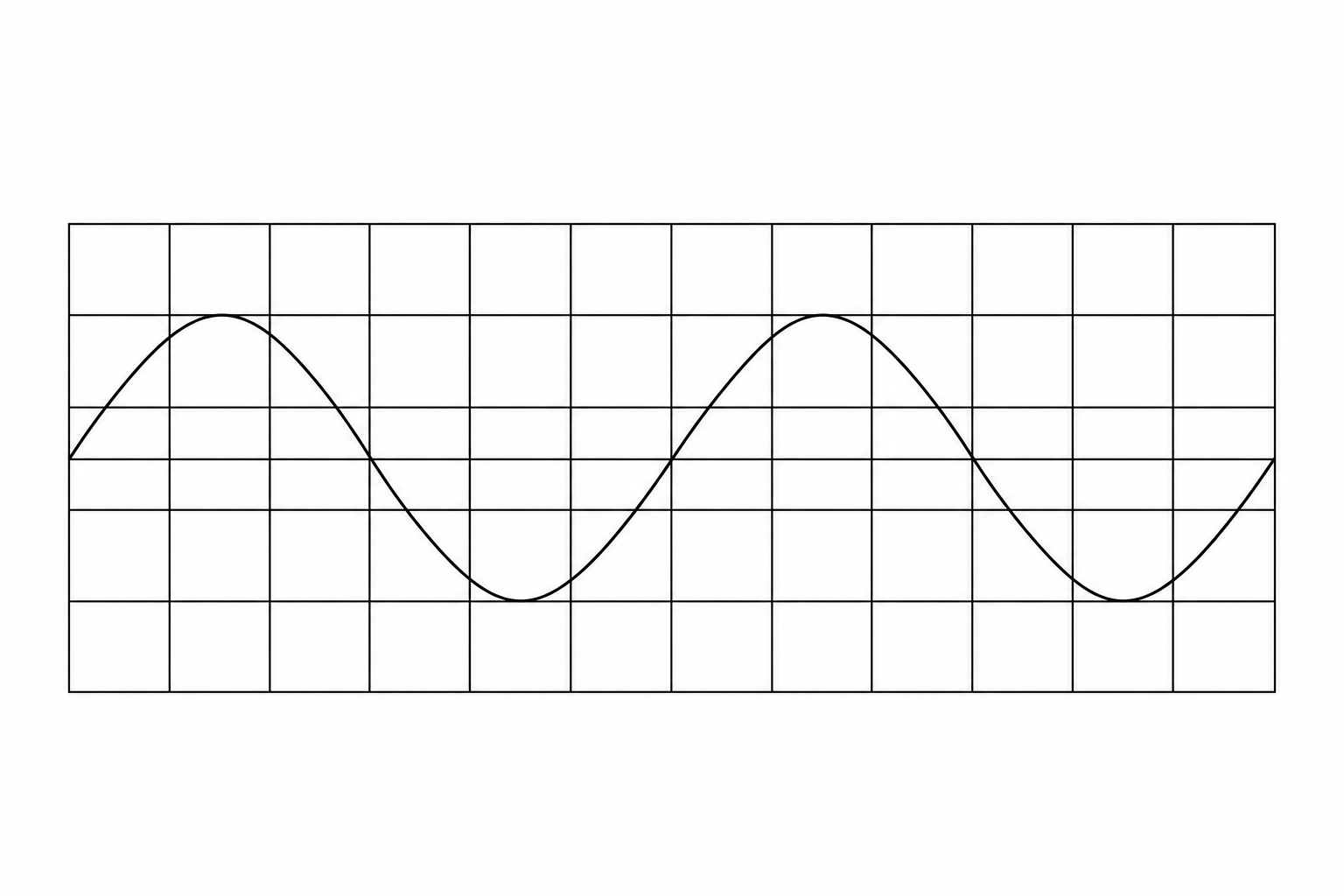
(i) State the wavelength of the wave shown.
(ii) A second wave travels along the same water surface at the same speed. It has a frequency that is three times as high, and an amplitude that is 0.40.40.4 times the size of the first wave. State the wavelength and the amplitude of this second wave.
Two students design an experiment to determine the speed of sound in a long steel structural beam of length 240 m240\text{ m}240 m on a construction site. One student has a heavy sledgehammer, and the other student at the far end has a digital stopwatch measuring to the nearest 0.01 s0.01\text{ s}0.01 s. Describe the procedure they should follow to obtain a reliable measurement for the speed of sound in steel, and explain how they can minimize experimental errors.
(i) State the equation linking wave speed, frequency, and wavelength.
(ii) A marine radar system emits electromagnetic waves with a frequency of 9.4 GHz9.4\text{ GHz}9.4 GHz through the air (where their speed is approximately 3.0×10⁸ m/s3.0 \times 10^8\text{ m/s}3.0×108 m/s). Calculate the wavelength of these radar waves.
A seismic P-wave and a very low frequency (VLF) radio wave have the same wavelength. Explain why they have vastly different frequencies.

