Waves can travel on surfaces, through media, or in a vacuum.
The diagram shows the side-view of a transverse wave travelling along a horizontal wire. The axes are graduated in centimetres.
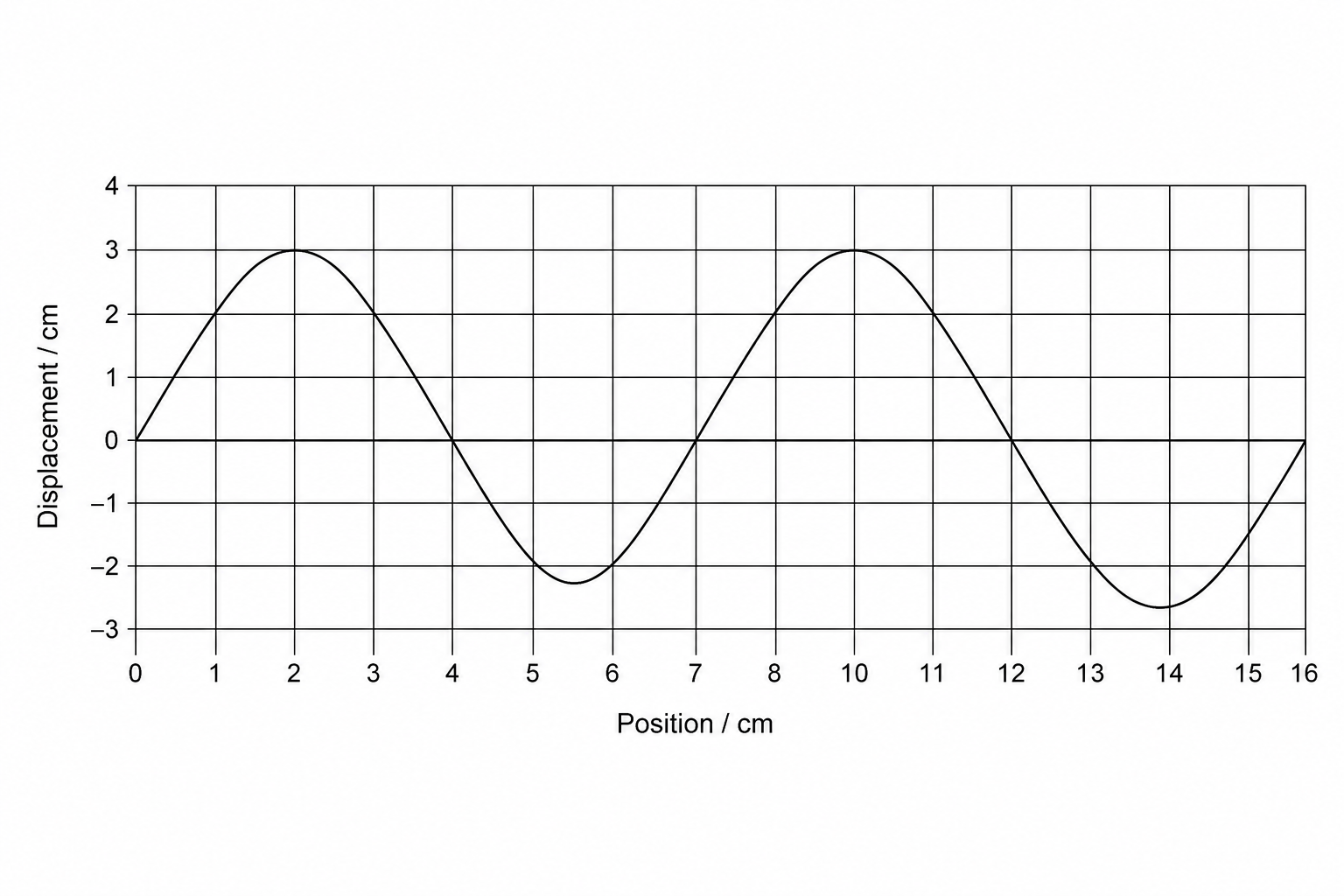
State the wavelength of the wave shown.
A second wave travels along the same wire at the same speed. It has a frequency that is three times as high, and an amplitude that is one-third the size of the first wave. State the wavelength and the amplitude of this second wave.
Two students design an experiment to determine the speed of sound in air over an open playing field. They have a tape measure to set up a distance of 250 m250\text{ m}250 m. One student has a starting pistol (which produces a highly visible puff of smoke simultaneously with the bang), and the other student has a stopwatch that measures to the nearest 0.01 s0.01\text{ s}0.01 s. Describe the procedure they should follow to obtain a reliable measurement for the speed of sound, and explain how they can minimize experimental errors.
State the equation linking wave speed, frequency, and wavelength.
The speed of electromagnetic waves in a vacuum is 3.0×10⁸ m/s3.0 \times 10^8\text{ m/s}3.0×108 m/s. An AM radio station transmits a signal with a wavelength of 250 m250\text{ m}250 m. Calculate the frequency of these radio waves in kilohertz (kHz\text{kHz}kHz).
An infrasound wave (a low-frequency sound wave) and an extremely low frequency (ELF) radio wave both have a wavelength of 15 km15\text{ km}15 km. Explain why their frequencies are vastly different.

