A scale model of a coastal defense harbor is set up inside a wave tank. A small floating sensor buoy is anchored in the tank, oscillating vertically as periodic surface waves pass.
On a scale diagram of the tank, the distance spanning three consecutive wave crests (corresponding to two complete wavelengths) is measured to be 9.6 cm9.6\text{ cm}9.6 cm. The scale of the diagram is 1:75 (where 1 cm1\text{ cm}1 cm on the diagram represents 75 cm75\text{ cm}75 cm in the actual wave tank). Calculate the actual wavelength of the waves in centimetres.
State the equation linking wave speed, frequency, and wavelength.
The frequency of the waves in the tank is 1.25 Hz1.25\text{ Hz}1.25 Hz. Calculate the speed of the waves in metres per second (m/s\text{m/s}m/s).
The surface water waves are transverse. State another example of a transverse wave.
A barrier with a gap is introduced into the wave tank. The diagram below shows plane wave fronts approaching this gap from a wave generator, with the sensor buoy located in a sheltered region behind the barrier, to the left of the gap.
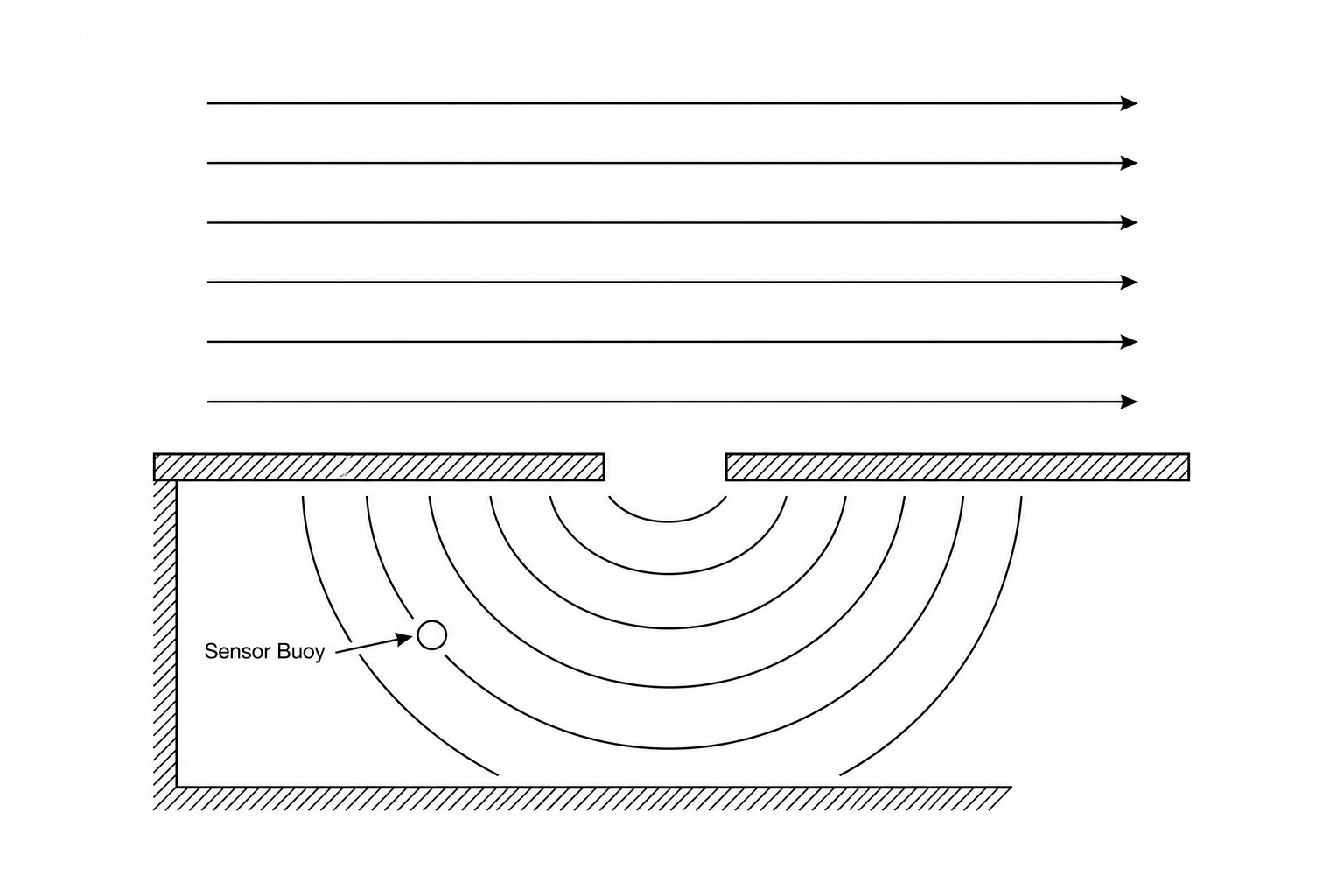
State the wave phenomenon that causes the waves to spread out into the sheltered region behind the barrier.
Discuss how changing the width of the gap in the barrier would affect the movement of the sensor buoy.

