Skip to content
MathsGenie logo
Open app

Course home

  1. IGCSE
  2. Biology Edexcel
  3. Question bank

Food production

EasyMediumHard
1234567891011121314151617181920212223242526272829303132333435363738394041424344454647484950515253545556575859606162636465666768697071727374757677787980
Question 72

The diagram shows an offshore salmon fish farm.
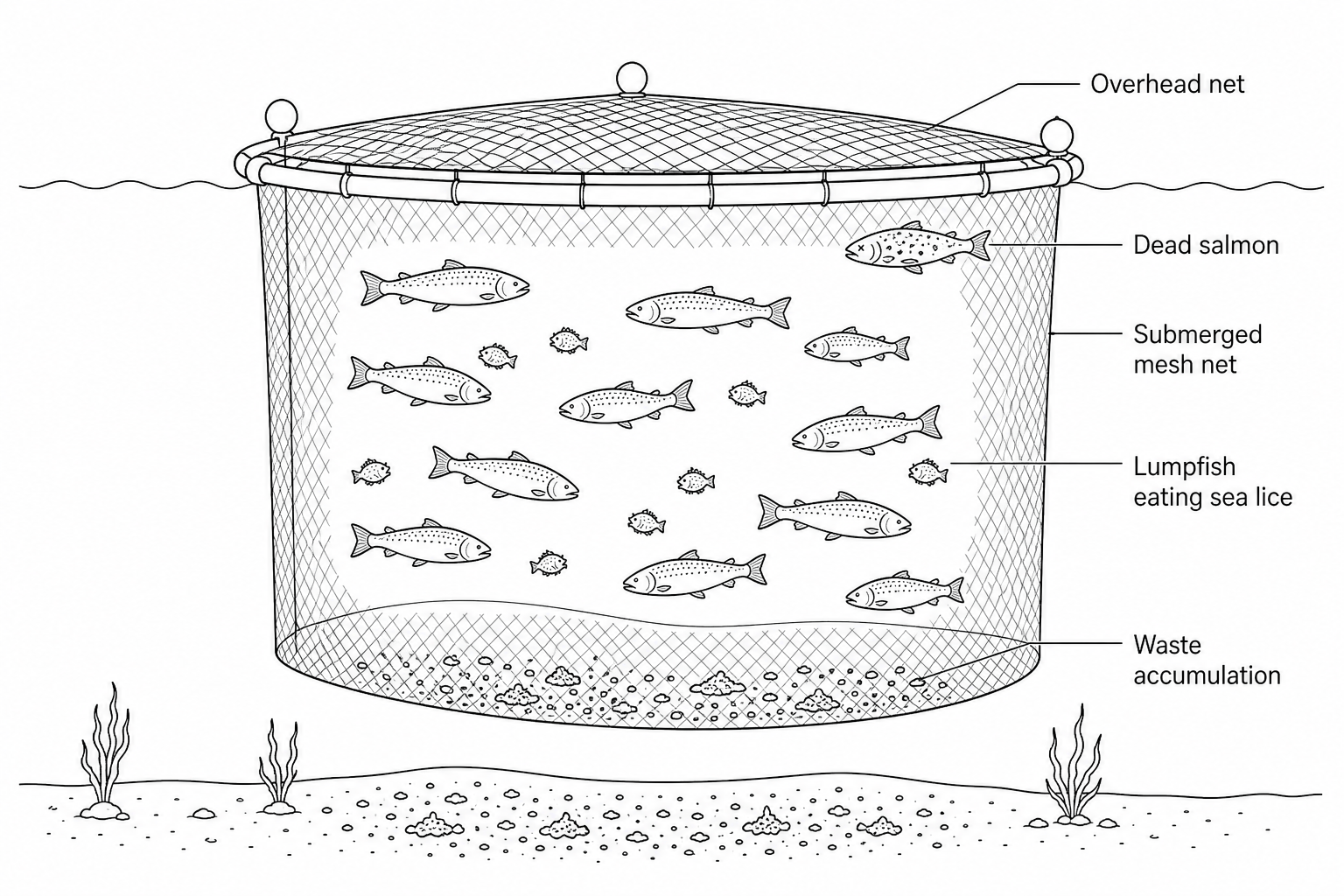
A diagram of a marine salmon farm. A floating net cage containing farmed Atlantic salmon is suspended in the sea. An overhead net covers the top of the cage to keep away predatory gulls. A submerged vertical mesh net forms the walls and floor of the cage, keeping out harbor seals and wild sea trout. Inside the cage, lumpfish are seen eating sea lice (parasitic copepods) off the salmon. On the seabed below, wastes such as uneaten food pellets and salmon faeces accumulate. A dead salmon infected with a bacterial disease is floating near the top corner of the cage.

a.

Suggest three distinct ways in which the net cage (both overhead and submerged nets) protects the farmed salmon.

[3]
b.

Accumulation of waste food and faeces on the seabed beneath the cage can lead to a reduction in the dissolved oxygen level in the water. Explain how this process occurs and how it could affect the growth of the salmon.

[3]
c.

Explain why it is important for the fish farmer to quickly remove any dead fish from the cage.

[2]
d.

State the biological control shown in the diagram and explain how it helps the salmon.

[2]

Food production Questions

  1. IGCSE
  2. /Biology
  3. /Food production
