Motion

EasyMedium
12345678910111213141516171819202122232425262728293031323334353637383940414243
Question 33
Easy

A student investigates motion graphs.

a.

Look at the distance-time graph for a runner training on a straight track.
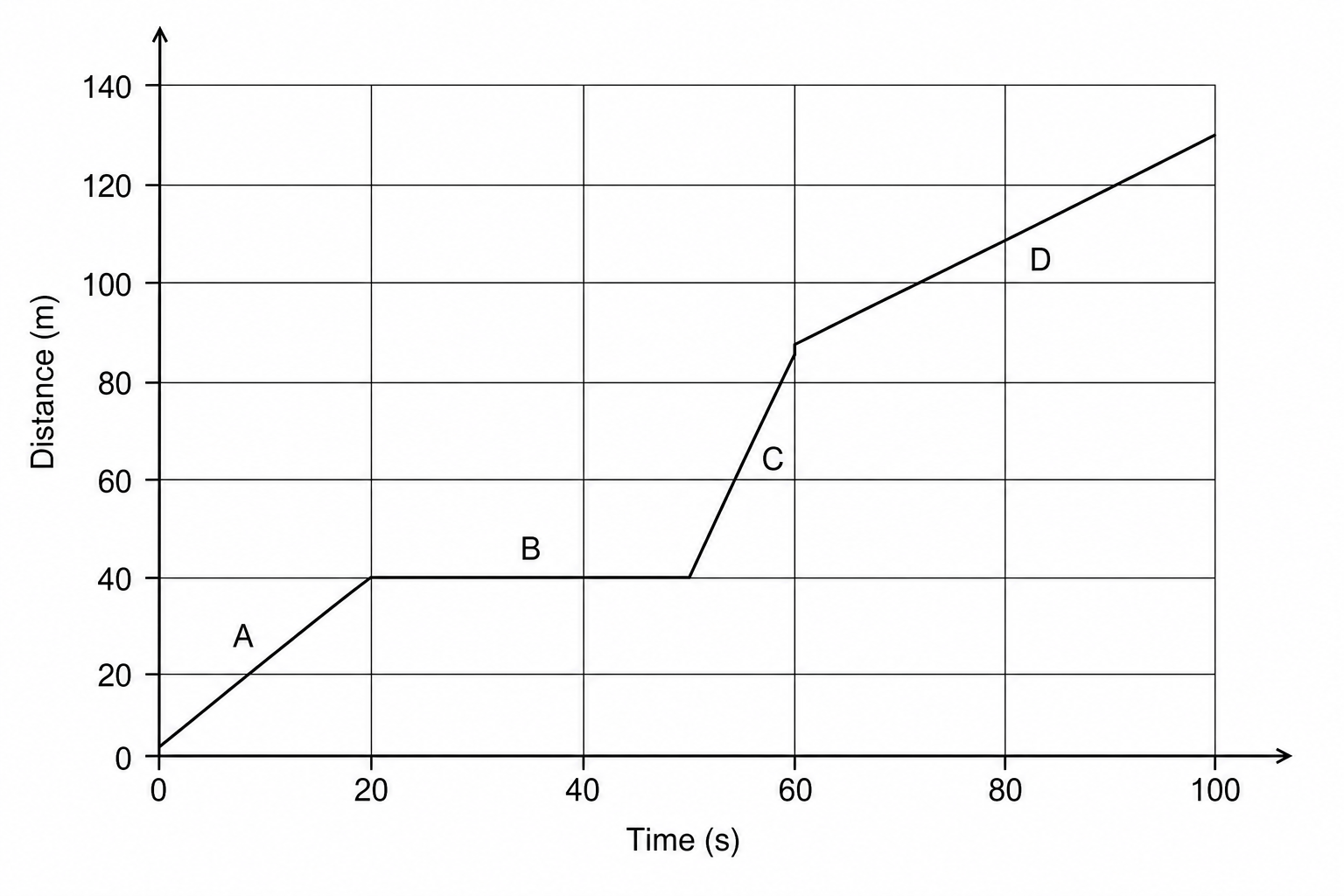
A distance-time graph showing a runner's movement over 100 seconds. The vertical axis is labeled 'Distance (m)' from 0 to 140, with major grid lines every 20 m. The horizontal axis is labeled 'Time (s)' from 0 to 100, with major grid lines every 10 s. The graph consists of four segments:
Section A: A straight line starting at (0, 0) and ending at (20 s, 40 m).
Section B: A horizontal straight line from (20 s, 40 m) to (50 s, 40 m).
Section C: A straight line from (50 s, 40 m) to (60 s, 90 m).
Section D: A straight line from (60 s, 90 m) to (100 s, 130 m).

How far did the runner travel?

Distance = ........................... m

[1]
b.

How long did the runner's training session last?

Time = ........................... s

[1]
c.

Name a piece of apparatus the student could use to accurately measure the distance the runner moved.

[1]
d.

The distance-time graph has four sections: A, B, C, and D.

Which section of the graph shows the greatest speed?

Select one (A, B, C, or D) and explain your answer.

[1]
e.

Which section of the graph shows zero speed?

Select one (A, B, C, or D) and explain your answer.

[1]
f.

The student draws a velocity-time graph for a toy car accelerating along a straight line.
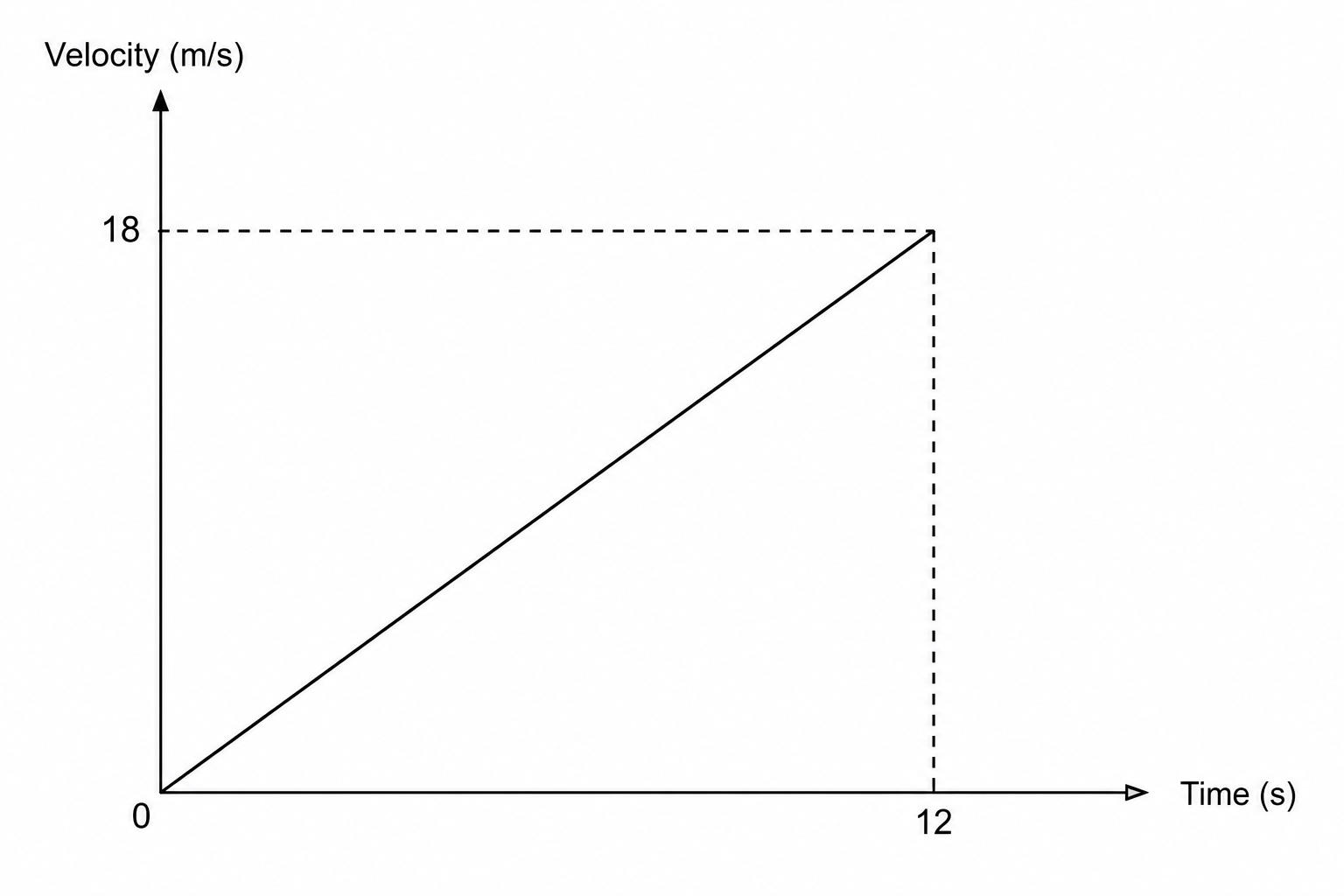
A velocity-time graph showing a straight line starting at (0, 0) and ending at (12 s, 18 m/s). The vertical axis is labeled 'Velocity (m/s)' with a key value of 18 at the peak, and the horizontal axis is labeled 'Time (s)' with a key value of 12 at the end of the line.

Acceleration is the gradient of a velocity-time graph.

Calculate the acceleration of the toy car.

Use the equation: acceleration=change in velocity÷time\text{acceleration} = \text{change in velocity} \div \text{time}acceleration=change in velocity÷time

Acceleration = ........................... m/s2\text{m/s}^2m/s2

[2]

Motion Questions

  1. GCSE
  2. /Physics
  3. /Motion