Question 29
HThe graph shows the percentage yield of ammonia at equilibrium in the Haber process at different temperatures and pressures.
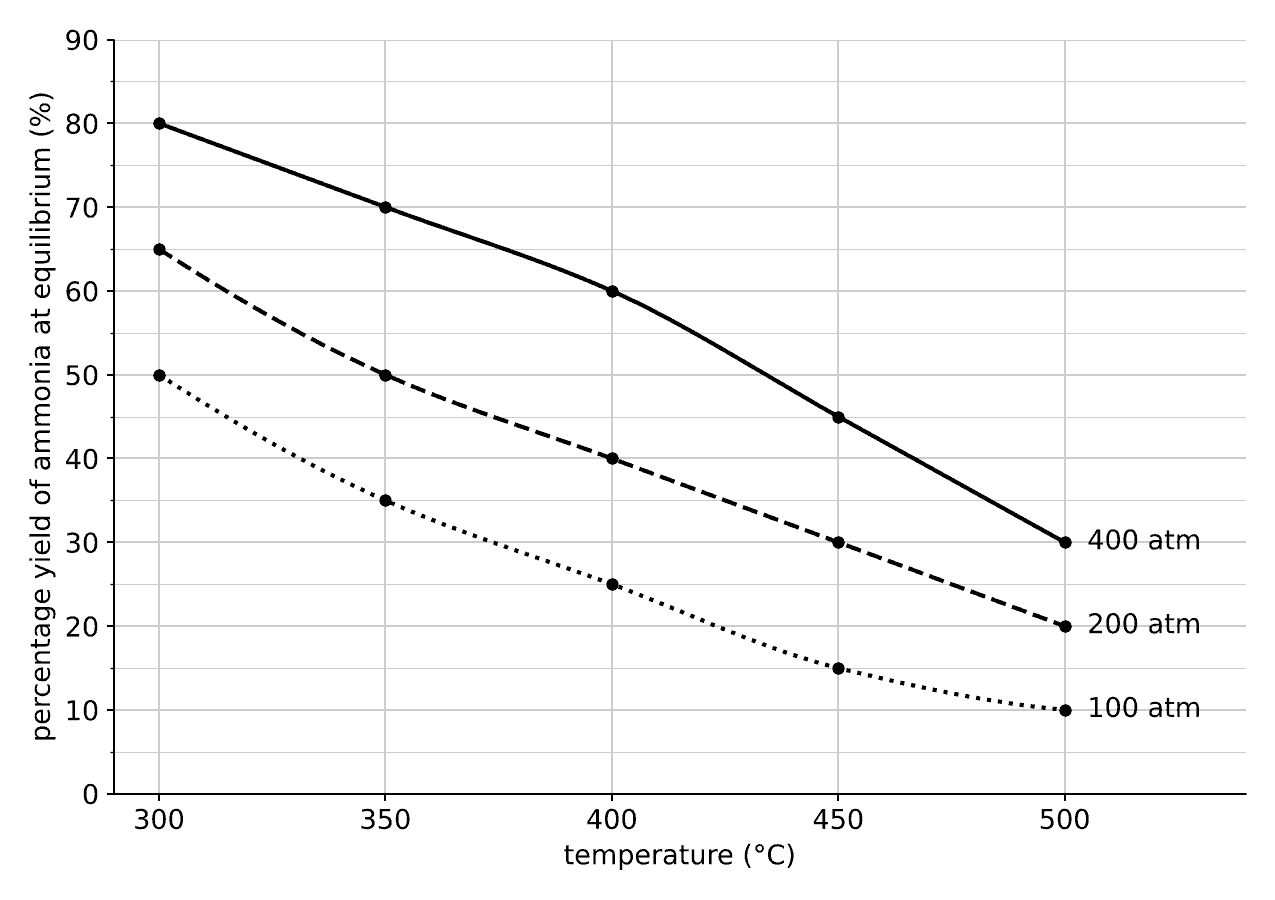
Which statement is supported by the graph?
At 450 ∘C450\,^\circ\mathrm{C}450∘C, increasing the pressure from 200 atm to 400 atm increases the yield by 15 percentage points.
At 200 atm, increasing the temperature from 300 ∘C300\,^\circ\mathrm{C}300∘C to 500 ∘C500\,^\circ\mathrm{C}500∘C halves the yield.
At 400 atm, the yield at 350 ∘C350\,^\circ\mathrm{C}350∘C is twice the yield at 500 ∘C500\,^\circ\mathrm{C}500∘C.
Increasing the pressure from 100 atm to 200 atm increases the yield by the same amount at every temperature.
6.1 Improving processes and products Questions
61 exam-style questions on OCR GCSE Chemistry 6.1 Improving processes and products, covering 6.1.1 Extracting metals industrially and by electrolysis, 6.1.2 Life cycle assessment and recycling, 6.1.3 Biological methods of metal extraction, 6.1.4 The Haber process and the production of fertilisers, 6.1.5 Alloys and their uses, 6.1.6 Corrosion and its prevention, 6.1.7 Comparing and selecting materials, and 6.1.8 Industrial conditions, rate and position of equilibrium. Each one has a worked solution and a mark scheme showing where the marks go.