Question 1
FAlloys are mixtures of a metal with one or more other elements.
The table shows some information about four alloys.
| Alloy | Main metal | Other element(s) in the alloy |
|---|---|---|
| brass | copper | zinc |
| bronze | copper | tin |
| stainless steel | iron | chromium and nickel |
| duralumin | aluminium | copper and magnesium |
a.[1]
Which alloy in the table does not contain copper?
b.[1]
Stainless steel is used to make cutlery and kitchen sinks.
Give one property of stainless steel that makes it suitable for these uses.
c.[2]
Pure aluminium has a low density, but it is too soft to make aircraft bodies. Duralumin is used instead.
The diagram shows the arrangement of atoms in pure aluminium and in duralumin.
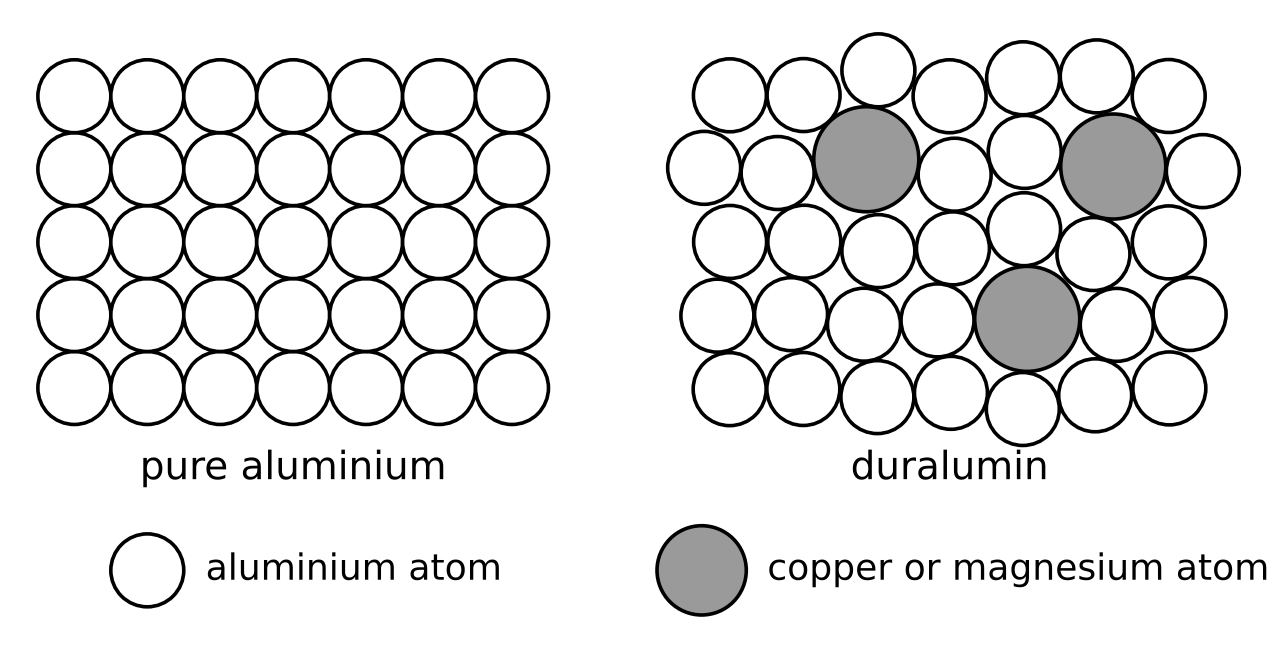
Explain why duralumin is harder than pure aluminium. Use the diagram.
d.[2]
A bronze bell has a mass of 250 g. The bronze contains 12% tin by mass.
Calculate the mass of tin in the bell.
Mass of tin = ...... g
e.[1]
Brass is used to make door handles. Pure copper is softer than brass.
Suggest one reason why door handles are made from brass and not from pure copper.
6.1 Improving processes and products Questions
61 exam-style questions on OCR GCSE Chemistry 6.1 Improving processes and products, covering 6.1.1 Extracting metals industrially and by electrolysis, 6.1.2 Life cycle assessment and recycling, 6.1.3 Biological methods of metal extraction, 6.1.4 The Haber process and the production of fertilisers, 6.1.5 Alloys and their uses, 6.1.6 Corrosion and its prevention, 6.1.7 Comparing and selecting materials, and 6.1.8 Industrial conditions, rate and position of equilibrium. Each one has a worked solution and a mark scheme showing where the marks go.