Question 23
FA student sets up four test tubes to investigate rusting. Each tube contains an identical iron nail.
Boiling water removes dissolved air from it.
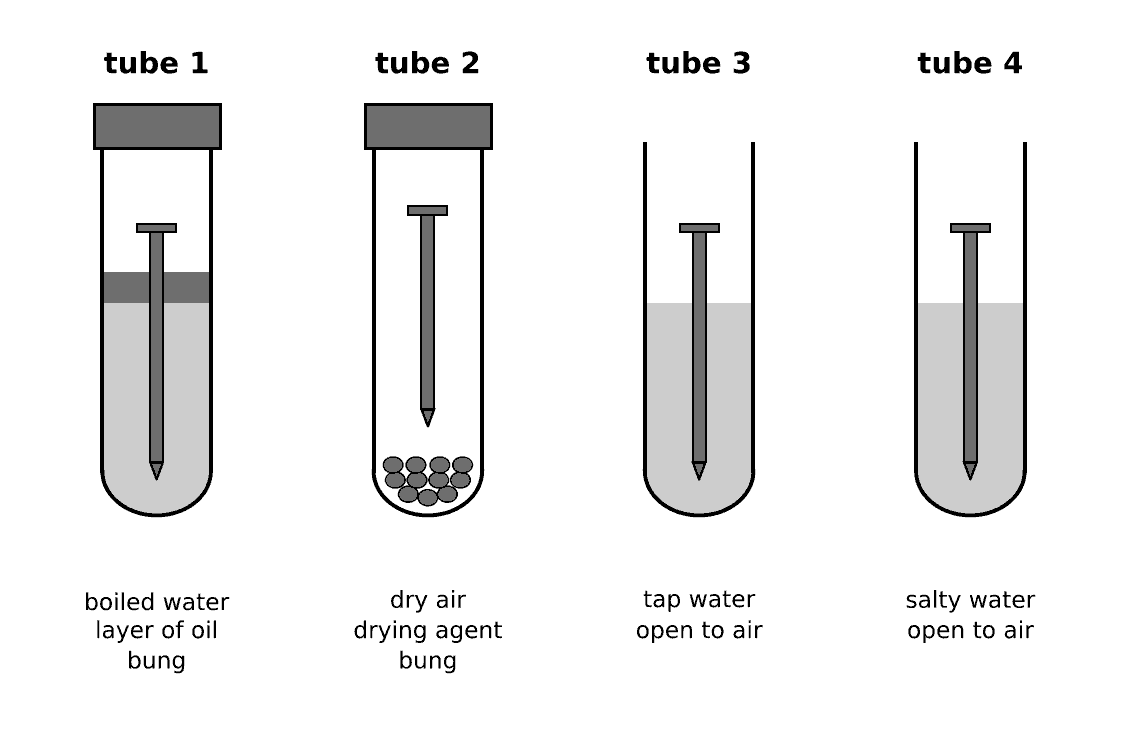
Which two tubes should the student compare to show that air (oxygen) is needed for iron to rust?
Tubes 1 and 2
Tubes 1 and 3
Tubes 2 and 3
Tubes 3 and 4
6.1 Improving processes and products Questions
61 exam-style questions on OCR GCSE Chemistry 6.1 Improving processes and products, covering 6.1.1 Extracting metals industrially and by electrolysis, 6.1.2 Life cycle assessment and recycling, 6.1.3 Biological methods of metal extraction, 6.1.4 The Haber process and the production of fertilisers, 6.1.5 Alloys and their uses, 6.1.6 Corrosion and its prevention, 6.1.7 Comparing and selecting materials, and 6.1.8 Industrial conditions, rate and position of equilibrium. Each one has a worked solution and a mark scheme showing where the marks go.