A student electrolyses a concentrated aqueous solution of sodium chloride (brine) using inert platinum electrodes. Hydrogen gas, H2(g)\text{H}_2(g)H2(g), is produced at the negative electrode (cathode) and chlorine gas, Cl2(g)\text{Cl}_2(g)Cl2(g), is produced at the positive electrode (anode).
Assuming both gases behave ideally and have negligible solubility in the aqueous electrolyte under the experimental conditions, which diagram correctly shows the state of the apparatus after 10 minutes of electrolysis?
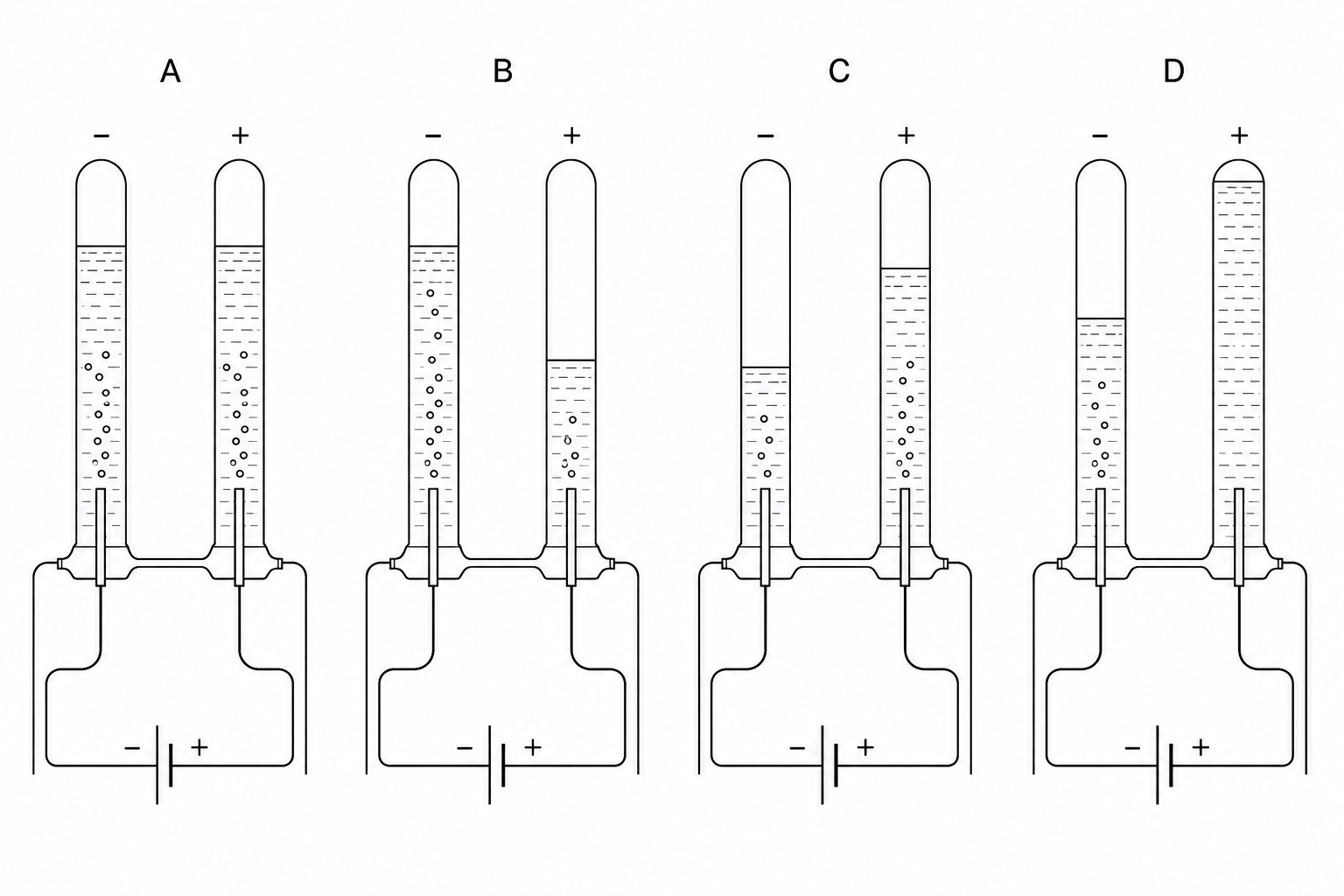
Diagram A
Diagram B
Diagram C
Diagram D
Electrolytic processes Questions
Practise Edexcel GCSE Chemistry Electrolytic processes with exam-style questions for Foundation and Higher tier. 100 questions, matched to the Edexcel GCSE Chemistry (1CH0) specification and written in Paper 1 and Paper 2 style. Every question includes a full worked solution and mark scheme, so you can see where marks are awarded rather than just whether you got the answer right.