Question 6
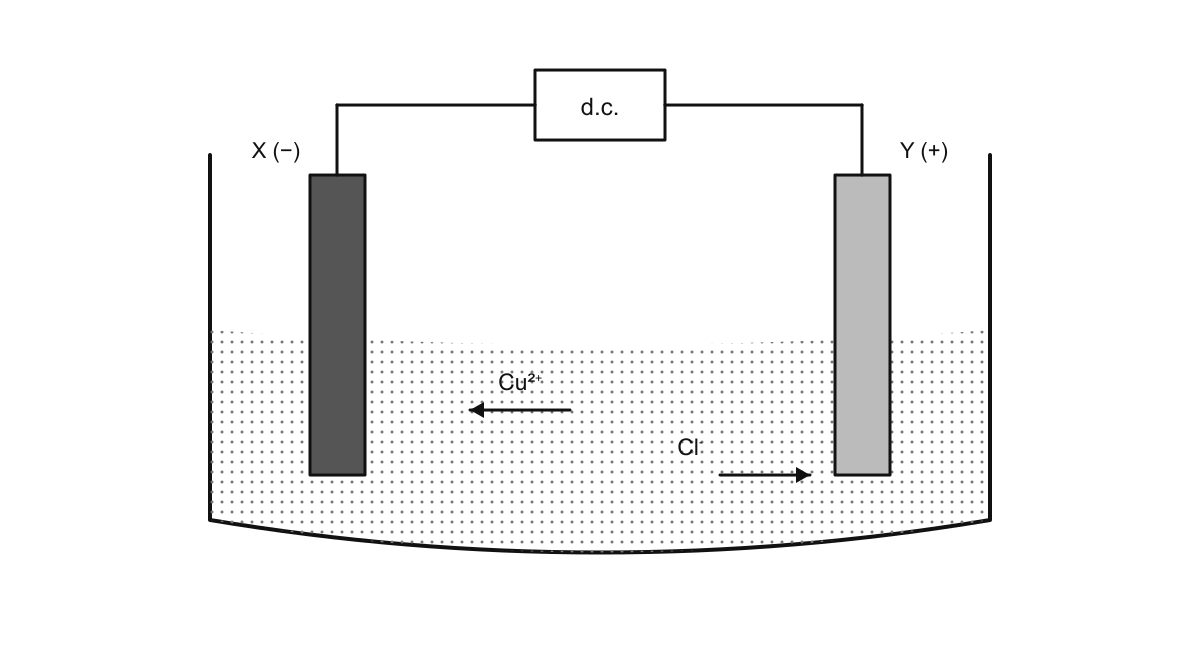
HConcentrated aqueous copper chloride is electrolysed using inert electrodes. The diagram shows electrodes X and Y and the movement of two types of ion. Under these conditions chlorine forms at the positive electrode.
a.[4]
Use the connections and ion movements to identify the product at each electrode. Write the balanced half-equation at each electrode.
b.[2]
Explain why the change at Y is oxidation, although oxygen is not involved.
c.[2]
The power supply is disconnected, but the electrodes remain immersed. Explain why the solution can still be described as an electrolyte even though electrolysis has stopped.
4.2 Electrolytic processes Questions
52 exam-style questions on Edexcel GCSE Chemistry 4.2 Electrolytic processes, covering 4.2.1 Electrolytes and the process of electrolysis, 4.2.2 Products of electrolysis using inert electrodes, 4.2.3 Half equations, oxidation and reduction in electrolysis, and 4.2.4 Electrolysis of copper sulfate and purifying copper. Each one has a worked solution and a mark scheme showing where the marks go.