An electronics recycling facility uses industrial electrorefining to recover high-purity copper from scrap copper wiring containing silver (AgAgAg), gold (AuAuAu), and zinc (ZnZnZn) impurities.
In this electrorefining cell:
- The anode (+) is a block of the impure scrap copper.
- The cathode (-) is a thin sheet of high-purity copper.
- The electrolyte is an acidified solution of copper(II) sulfate (CuSO4CuSO_4CuSO4).
The layout of the apparatus is shown below:
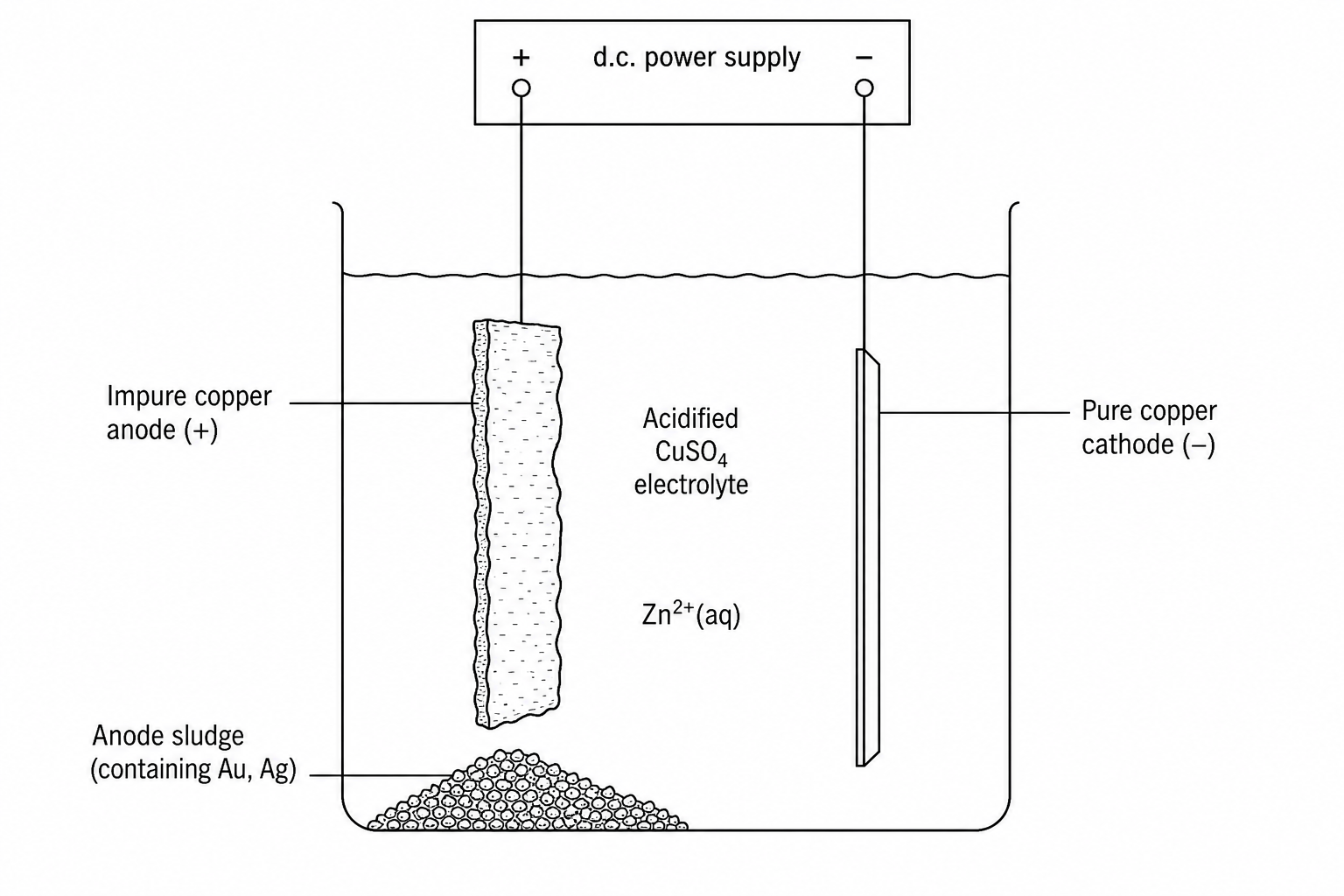
During the continuous operation of the cell, three key observations are recorded:
- The mass of the impure copper anode decreases, while the mass of the pure copper cathode increases.
- A solid anode sludge containing silver and gold accumulates at the base of the cell directly underneath the anode, but zinc is found dissolved in the electrolyte as Zn2+(aq)Zn^{2+}(aq)Zn2+(aq) ions.
- The concentration of copper(II) ions in the electrolyte remains constant.
Explain all three observations. Write relevant half-equations to support your explanations.
Electrolytic processes Questions
Practise Edexcel GCSE Chemistry Electrolytic processes with exam-style questions for Foundation and Higher tier. 100 questions, matched to the Edexcel GCSE Chemistry (1CH0) specification and written in Paper 1 and Paper 2 style. Every question includes a full worked solution and mark scheme, so you can see where marks are awarded rather than just whether you got the answer right.