Question 2
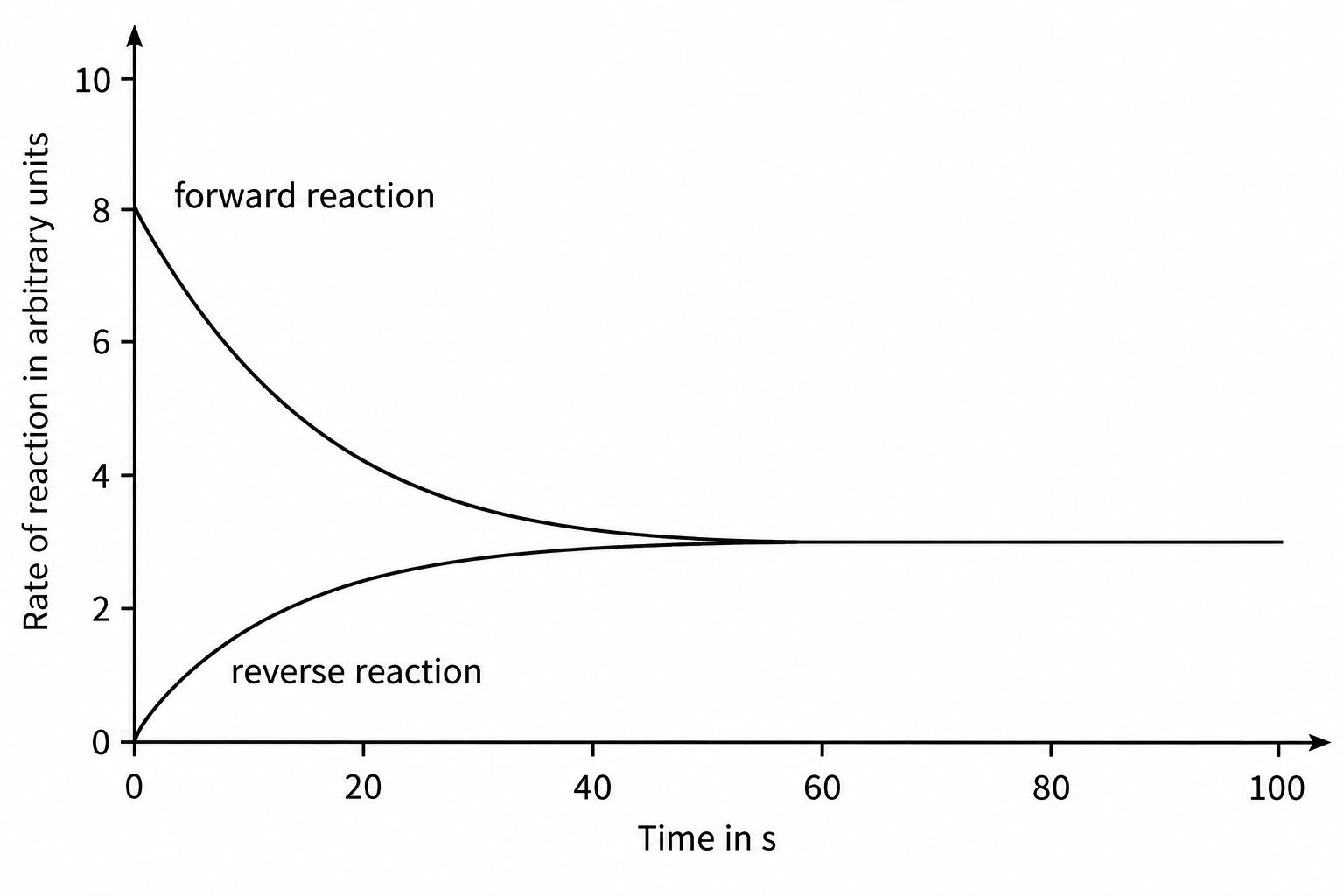
FA reversible reaction is carried out in a sealed flask. Figure shows how the rate of the forward reaction and the rate of the reverse reaction change with time.
Figure: The rate of the forward reaction and the rate of the reverse reaction plotted against time for a reversible reaction in a sealed flask
a.[1]
Use Figure to give the time at which equilibrium was first reached.
b.[2]
Explain why the rate of the forward reaction falls during the first 60 s.
c.[2]
Explain what Figure shows about the two reactions after 60 s.
6.2 Reversible reactions and dynamic equilibrium Questions
40 exam-style questions on AQA GCSE Chemistry 6.2 Reversible reactions and dynamic equilibrium, covering 6.2.1 Reversible reactions, 6.2.2 Energy changes and reversible reactions, 6.2.3 Equilibrium, 6.2.4 The effect of changing conditions on equilibrium, 6.2.5 The effect of changing concentration, 6.2.6 The effect of temperature changes on equilibrium, and 6.2.7 The effect of pressure changes on equilibrium. Each one has a worked solution and a mark scheme showing where the marks go.