Question 10
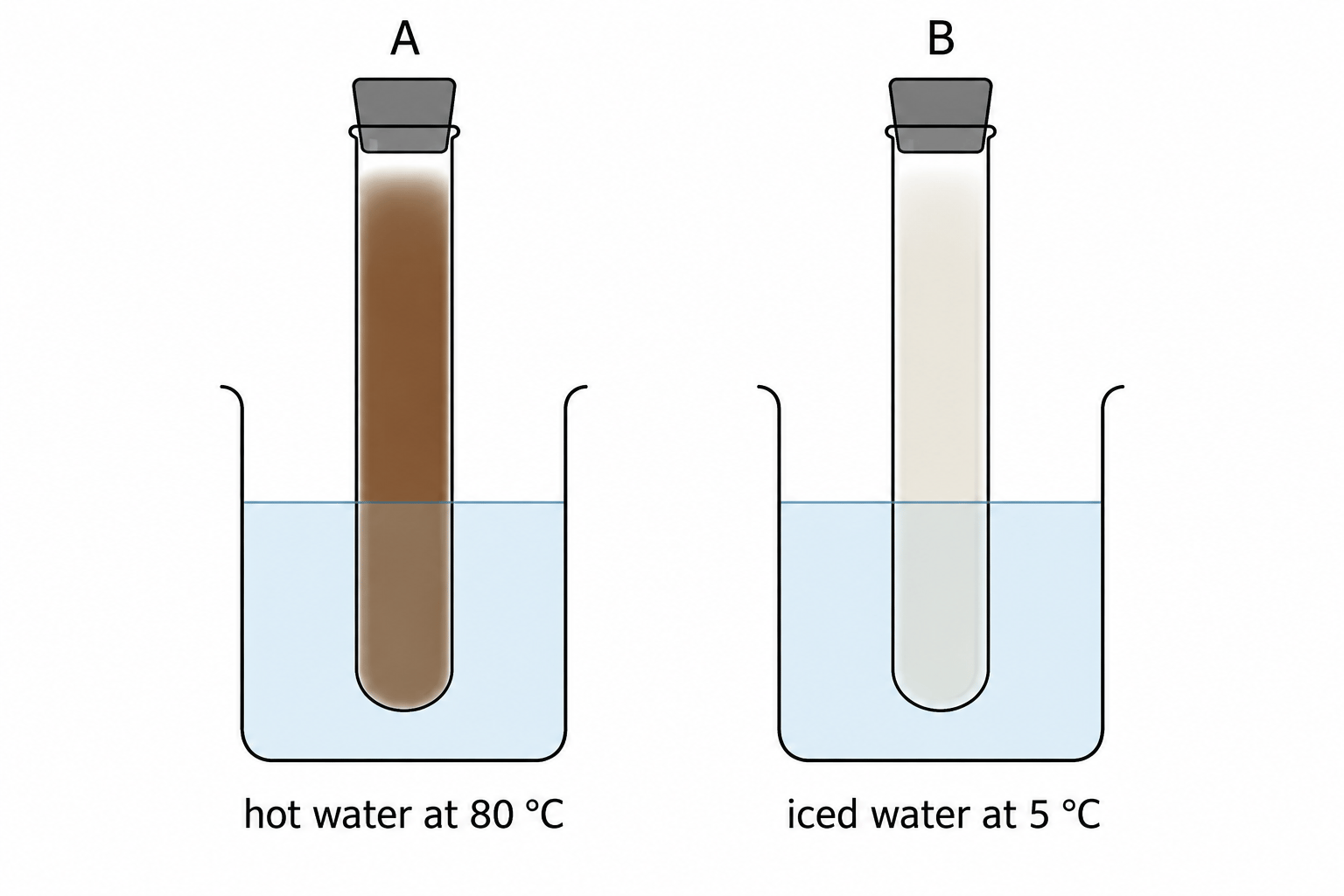
HDinitrogen tetroxide, N2O4\text{N}_2\text{O}_4N2O4, is colourless. Nitrogen dioxide, NO2\text{NO}_2NO2, is dark brown.
N2O4(g)⇌2NO2(g)\text{N}_2\text{O}_4(\text{g}) \rightleftharpoons 2\text{NO}_2(\text{g})N2O4(g)⇌2NO2(g)
Figure shows two identical sealed tubes containing the same equilibrium mixture. Tube A is in hot water and tube B is in iced water.
Figure: Two sealed tubes containing the same equilibrium mixture, one standing in hot water and one standing in iced water
a.[3]
Use Figure to deduce whether the forward reaction is exothermic or endothermic. Explain your answer.
b.[1]
Tube A is taken out of the hot water and left to cool to room temperature. Predict what happens to the colour of the mixture in tube A.
6.2 Reversible reactions and dynamic equilibrium Questions
40 exam-style questions on AQA GCSE Chemistry 6.2 Reversible reactions and dynamic equilibrium, covering 6.2.1 Reversible reactions, 6.2.2 Energy changes and reversible reactions, 6.2.3 Equilibrium, 6.2.4 The effect of changing conditions on equilibrium, 6.2.5 The effect of changing concentration, 6.2.6 The effect of temperature changes on equilibrium, and 6.2.7 The effect of pressure changes on equilibrium. Each one has a worked solution and a mark scheme showing where the marks go.