Question 23
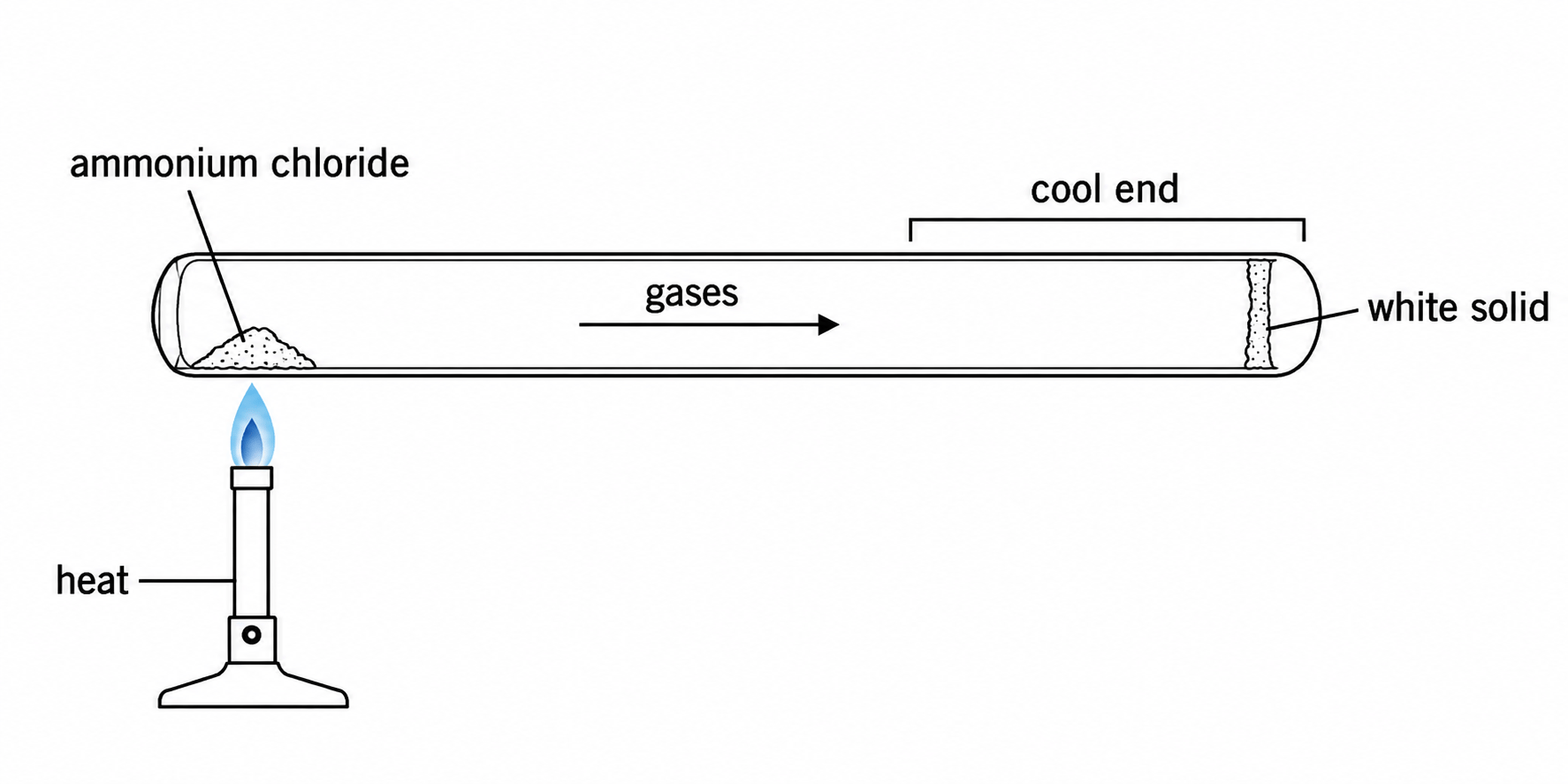
FFigure shows a glass tube containing solid ammonium chloride. The tube is sealed at both ends. The ammonium chloride is heated at one end of the tube. A white solid forms on the cool glass at the other end of the tube.
ammonium chloride ⇌ \rightleftharpoons\,⇌ ammonia + hydrogen chloride
Figure: A sealed glass tube containing ammonium chloride, heated at one end, with a white solid forming at the cool end
a.[2]
Explain why a white solid forms at the cool end of the tube.
b.[2]
The experiment is repeated using a tube that is open at the cool end. No white solid forms in the tube. Explain why.
c.[1]
Name the type of reaction shown by the equation.
6.2 Reversible reactions and dynamic equilibrium Questions
109 exam-style questions on AQA GCSE Chemistry 6.2 Reversible reactions and dynamic equilibrium, covering 6.2.1 Reversible reactions, 6.2.2 Energy changes and reversible reactions, 6.2.3 Equilibrium, 6.2.4 The effect of changing conditions on equilibrium, 6.2.5 The effect of changing concentration, 6.2.6 The effect of temperature changes on equilibrium, and 6.2.7 The effect of pressure changes on equilibrium. Each one has a worked solution and a mark scheme showing where the marks go.