Question 1
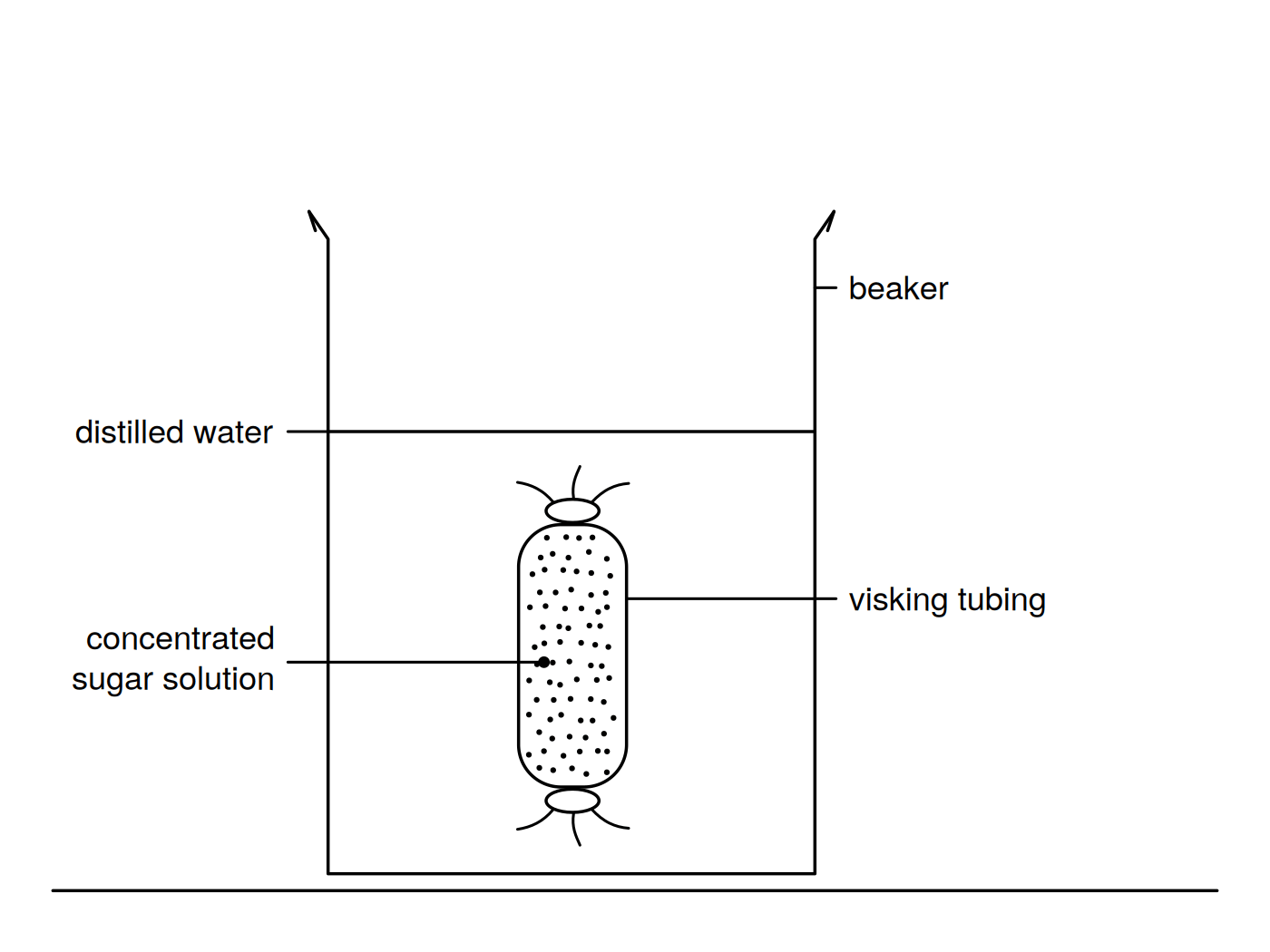
FFigure shows the apparatus a student used to investigate the movement of water. Visking tubing acts as a partially permeable membrane.
Figure: Apparatus used to investigate the movement of water into and out of visking tubing
a.[1]
Name the process by which water moves through the visking tubing.
b.[1]
Give the property of the visking tubing that allows this process to happen.
c.[2]
Predict the change in the mass of the visking tubing after one hour. Give a reason for your answer.
d.[2]
The student repeats the investigation with distilled water inside the visking tubing and concentrated sugar solution in the beaker.
Describe how the result would be different.
1.3 Transport in cells Questions
58 exam-style questions on AQA GCSE Biology 1.3 Transport in cells, covering 1.3.1 Diffusion, 1.3.2 Osmosis, and 1.3.3 Active transport. Each one has a worked solution and a mark scheme showing where the marks go.