Year 12 Study Habits for A-Level Maths That Work
Year 12 study habits for A-Level Maths: build a realistic weekly routine, practise actively, review mistakes and bridge GCSE gaps with greater confidence.
Starting Year 12 can create a strange kind of confidence. The first lessons look familiar, and the final A Level exams feel distant. Then homework takes longer, earlier algebra reappears inside harder questions, and one missed idea begins affecting several topics.
The most effective year 12 study habits for A-Level Maths are straightforward: review lessons promptly, answer questions without notes, revisit mistakes, maintain GCSE skills and follow a realistic weekly plan. You need a routine that prevents small gaps from becoming large ones.
Imagine a student who completes every homework task yet feels uncertain in tests. If most revision involves rereading examples, the missing ingredient may be independent practice. Recognising a method on the page feels reassuring; choosing and applying it yourself reveals what you understand.
The Year 12 habits checklist
A dependable routine includes:
- a short review after each lesson
- independent practice without solutions open
- weekly mixed-topic questions
- an error log that guides future practice
- targeted repair of GCSE weaknesses
- time for rest and other subjects
Lesson reviews catch confusion early. Mixed practice develops method selection. Revisiting errors gives the next session a clear purpose.
Build a weekly routine around lessons
A revision plan should explain what you will practise, when you will do it and what counts as finished. Replace “revise maths” with a specific task: complete differentiation questions without notes, mark them and correct errors.
After each lesson, briefly check unclear steps and attempt a question from memory. Add focused practice during the week and a mixed session at the weekend. Finish by choosing one weakness to revisit.
The workload depends on your timetable, understanding and school guidance. The revision timetable guide offers planning principles you can adapt to sixth form. Use the MathsGenie Revision Planner to organise specific tasks alongside homework and other subjects.
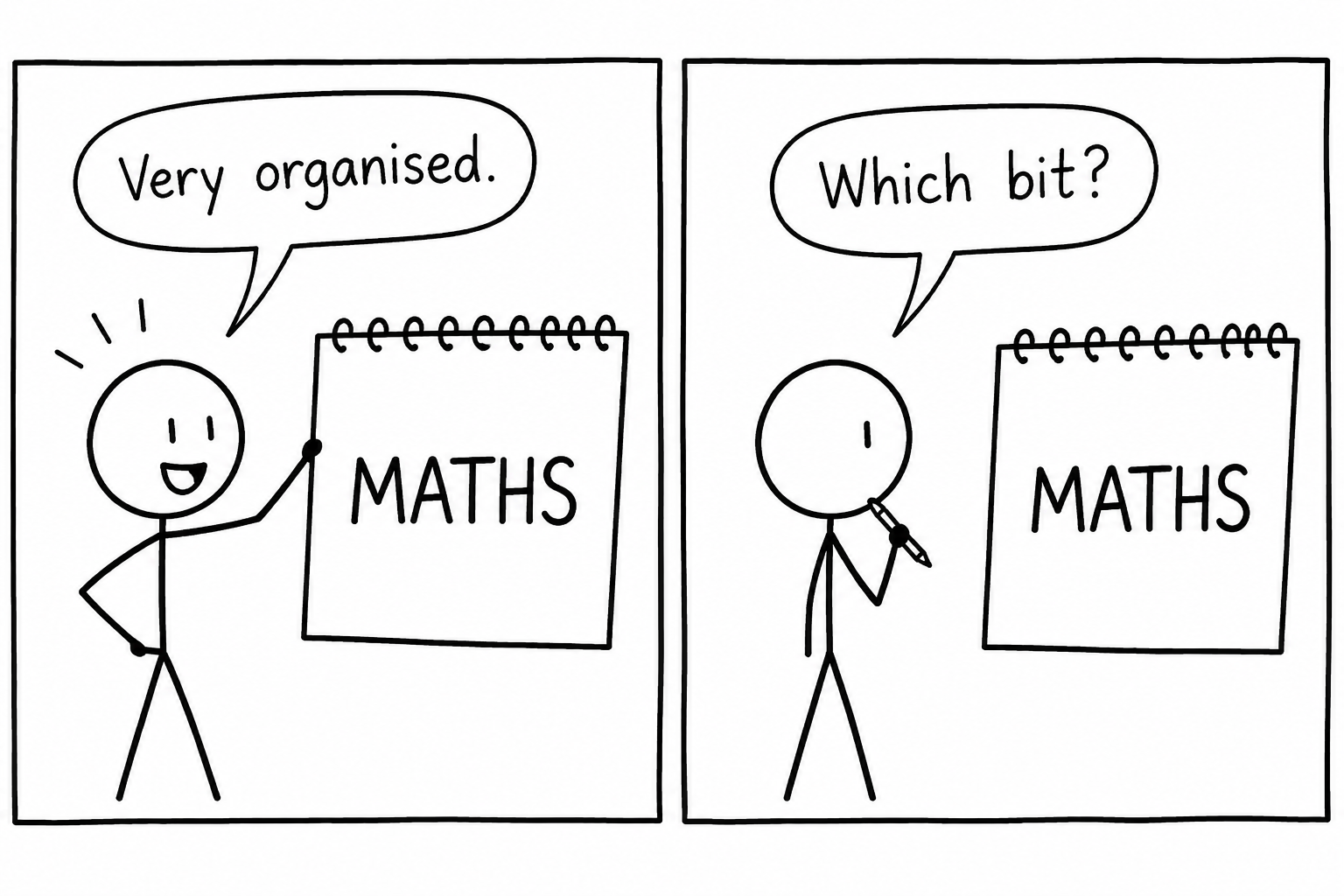 A student discovers that writing maths on every calendar square is not quite a revision plan
Replace rereading with active practice
Rereading can reconnect you with an unfamiliar topic. Follow it with a cycle that tests understanding.
Recall: close your notes and recall the method, definition or key result before checking it.
Practise: attempt questions independently. Start with routine questions, then include some where the method is less obvious. The A Level Maths revision hub helps you find resources aligned with your exam board.
Mark: check reasoning and notation as well as the final answer. Use mark schemes or video solutions after making a genuine attempt.
Correct: redo the question on a blank page. Copying a solution records the method but does not show that you can reproduce it.
Return: attempt it again several days later to check whether the learning lasted.
Edexcel students can use the Edexcel A Level Maths revision resources for topic practice and the Edexcel A Level Maths past papers when enough content has been covered.
Keep an error log that changes your practice
Writing “careless mistake” repeatedly explains little. Identify the cause:
- Knowledge: you did not know a fact or method.
- Recognition: you knew the method but missed when to use it.
- Execution: algebra, arithmetic or calculator work broke down.
- Communication: notation or reasoning was incomplete.
- Checking: an inconsistent answer went unchallenged.
Record the topic, cause and next action. A knowledge gap may need a revision lesson; a recognition gap needs mixed questions. Repeated algebra errors call for focused skills practice.
Give each correction a review date. The log becomes useful when it changes what you do next.
Repair GCSE gaps without restarting GCSE
A Level Maths builds on algebra, graphs, trigonometry, fractions, indices and equation solving. An unreliable foundation can make new content feel harder than it is.
Diagnose the precise obstacle. If rearranging formulae slows down mechanics, practise that skill, then return to mechanics. Avoid restarting an entire course when a focused repair will help.
The GCSE Maths revision hub provides foundation and higher tier material. For basic manipulation, use the simplifying algebra lesson and questions, then apply the skill within your current A Level work.
Use mixed practice before tests expose gaps
Topic worksheets tell you which technique to use. Tests require you to make that decision yourself.
Keep focused practice while learning a method, then mix current questions with older topics. Before calculating, identify the information given and possible approaches.
Mini tests make this manageable before full papers are appropriate. Later, past papers and predicted papers can support timing and exam judgement. Check that questions match covered content, and use mark schemes to review your reasoning.
How parents can support the routine
Parents can help without teaching A Level Maths. Ask what topic the student is practising, which mistake they are addressing and when they will revisit it.
Keep the timetable realistic during busy weeks. The guide to balancing daily revision hours offers adaptable advice about focus, breaks and competing subjects. Judge sessions by completed practice and corrections, rather than time at a desk alone.
Common mistakes with Year 12 maths revision
Waiting for mocks: revisit older content weekly so gaps do not accumulate.
Making notes instead of practising: follow note review with independent questions.
Opening solutions too quickly: try another approach and write down where you became stuck before checking.
Counting hours alone: record questions attempted, errors corrected and topics revisited.
Ignoring repeated GCSE errors: address the underlying skill directly.
Following an inflexible timetable: move missed tasks and adjust priorities rather than abandoning the plan.
Build the habit before the pressure arrives
Choose one current topic, one practice task and one review date. That is enough to begin a useful routine.
Use MathsGenie's free revision lessons, practice questions and video solutions to address the weaknesses your work reveals. Put your next sessions into the MathsGenie Revision Planner, then return to those topics before they fade.