Wrong Tier GCSE Biblical Hebrew: What Happens?
Wrong tier GCSE Biblical Hebrew? It is untiered. Learn what to check, how entries can be corrected before the exam, and what to do if a paper is wrong.
A GCSE entry can look like a small administrative detail until one word makes everything feel uncertain. Foundation. Higher. The wrong subject code. The wrong paper. If you are worried about a wrong tier GCSE Biblical Hebrew entry, the most important fact is reassuring: the current Pearson Edexcel GCSE Biblical Hebrew qualification is untiered. There is no Foundation or Higher tier to choose between.
That means you cannot be entered for the wrong tier in GCSE Biblical Hebrew. However, you could still be entered for the wrong qualification, exam board or component. Those problems should be raised with your school's exams officer immediately and can often be corrected before the examination.
The short answer
Use this checklist before doing anything else:
- GCSE Biblical Hebrew is currently offered by Pearson Edexcel under specification code 1BH0.
- It is an untiered GCSE with access to the full grade range from 999 to 111.
- It has two externally examined components: Paper 1: Language and Paper 2: Literature.
- A reference to Foundation or Higher may relate to another subject, particularly GCSE Maths or a modern foreign language.
- If any entry information looks wrong, show it to your teacher and exams officer as soon as possible.
- If you receive an unexpected paper during the examination, do not try to solve the problem silently. Raise your hand and tell the invigilator immediately.
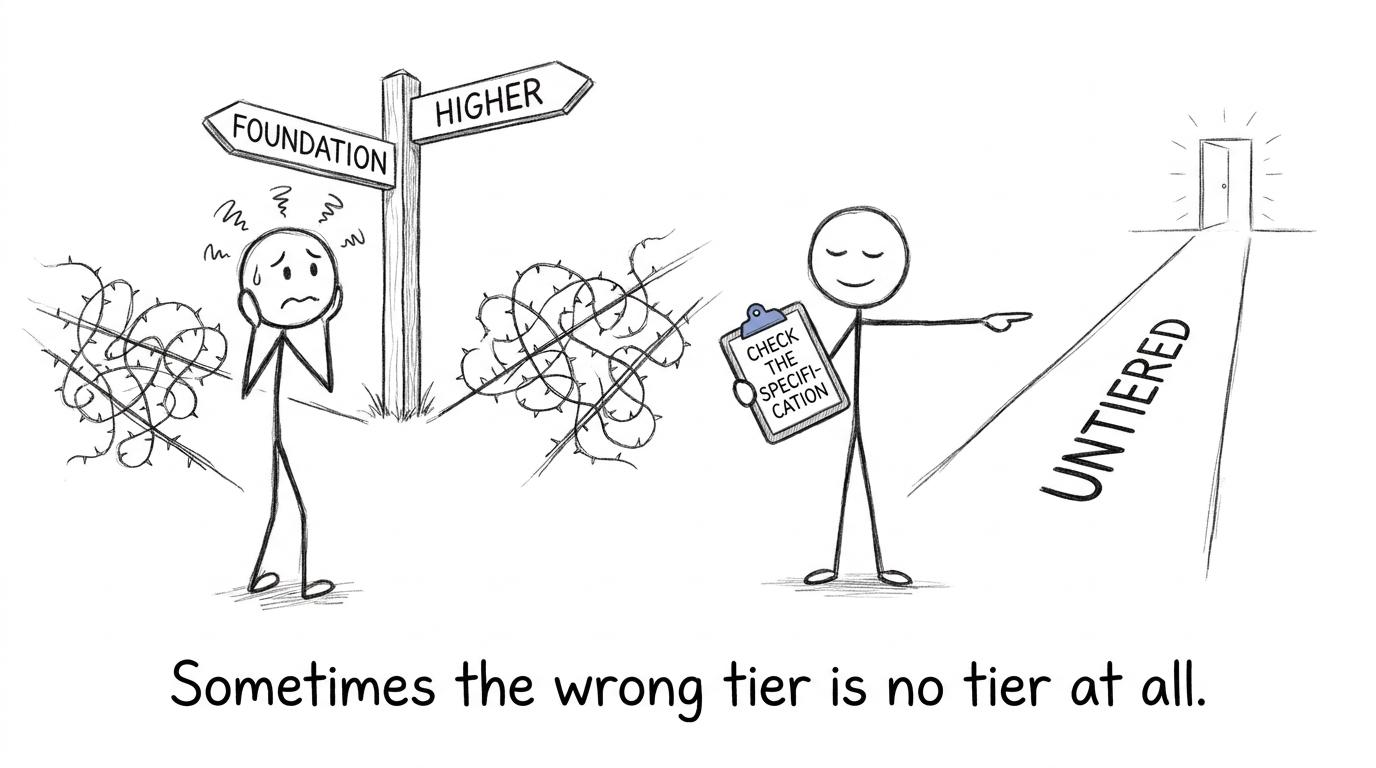 A student discovers that GCSE Biblical Hebrew is untiered
Does GCSE Biblical Hebrew have Foundation and Higher tiers?
No. Pearson's current GCSE Biblical Hebrew specification is untiered. Every candidate follows the same qualification structure and can receive any available GCSE grade from 999 down to 111, depending on the overall standard demonstrated.
This is different from GCSE Maths. The main UK maths specifications offered by Edexcel, AQA, OCR and Eduqas have Foundation and Higher papers. Foundation normally provides access to grades 111 to 555, while Higher provides access to grades 444 to 999, with a limited grade 333 safety net for candidates who narrowly miss grade 444.
Biblical Hebrew belongs to the ancient languages subject framework rather than the modern foreign languages framework. The distinction matters because modern foreign language GCSEs use tiered assessments, while Biblical Hebrew does not.
Confusion can arise when a student's statement of entry contains several subjects. A Foundation or Higher label beside Maths, science or a modern foreign language may be mistaken for part of the Biblical Hebrew entry. Read each row separately and check which subject the tier label belongs to.
For your maths entry, the GCSE Maths topics by exam board and tier guide explains the genuine differences between Foundation and Higher content.
What might “wrong tier” actually mean?
If someone has told you that your Biblical Hebrew tier is wrong, there is probably a different administrative issue hiding behind that description.
The wrong subject may have been entered
Biblical Hebrew and Modern Hebrew are separate GCSE qualifications. They assess different knowledge and use different specifications. Biblical Hebrew focuses on the language of biblical texts and prescribed literature; Modern Hebrew assesses contemporary language skills.
An entry for Modern Hebrew instead of Biblical Hebrew is not a tier error. It is a wrong qualification entry, which is more significant and needs urgent attention from the exams officer.
The wrong exam board or specification code may appear
The current Pearson Edexcel GCSE Biblical Hebrew specification code is 1BH0. If your entry document displays another code, do not assume that it is close enough. Ask your exams officer to confirm the subject title, awarding organisation and specification.
Codes are less memorable than subject names, but they are often more useful. They tell the exams office precisely which qualification and papers have been ordered.
One of the required papers may be missing
The qualification is linear and consists of two externally examined components:
- Paper 1: Language
- Paper 2: Literature
Both contribute to the final qualification. A student should therefore check that the examination timetable includes both components, on the correct dates and under the correct specification.
The tier label may belong to GCSE Maths
For a student taking several GCSEs, this is often the simplest explanation. Your Biblical Hebrew entry may be correct while your Maths entry is Foundation or Higher.
Unlike Biblical Hebrew, the maths tier affects the papers you sit and the grades available. If that is the real concern, read whether you can move from Foundation to Higher GCSE Maths and discuss the evidence from mocks and practice papers with your maths teacher.
Can an incorrect entry be fixed before the exam?
Usually, yes, provided the centre identifies the problem and follows the awarding body's entry procedures.
Students do not normally amend official GCSE entries themselves. Your school's exams officer submits and changes entries through the awarding body's system. Pearson publishes entry, late-entry and amendment deadlines for each examination series. Charges may apply after particular dates, but a deadline passing does not mean you should stay quiet or assume that nothing can be done.
The right response is simple:
- Find your statement of entry or candidate timetable.
- Highlight the entry you believe is incorrect.
- Write down what you expected to see.
- Show both to your subject teacher and exams officer.
- Ask for written confirmation once the entry has been checked.
Do this promptly. Administrative problems tend not to improve through waiting, and schools need time to check teaching records, entry codes and paper requirements.
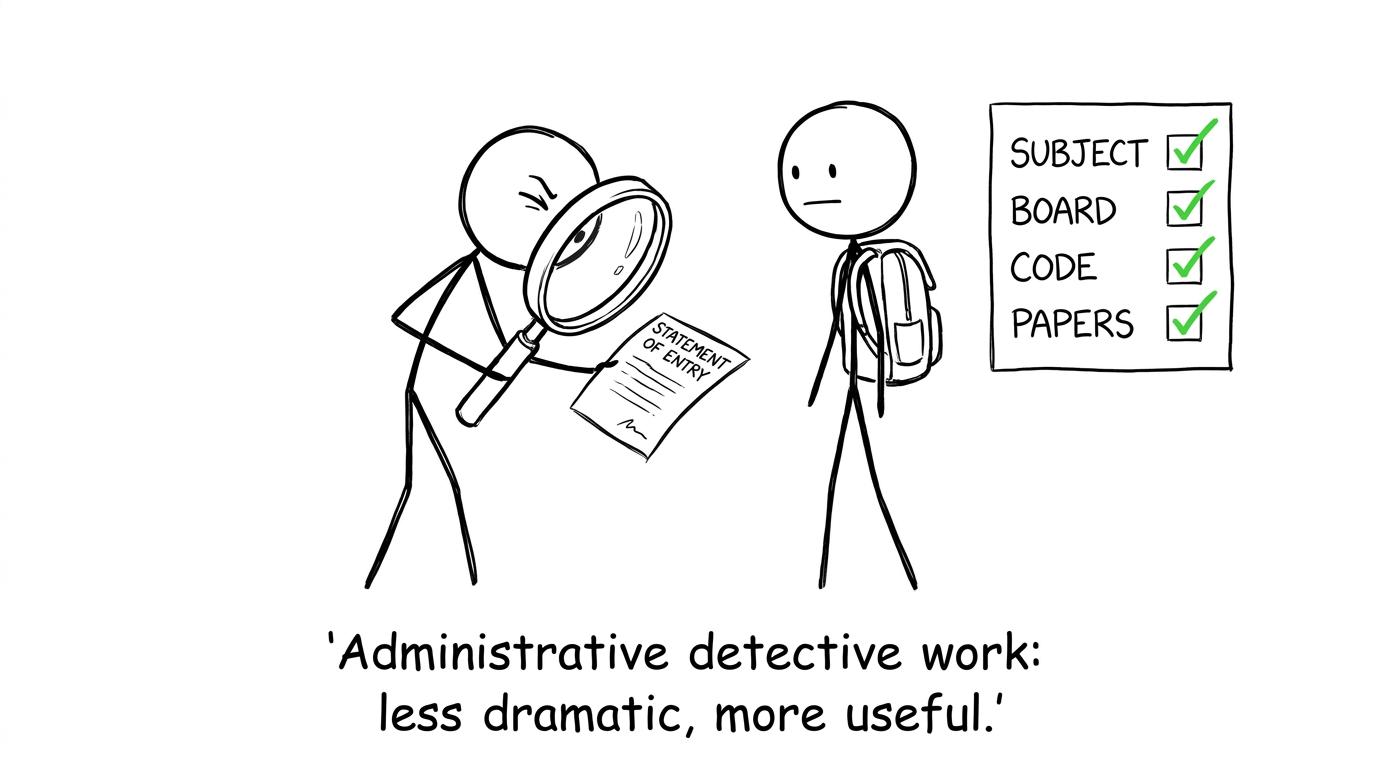 An exams officer investigates a statement of entry
What should you check on your statement of entry?
A statement of entry is not just another letter to place in a bag. Treat it as a final opportunity to catch mismatches while there is still time to act.
Check the following details:
- your legal name is shown correctly;
- your candidate number and centre details are correct;
- the subject says Biblical Hebrew, not Modern Hebrew;
- the awarding organisation is the one your school has taught;
- the specification code is 1BH0 for the current Pearson Edexcel GCSE;
- both Language and Literature papers appear on your timetable;
- the dates and session times match the centre's official timetable;
- any approved access arrangements have been communicated accurately.
Do not be concerned merely because there is no Foundation or Higher designation. For Biblical Hebrew, the absence of a tier is correct.
Apply the same habit to Maths. Confirm your board and tier before choosing revision material from the GCSE Maths revision hub. Practising a Higher paper when you are entered for Foundation, or the reverse, can make your revision less representative of the examination you will sit.
What happens if the problem is discovered on exam day?
Start by checking the front of the question paper before answering anything. Look at the subject, paper title and paper reference.
If you believe you have been given the wrong paper, raise your hand immediately. JCQ instructions tell candidates to notify an invigilator at once if they think they have not received the correct question paper or all the required materials.
Do not continue simply because everyone else has started. The invigilator and exams officer can check the secure examination records and contact the awarding body where necessary.
If an incorrect paper has already been attempted, the centre must report and manage the incident under the relevant examination procedures. It may be able to submit an application for special consideration, but special consideration is not automatic and cannot guarantee a particular mark or grade. The awarding body decides what response is possible from the evidence and circumstances.
The earlier you speak, the more options the centre is likely to have.
Keep the entry problem separate from your revision
An entry concern has a strange ability to consume every revision session. It creates the feeling that nothing else matters until the paperwork is settled.
A calmer approach is to divide the problem into two tracks:
- Administration: send the query to your exams officer and keep the reply.
- Preparation: continue revising for the qualification you have been taught unless your school tells you otherwise.
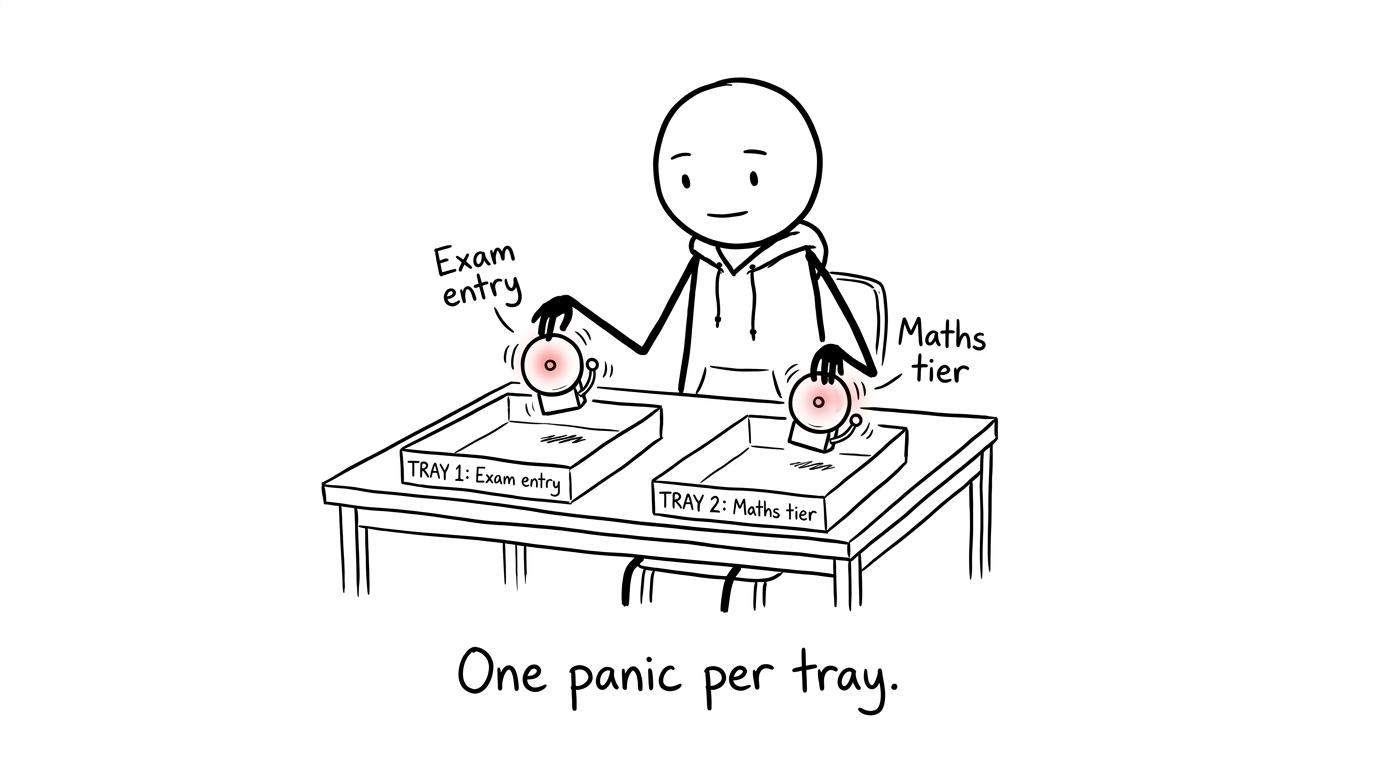 A student separates exam-entry worries from revision
This distinction is especially useful during GCSE Maths revision. Once you have confirmed your maths board and tier, choose matching resources. The Edexcel GCSE Maths revision hub brings together topic lessons and exam-style questions, while Edexcel GCSE Maths past papers let you practise the correct paper format under timed conditions.
Shorter practice also has value when another exam issue is distracting you. A focused GCSE Maths mini test gives you a manageable task, clear feedback and evidence of the topics that need attention.
Common mistakes when dealing with an entry concern
Assuming every GCSE has two tiers
Only certain GCSE subjects are tiered. Biblical Hebrew is not one of them. Check the relevant specification rather than transferring the rules from Maths or science.
Confusing Biblical Hebrew with Modern Hebrew
The names are similar, but the qualifications and assessments are not interchangeable. Always check the full subject title and specification code.
Waiting until the examination morning
Students sometimes avoid asking because they fear creating trouble. In reality, an early question is much easier for an exams office to investigate than an unexpected paper on the day.
Relying on a friend's timetable
Candidates may have different subjects, tiers, access arrangements or examination rooms. Your own statement of entry and centre-issued timetable are the documents that matter.
Treating a late deadline as a complete barrier
Entry deadlines determine administrative procedures and possible fees. They do not remove the need to report an error. Your centre should contact Pearson and establish the available options.
Letting the concern derail Maths revision
Once you have reported the issue, return to what you can control. The efficient GCSE Maths revision guide shows how to use lessons, practice questions, mark schemes and an error log without allowing uncertainty to take over your schedule.
The useful next step
The phrase “wrong tier” sounds serious because, in GCSE Maths, tier choice genuinely changes the paper and grade range. But for GCSE Biblical Hebrew, the underlying answer is simpler: the Pearson Edexcel qualification is untiered, so there is no Foundation or Higher entry to get wrong.
What still matters is checking that you have been entered for Biblical Hebrew under the correct specification and that both required papers appear. If anything does not match, contact your teacher and exams officer now. If the wrong paper appears in the examination room, tell the invigilator immediately.
Then return your attention to preparation. Use MathsGenie's free revision lessons and practice questions to strengthen individual skills, mini tests to check recall, and past papers with mark schemes and video solutions to build exam confidence. Add predicted papers and the revision planner as the exams approach. Paperwork deserves a prompt response, but once it is in the right hands, your daily revision is where progress continues.