

Will OCR GCSE Maths Change? A Guide for Parents
Will OCR GCSE Maths change? Understand planned GCSE reform, the official timetable and what parents should do about current courses and revision materials.
Yes, OCR GCSE Maths is expected to change as part of England’s planned GCSE reform, but that does not mean your child’s current course is being replaced immediately. If you are asking “will OCR GCSE Maths change?”, the useful distinction is between future qualifications and the specification your child is preparing for now.
Policy update: September 2026. This article reflects the Department for Education’s response to the Curriculum and Assessment Review and Ofqual’s published assessment decisions. Review annually, and whenever new subject content or an OCR implementation timetable is published.
Imagine opening a headline about a “new GCSE maths” just after buying a revision guide. The immediate worry is practical: have we bought the wrong book? Is school teaching the wrong material? Should revision wait?
The answer is to keep following your child’s confirmed specification. The government has announced a phased reform programme, with updated GCSEs intended for first teaching from 2029 onwards. That is different from announcing that every existing OCR candidate must change course.
What parents need to know
The straight answer rests on four distinctions:
- National curriculum changes and GCSE changes have different timetables. The government plans the refreshed national curriculum for first teaching from September 2028, with updated GCSEs following from 2029 onwards.
- First teaching is different from first examination. A course starting in a particular year does not normally have its final GCSE examinations that same year.
- A reform programme is not a finished specification. Detailed OCR arrangements need their own confirmation.
- Some assessment changes already affect current qualifications. Formulae-sheet arrangements are separate from the future replacement of GCSE specifications.
These distinctions matter more than the headline. They tell you which announcements require action and which simply need monitoring.
Will OCR GCSE Maths change for my child?
The most useful starting point is your child’s examination year, rather than their age or the date of a news article.
The Department for Education’s Government response to the Curriculum and Assessment Review, published in November 2025, sets out plans to update GCSEs in national curriculum subjects. Its stated aim is for some to be ready for first teaching in 2029 and the remainder in 2030.
That establishes the direction of travel. It does not, by itself, identify the replacement OCR Maths specification your child will take or settle every transition arrangement.
For a pupil already preparing for an existing qualification, the practical advice is therefore straightforward: continue using the specification confirmed by school. Do not replace revision materials simply because an article mentions GCSE reform.
For a younger pupil, keep the future timetable under review. Ask school which qualification it expects the pupil to follow when GCSE teaching begins, then check again once the relevant specifications are confirmed.
MathsGenie’s OCR GCSE Maths resources provide a board-specific starting point, but your child’s teacher should confirm the course and tier they are working towards.
What has actually been announced?
Three official sources answer different parts of the question.
The Curriculum and Assessment Review recommends changes
The Review’s final report, Building a world-class curriculum for all, sets out recommendations for England’s curriculum and assessment system.
A recommendation tells us what the Review believes should happen. It does not automatically change an examination paper. Parents should be cautious when a headline turns “the Review recommends” into “your child will now sit”.
The Department for Education sets the policy direction
The government’s November 2025 response commits to refreshing the national curriculum and updating GCSEs through a phased programme.
For maths, the wider reform discussion includes strengthening foundations and improving how learning builds across the curriculum. The government’s subsequent Every child achieving and thriving publication also describes resequencing the maths curriculum to deepen understanding.
These are reasons to expect future change. They are not a complete topic checklist for a replacement OCR qualification, nor a reliable basis for declaring particular topics removed.
Ofqual determines qualification and assessment requirements
Ofqual’s decisions explain what awarding organisations must do within the regulatory framework.
This matters because an assessment adjustment can apply to an existing qualification without creating an entirely new GCSE. Formulae sheets are a clear example.
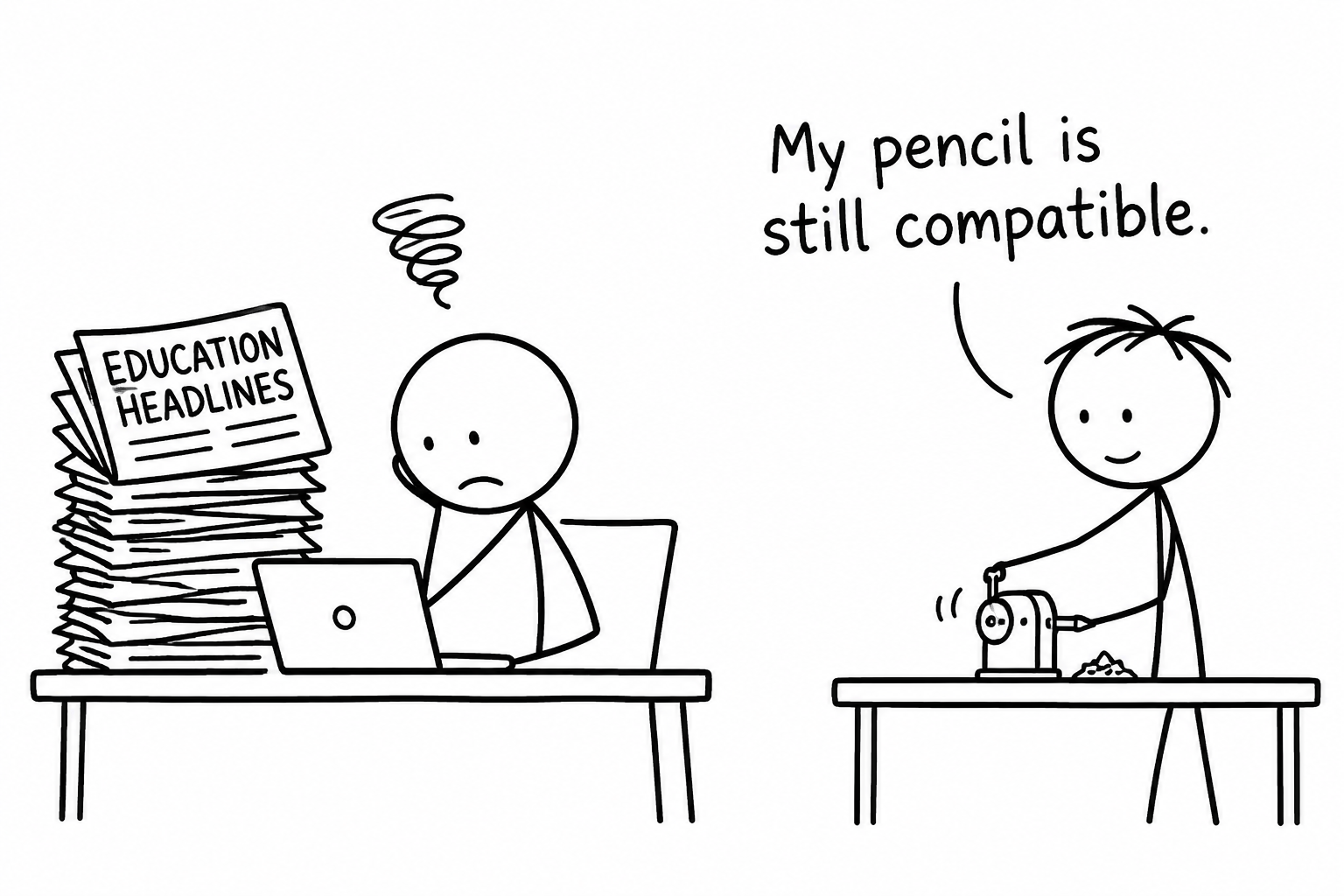 A parent faces a pile of education headlines while a teenager calmly remarks that their pencil is still compatible.
Are formulae sheets changing?
Ofqual’s decision published on 5 May 2026 confirms that formulae sheets in GCSE Mathematics will continue for the remaining lifetime of the current specifications. The arrangements extend from 2028 onwards, including relevant resit opportunities.
This follows the arrangements already established for examinations in 2025, 2026 and 2027.
For parents, the useful conclusion is specific: continued formulae-sheet support does not mean that a new maths syllabus has already replaced the current one. Equally, that decision does not establish the arrangements for every future reformed qualification.
Your child should practise with the sheet relevant to their examination series. Having a formula available still leaves the work of recognising when to use it, selecting the right information and explaining a method.
A practical plan while GCSE maths changes develop
You do not need to become an education-policy expert. You need a short chain of reliable information.
Confirm the course. Ask school for the exam board, specification, examination year and current or intended foundation or higher tier. Write these together so that everyone at home uses the same reference point.
Check materials against that course. Match books and online resources to the confirmed qualification. MathsGenie’s GCSE Maths revision pages separate resources by exam board, helping you avoid an accidental mismatch.
Keep revision focused on current weaknesses. Ask your child which topic they find difficult and what feedback they received. A specific difficulty gives you something useful to address today, while future policy details develop.
Set a review point. Revisit the position when school confirms GCSE options or sends an examination update. For younger pupils, an annual check is a sensible starting point, with another check when new specifications appear.
Start with your child’s current topic in Maths Genie’s OCR GCSE Maths Lessons to put that plan into practice without rebuilding revision around reform headlines.
The parent’s question has now become manageable. Instead of asking whether everything might change, you are checking whether a confirmed announcement affects this child, this course and this examination year.
Common mistakes when reading reform headlines
Treating September 2028 as the start date for every new GCSE. The government distinguishes the refreshed national curriculum timetable from the phased introduction of updated GCSEs.
Confusing teaching dates with examination dates. Before interpreting a year in a headline, check what begins then.
Assuming OCR alone is changing. The reform programme concerns England’s wider curriculum and qualifications framework. Each awarding organisation will need to communicate its own implementation details.
Assuming a shorter or different assessment means easier maths. Until detailed requirements are confirmed, that conclusion goes beyond the evidence.
Discarding useful resources too early. Check relevance against the confirmed specification. A topic and tier overview can help you understand resource organisation, but it cannot replace confirmation from school.
Pausing revision while waiting for certainty. Your child can continue addressing the material their teacher has set. Future reform does not make today’s feedback irrelevant.
Keep your child moving on the current course
You want to know that your child’s revision matches the examination they will actually sit. Once school has confirmed the specification, the remaining task is turning that certainty into regular topic practice. Start your child’s next revision session with Maths Genie’s OCR GCSE Maths Lessons for their current specification.















