

Will the Number of GCSEs Students Take Fall?
Will the number of GCSEs students take fall? A clear November 2026 update for parents on GCSE reform, exam time and GCSE maths changes in England.
Updated: 3 November 2026. This article covers education policy in England.
No, there is currently no confirmed national decision that students will take fewer GCSEs. If you are asking will the number of GCSEs students take fall, the clearest answer is that the government plans to reduce the time spent in GCSE examinations, not prescribe a smaller number of qualifications for every pupil.
That distinction is easy to miss. A parent opens one headline about reducing GCSE assessment, another about removing performance measures, and a third about curriculum reform. By the end, it can sound as though the familiar collection of eight, nine or ten GCSEs is about to disappear.
It is not. At least, that is not what the Department for Education, Ofqual or the Curriculum and Assessment Review has announced.
The answer at a glance
Here is the practical position for parents in November 2026:
- No national rule has been announced requiring pupils to take fewer GCSEs.
- Schools will continue to decide their GCSE offer and pupils’ programmes within the relevant curriculum and accountability arrangements.
- The government intends to reduce total GCSE examination time by an average of approximately 2.5-3 hours for a typical pupil taking eight or nine GCSEs.
- A revised national curriculum is due to be introduced from September 2028.
- Updated GCSEs in selected subjects are intended to begin teaching in 2029 or 2030.
- Pupils already preparing for GCSE maths should continue following their present exam board specification unless their school says otherwise.
For the parent trying to turn policy news into a decision at the kitchen table, the immediate plan is simple: confirm your child’s exam board and tier, keep revising the current specification, and treat future reform as something to monitor rather than something that changes tonight’s homework.
If organising the current course already feels like enough, use the Maths Genie GCSE Maths lessons to choose the relevant exam board and keep revision tied to the specification your child is actually taking.
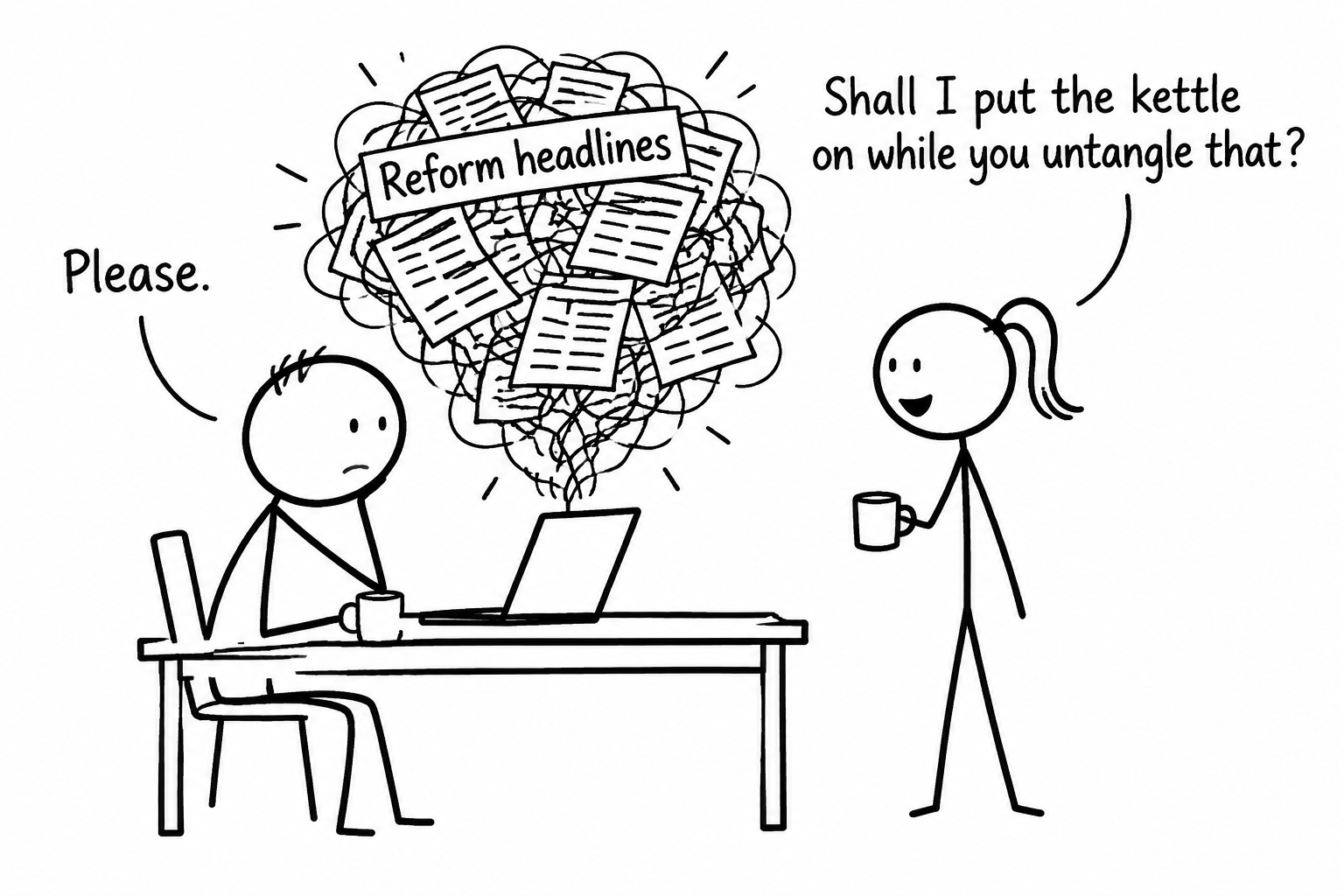 A parent and teenager untangling GCSE reform headlines at the kitchen table
Why the headlines sound like fewer GCSEs
The Curriculum and Assessment Review published its final report in November 2025. It concluded that the overall volume of examinations at age 16 had become excessive and recommended reducing GCSE exam volume by at least 10%.
The government accepted the case for reducing the assessment burden, although its stated implementation measure was more specific: work with Ofqual and awarding organisations to reduce examination time by an average of 2.5-3 hours for a pupil taking eight or nine GCSEs.
These are changes to the volume of assessment. They are not the same as reducing the number of qualifications.
A GCSE could, in principle, retain its subject content while being assessed through shorter papers, fewer duplicated questions or a different balance of assessment. Ofqual’s role is important here because any revised assessment must remain fair, valid, reliable and manageable.
This is why parents should read “fewer hours in exams” literally. It does not automatically mean “fewer subjects on the timetable”.
Could schools eventually offer fewer GCSEs?
Possibly, but that would be a school-level consequence rather than a confirmed national requirement.
Schools build GCSE programmes around several pressures: curriculum breadth, staffing, timetable space, pupil needs and government performance measures. The government has removed the headline English Baccalaureate measures from the performance framework for the 2025-26 academic year, with the change reflected in data published in autumn 2026. It has also proposed changes to Progress 8 and Attainment 8.
Those decisions may give schools more flexibility over subject combinations. Flexibility, however, can work in more than one direction. One school might protect a wider choice of arts subjects. Another might reorganise option blocks without changing the total number of GCSEs. A third might adjust its offer for particular pupils.
Parents should therefore ask the school a direct question: “How many GCSEs does my child’s programme contain, and has your options policy changed?” The school’s answer matters more than a national headline because there is no single GCSE total followed by every pupil.
You can also browse the wider Maths Genie GCSE subject hub to see how qualifications, exam boards and revision materials are organised by subject.
What GCSE reform means for current pupils
Timing resolves much of the uncertainty.
The government intends to publish the final revised national curriculum in spring 2027, with first teaching from September 2028. Updated GCSEs in subjects connected to the revised national curriculum are expected to follow in phases, with some intended for first teaching in 2029 and the remainder in 2030.
That means most pupils currently in Key Stage 4 will complete their qualifications before a new GCSE maths specification could begin teaching. Younger pupils may encounter the revised curriculum or updated qualifications, depending on their year group and the eventual implementation timetable.
Parents should not buy materials for an imagined new GCSE maths course before the specification exists. Exam boards such as Edexcel, AQA, OCR and Eduqas publish specifications and assessment information when changes are settled. Schools then confirm which course they will teach.
For now, match revision to the current board. The GCSE maths topics by exam board and tier guide helps parents identify what belongs to Foundation or Higher and how the major boards organise the course.
Are GCSE maths changes already happening?
There is one important assessment update for current specifications. Following consultation, Ofqual decided that formula sheets should be provided in GCSE mathematics examinations for the lifetime of the current specifications. This applies to exams from 2028 onwards as well as earlier arrangements announced for the current qualification.
That decision does not create a new GCSE maths specification. It changes an assessment condition within the existing qualifications.
The distinction matters because a formula sheet does not remove the need to understand how and when a formula works. A pupil may be given the area of a trapezium, for example, but still needs to identify the parallel sides, substitute accurately and use the correct units.
Parents can support this by asking their child to explain a method rather than merely recite it. “Why does this formula apply?” is usually a more useful revision question than “Can you remember the formula?”
The Edexcel GCSE Maths lessons, for example, build topics step by step towards exam-style questions. Families using another board can select it through the main GCSE maths page.
A sensible parent checklist
Until further details of GCSE reform are published, use this checklist:
- Confirm your child’s exam board for GCSE maths.
- Ask whether they are entered for Foundation or Higher tier.
- Check the school’s planned number of GCSE entries rather than relying on national averages.
- Continue using resources written for the current specification.
- Watch for information from the school before changing revision materials.
- Separate confirmed policy from proposals, consultations and press speculation.
- Review the position annually, especially for pupils who will start GCSE courses in 2029 or later.
The Edexcel GCSE Maths revision page shows how current topics and lessons fit together, while the main hub provides equivalent routes for AQA, OCR, Eduqas, WJEC and CCEA.
Common mistakes parents should avoid
Assuming shorter exams mean fewer subjects
The government’s confirmed direction concerns average examination time. No equivalent national instruction says that every pupil must take fewer GCSE qualifications.
Revising for a future specification too early
A revised curriculum is not the same as a final exam-board specification. Current pupils should prepare for the qualification their school has entered them for.
Treating every UK nation as one system
The Curriculum and Assessment Review and the implementation timetable discussed here apply to England. Education policy and qualifications differ across Wales, Northern Ireland and Scotland.
Believing the number of GCSEs matters more than attainment
A long list of entries is not automatically better. The appropriate programme depends on the pupil, the school and future plans. Secure understanding across a balanced set of subjects is more valuable than chasing an impressive total without enough time to learn each course properly.
Keep today’s revision aligned with today’s GCSE
A parent cannot control the timetable of national reform. What you can control is whether your child is revising the course they will actually sit, in the right tier and for the right exam board. Knowing that is only the first step; regular, specification-matched practice is what turns clarity into progress.
Start with the Maths Genie Lessons for the current GCSE Maths specification, select your child’s exam board, and begin the next relevant lesson.















