

Will IGCSE Maths Change? A Parent’s Guide
Will IGCSE maths change? Read the November 2026 answer on GCSE reform, IGCSE specifications, formula sheets and what parents should do now.
Updated: 3 November 2026
No, there is no announced blanket change to IGCSE Maths caused by the current GCSE reforms in England. The important nuance is that an International GCSE is not the same qualification as a GCSE. Changes announced by the Department for Education and Ofqual for GCSE Maths do not automatically rewrite an IGCSE specification.
So, if you are a parent asking, “Will IGCSE Maths change before my child takes the exam?”, the practical answer is reassuring: continue with the specification named by your child’s school unless the school or awarding organisation confirms otherwise.
The uncertainty is understandable. A parent searches for a straight answer, finds headlines about a new curriculum, formula sheets and GCSE reform, then wonders whether the revision materials on the kitchen table have suddenly become obsolete. They almost certainly have not.
The answer at a glance
Use this checklist before changing any revision plans:
- Confirm whether the qualification is GCSE Maths or International GCSE Maths.
- Find the awarding organisation and qualification code on the school’s course information.
- Check the specification and examination series being taught.
- Treat national GCSE reform announcements as separate from IGCSE until the relevant awarding organisation says otherwise.
- Keep revising the current specification while changes remain proposals or future plans.
The distinction between the two qualifications matters more than the word “international” might suggest.
Why GCSE reform does not automatically change IGCSE Maths
The Department for Education controls GCSE subject content in England. Ofqual sets regulatory requirements for qualifications within its remit. The Curriculum and Assessment Review considered the curriculum and assessment system in England, and the government published its response in November 2025.
International GCSEs are developed by individual awarding organisations for an international market. Some may be available in UK schools, but they are not simply another name for the government’s GCSE qualification. Ofqual has also explained that International GCSEs and GCSEs are distinct qualification types, and their grades should not automatically be treated as precisely aligned.
That means a government announcement about new GCSE maths content may be important without being an announcement about your child’s IGCSE course.
This is where the parent in our story can put down the stack of reform headlines and pick up one much more useful document: the specification being taught by the school.
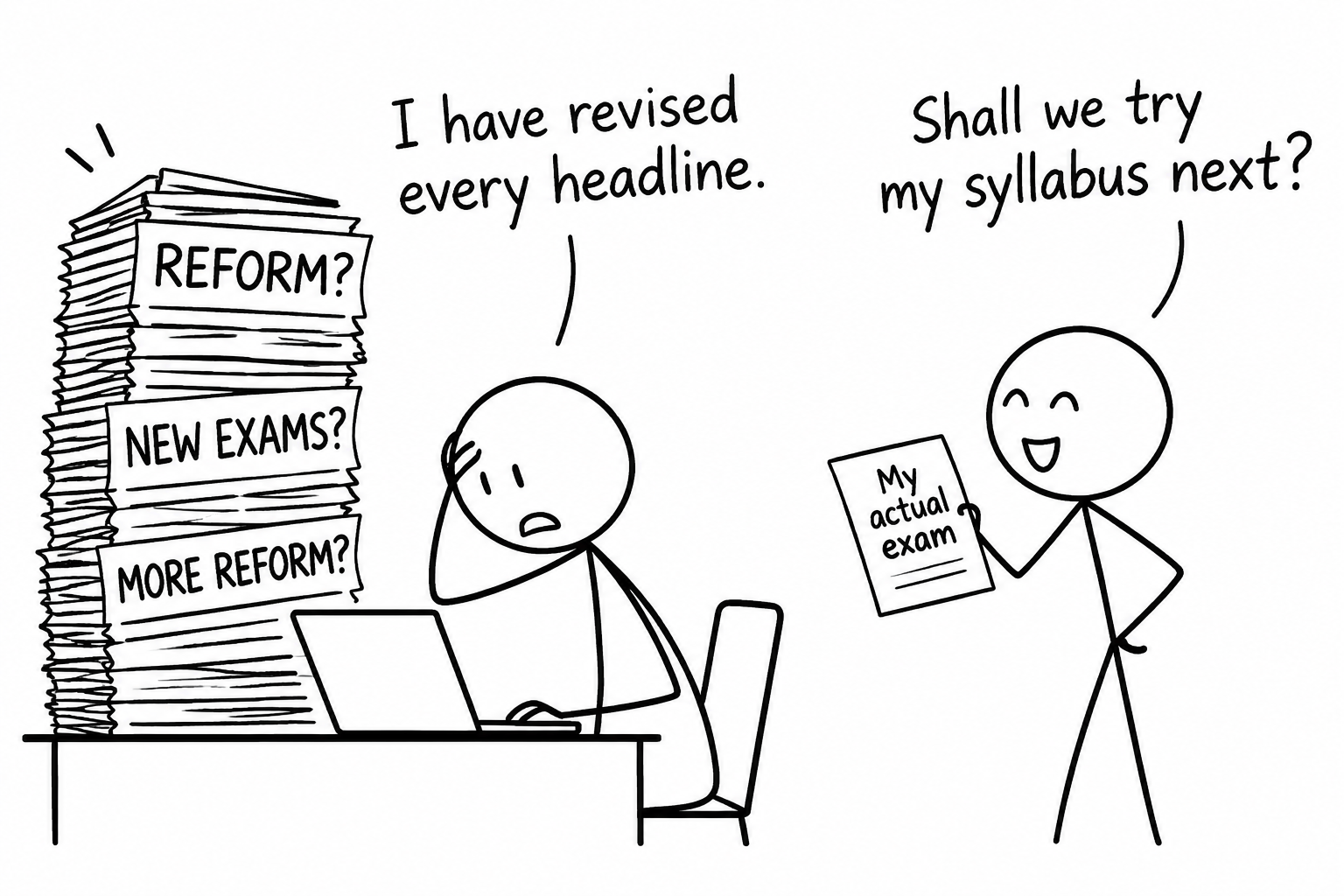 A parent revises every reform headline while a student suggests checking the actual syllabus
What is actually changing in GCSE Maths?
The government response to the Curriculum and Assessment Review says that refreshed qualifications in England are intended to begin first teaching in 2029 or 2030, depending on how subjects are phased. That is a future implementation timetable, not an instruction for current pupils to switch courses now.
At the time of this November 2026 update, parents should separate three developments.
Future curriculum and qualification reform
The Curriculum and Assessment Review final report was published on 5 November 2025. The government’s response set out plans to refresh the national curriculum and qualifications, with some changes intended for first teaching in 2029 and the remainder in 2030.
Further subject development and regulatory work are needed before parents can rely on detailed claims about future papers, content or assessment arrangements. A planned reform date is not the same as a final specification.
Formula sheets for current GCSE specifications
In 2026, the Department for Education changed its subject-content expectations so that pupils taking the current GCSE Maths specifications would not have to memorise all the usual formulae. Ofqual subsequently decided that exam boards must continue providing formula sheets for the remaining lifetime of those current specifications.
That decision applies to GCSE Maths within the current arrangements. It should not be assumed to alter an International GCSE paper. IGCSE candidates must follow the instructions and permitted materials published for their exact qualification.
Changes made by individual IGCSE awarding organisations
An IGCSE can still change. An awarding organisation may revise a specification, adjust assessment arrangements or introduce a replacement qualification. However, such a change would be published for that qualification, normally with clear information about first teaching and first assessment.
The key answer is therefore not “IGCSE never changes”. It is “GCSE reform does not automatically change IGCSE”.
A four-step plan for parents
The best response to uncertainty is a short verification process rather than a new revision strategy.
Identify the exact qualification
Ask the school for the full qualification title, awarding organisation and specification code. Do not rely only on a timetable entry saying “Maths”.
If the course is an ordinary GCSE, the GCSE Maths revision page helps you locate resources by exam board. The GCSE Maths topics by exam board and tier guide also explains why foundation, higher and awarding organisation details matter.
Check the examination series
A specification may have several published documents online, including older versions. Match the document to the year in which your child will sit the examination. Look for first-assessment dates, final-assessment dates and notices from the school.
Ask one precise question
Instead of asking, “Is Maths changing?”, ask the teacher or examinations officer:
Is my child still being entered for the qualification code and specification currently shown in the school’s course information?
That question is easier to answer definitively. It also prevents general curriculum news from being confused with a confirmed change to an exam entry.
Keep revision tied to the current specification
Once the course is confirmed, build revision around its listed content and assessment style. Do not pause revision while waiting for reforms that may affect a later cohort.
If checking and organising every current topic feels like another job, use Maths Genie GCSE Lessons to keep revision focused on the specification your child is studying.
Will current students be affected by GCSE maths changes?
Pupils already following a current specification should continue preparing for it unless their school gives formal notice of a change. The government’s stated first-teaching window of 2029-2030 concerns future reformed qualifications. It does not retrospectively replace the course being taught in 2026.
For younger pupils, particularly those whose GCSE or IGCSE course has not begun, it is sensible to watch for later announcements. Their school will decide which approved qualification to teach and should communicate any transition once specifications and assessment dates are settled.
The difference is between awareness and action. Parents should be aware of reform, but action should be based on a confirmed qualification rather than a newspaper headline.
Maths Genie’s free GCSE Maths resources are organised around current courses, with revision lessons, practice questions, mark schemes and video solutions. For pupils taking Edexcel GCSE rather than IGCSE, the Edexcel GCSE Maths lessons provide a clear example of specification-focused revision.
Common mistakes parents should avoid
Treating GCSE and IGCSE as interchangeable
They cover much of the same broad mathematical territory, but their specifications, paper structures and permitted support can differ. Revision should follow the actual qualification entry.
Assuming every reform headline affects the next examination
Curriculum reviews, government responses, consultations, regulatory decisions and final specifications are different stages. A proposal can shape the future without changing this summer’s paper.
Buying replacement materials too early
A future reform does not make a current textbook or worksheet irrelevant. Check the specification code before replacing resources.
Assuming the GCSE formula-sheet decision applies everywhere
The continuing formula-sheet policy is a confirmed change for current GCSE Maths specifications. Parents of IGCSE candidates should check the relevant awarding organisation’s instructions instead of carrying the GCSE rule across.
Waiting for complete certainty before revising
The core task has not changed: confirm the course, identify weaker topics and practise questions that match the specification. Future policy details do not need to be settled before that work begins.
Keep revision anchored to the exam your child will sit
You now have the straight answer: current GCSE reform does not automatically change IGCSE Maths, and your child should keep following the qualification confirmed by their school. Knowing that is useful, but steady progress still depends on turning the current specification into regular, manageable revision.
Start with Maths Genie Lessons for the current specification.















