

Will GCSE Maths Include Coding or Computational Thinking?
Will GCSE Maths include coding or computational thinking? Read the dated answer on current exams, reform plans and what parents in England should do now.
Last reviewed: 3 November 2026
No. For students following the current GCSE Maths specifications in England, coding and computational thinking are not being added as separate examinable topics. Your child does not need to learn a programming language for their GCSE Maths papers.
That is the straight answer to will GCSE Maths include coding or computational thinking. The nuance is that curriculum reform is under way, and some mathematical skills resemble computational thinking. Neither fact changes what a student preparing for the current qualification should revise.
Imagine a parent at the kitchen table. One tab reports curriculum reform, another discusses artificial intelligence, and a third says digital skills will become more important. It is understandable to wonder whether Python is about to appear beside Pythagoras. The official documents draw a clearer line than the headlines do.
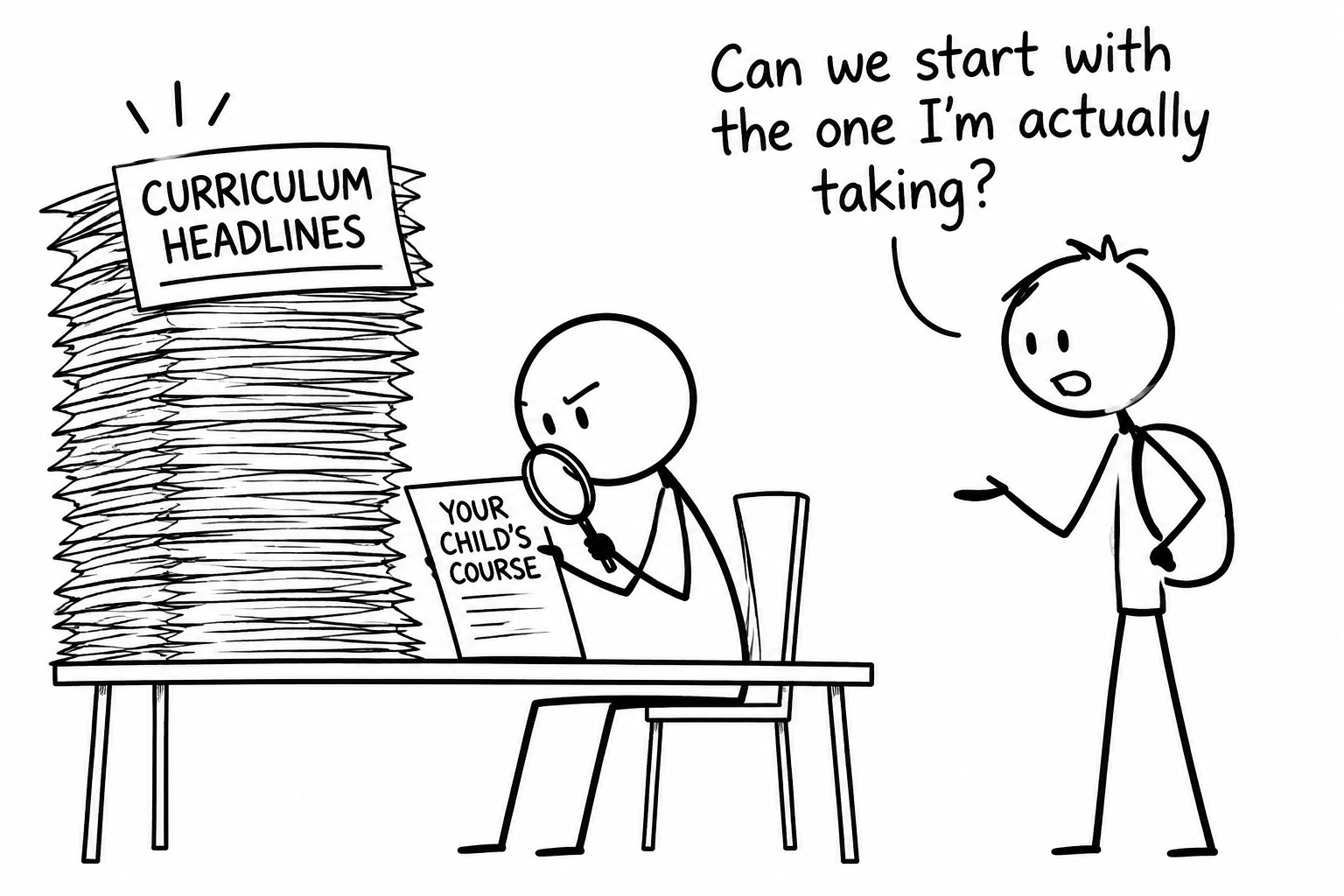 A parent searching curriculum headlines while a student points to the course they are actually taking
The answer at a glance
For families in England:
- Current GCSE Maths content does not include writing or debugging computer code.
- Students are assessed on number, algebra, ratio and proportion, geometry and measures, probability, and statistics.
- Logical reasoning and multi-step problem-solving can feel similar to computational thinking, but they remain mathematical skills.
- The Curriculum and Assessment Review discussed reform to both maths and computing, but it treated them as distinct subjects.
- The government has announced future curriculum and qualification updates. Detailed future GCSE Maths specifications are not yet available.
- Students should continue revising the specification confirmed by their school and exam board.
The practical decision is therefore simple: do not divert current GCSE Maths revision time into coding unless your child also takes Computer Science or wants to explore it independently.
What is actually in the current GCSE Maths specification?
The Department for Education’s GCSE Mathematics subject content provides the framework used by awarding organisations. Its main areas are:
- number
- algebra
- ratio, proportion and rates of change
- geometry and measures
- probability
- statistics
Students must also develop fluency, mathematical reasoning and problem-solving. That includes translating a problem into a sequence of mathematical processes, choosing a method, interpreting a result and evaluating whether an answer is sensible.
Those actions can sound computational. A student might break a complex problem into smaller steps, identify a pattern or follow an iterative process. However, an exam question assesses the mathematics, not whether the student can express the method in Python, JavaScript or another programming language.
Parents can see the content organised by board and tier in the GCSE Maths revision hub. The GCSE Maths topics by exam board and tier guide also helps distinguish genuine specification content from general predictions about education.
Why does computational thinking keep appearing in the conversation?
The phrase belongs most explicitly to computing education. England’s national curriculum for computing describes computational thinking as part of understanding and changing the world, while also recognising that computing has strong links with mathematics.
The overlap is real. Both subjects may involve:
- breaking a problem into manageable parts
- recognising structures and patterns
- creating an ordered method
- checking results and correcting errors
- using abstraction to ignore irrelevant details
A sequence problem, for example, asks a student to identify a rule and apply it consistently. That habit may support programming later, but it remains an algebra question in GCSE Maths. The sequences practice booklet shows what the current examinable task looks like.
Similarly, a multi-stage calculation may resemble an algorithm because the operations must be completed in a sensible order. It does not become coding simply because the reasoning is systematic. Students can practise that distinction through calculation problem lessons.
What do the GCSE reform documents say?
The Curriculum and Assessment Review final report was published in November 2025, followed by the government’s response. The review considered maths and computing in separate subject sections.
For maths, the direction of travel includes improving curriculum sequencing so that understanding develops more coherently. For computing, the review recommended a revised GCSE that reflects computer science, information technology, digital literacy and the effective use and creation of technology. It did not recommend moving programming into the current GCSE Maths qualification.
The government response set out plans for a revised national curriculum from 2028 and updates to GCSEs from 2029 onwards, with changes phased across subjects. Ofqual’s work concerns how revised qualifications can be assessed fairly, validly and reliably. Ofqual has also referred to reformed qualifications being introduced from 2029 or 2030, depending on the subject and timetable.
These dates indicate when reform may begin, not the final content of a future GCSE Maths specification. Until the Department for Education publishes subject content and exam boards publish accredited specifications, nobody can responsibly provide a detailed list of future Maths topics.
That distinction matters. A policy direction is not an exam specification.
A practical plan for parents
You can settle the question without monitoring every education headline:
Confirm the qualification
Ask the school which exam board, tier and specification your child is following. Edexcel, AQA, OCR and Eduqas organise their materials differently, even though qualifications in England follow common subject content.
Use the specification for the examination year
Check the school’s information and the awarding organisation’s current specification. Pay attention to the first-teaching and first-assessment dates whenever a future reform is announced.
Keep revision matched to assessed content
Build revision around taught topics, exam-style questions and current past papers. The Edexcel GCSE Maths scheme of learning, for example, arranges the existing course into a progressive sequence.
Treat coding as a separate opportunity
Coding can be valuable, particularly for a student interested in Computer Science, engineering, data or technology. It just should not replace GCSE Maths preparation when it is not part of the paper.
If organising the current syllabus feels like another research task, use Maths Genie GCSE Maths Lessons to keep practice tied to the specification your child is actually learning.
England and Wales are not interchangeable
Curriculum and qualification policy is devolved. The DfE, Ofqual and the Curriculum and Assessment Review documents discussed here apply to England.
Wales has introduced its own GCSE Mathematics and Numeracy arrangements, including references to data and computational thinking within the qualification’s broader structure. That should not be read as evidence that coding has entered GCSE Maths in England. If your child attends school in Wales, use the exact WJEC qualification title and specification supplied by the school.
Common mistakes parents should avoid
Treating computational thinking as a synonym for coding. Computational thinking is a collection of problem-solving habits. Coding is one possible way to apply them.
Assuming every curriculum announcement affects current Year 10 or Year 11 students. Reform normally involves consultation, new subject content, qualification development and confirmed first-teaching dates.
Revising from a future-facing news story. Exams assess the applicable specification, not proposals or commentary.
Ignoring the exam board and national system. An announcement about computing, Wales or a future qualification may have no effect on your child’s GCSE Maths course in England.
Dropping core maths to prepare for an unconfirmed change. Algebra, proportion, geometry, probability, statistics and numerical fluency remain the productive use of revision time for current students.
Keep revision focused on the real paper
You now have the answer: coding is not a current GCSE Maths topic in England, while future specifications remain subject to the formal reform process. The remaining gap is turning that clarity into focused weekly revision rather than allowing speculative changes to distract your child. Start the Maths Genie Lessons for the current GCSE Maths specification.















