

Why Choose GCSE Business? What Students Enjoy
Why choose GCSE Business? Explore what students enjoy, the topics and maths involved, useful skills, exam demands and how to decide if it suits you.

Choosing GCSE options can feel oddly permanent. You are asked to predict what your future self will enjoy before you have met that version of yourself. Subjects with familiar names feel safer; new subjects require a small leap.
So, why choose GCSE Business? Students who enjoy it often value the same qualities: it explains familiar organisations, combines writing with manageable calculations, rewards reasoned decisions and makes everyday choices about prices, advertising and employment easier to understand. It can suit students who like asking not only what happened, but why a business acted that way.
That does not make it an effortless GCSE or the right option for everyone. It involves terminology, case-study application, calculations and structured extended responses. The attraction is that these elements usually connect to recognisable situations.
GCSE Business at a glance
Before choosing it, check whether these statements sound appealing:
- You are curious about how businesses make and sell products.
- You enjoy discussing why one decision may be better than another.
- You would like a mixture of numerical and written work.
- You can learn key terminology and apply it to unfamiliar contexts.
- You are interested in marketing, finance, operations or people at work.
- You are prepared to justify conclusions rather than give unsupported opinions.
GCSE Business specifications from Edexcel, AQA, OCR and Eduqas vary in structure, so check the exact course offered by your school. Across the national subject content, however, students encounter areas such as business activity, marketing, operations, finance, human resources and external influences.
Students enjoyed seeing ordinary life differently
A repeated theme in published school testimonials and informal student discussions is relevance. These comments are personal experiences rather than representative survey evidence, but the pattern is understandable: Business gives names to things students already encounter.
A supermarket changes its packaging. A streaming service raises its price. A café opens beside a successful competitor. An employer offers staff flexible working. Each can become a question about objectives, costs, demand, competition, motivation or stakeholder interests.
That recognition can make revision feel less detached. The terminology is new, but the world it describes is not. Once students understand market segmentation, they may notice how adverts target different groups. After learning about location decisions, they may see why a particular shop operates near a station rather than on a quieter street.
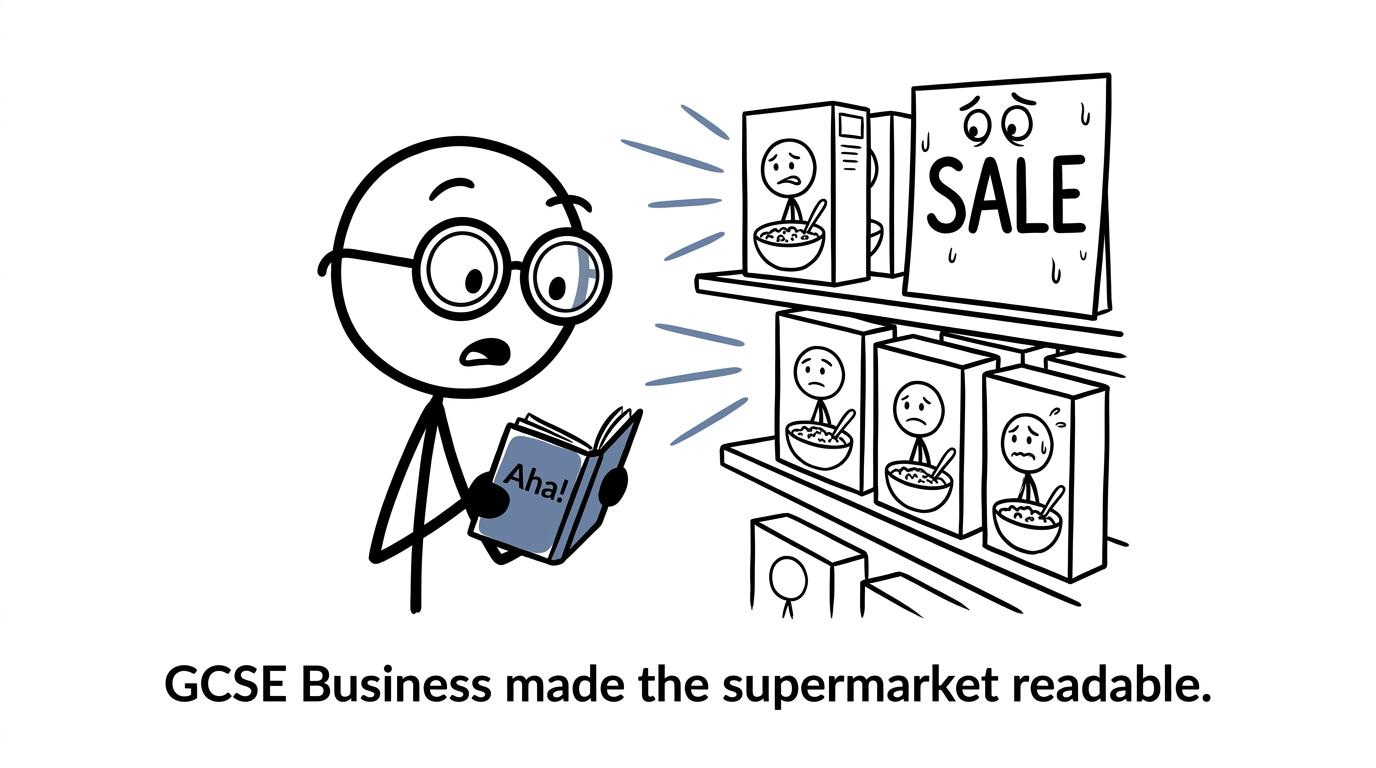 A student discovers that supermarket marketing has been hiding in plain sight
This is one reason some students are glad they picked the subject: lessons give structure to observations they were already making.
It offers a balance of words and numbers
Some GCSEs lean heavily towards extended writing. Others involve frequent calculations. Business sits between the two.
The official GCSE subject content requires students to develop quantitative skills in business contexts. These include percentages, percentage change, averages, revenue, costs, profit, profit margins, average rate of return and cash-flow forecasts. Students also interpret graphs, market research and financial information.
Core relationships include:
Revenue=selling price per unit×quantity sold\text{Revenue}=\text{selling price per unit}\times\text{quantity sold}Revenue=selling price per unit×quantity sold Profit=total revenue−total costs\text{Profit}=\text{total revenue}-\text{total costs}Profit=total revenue−total costs Percentage change=new value−original valueoriginal value×100\text{Percentage change}=\frac{\text{new value}-\text{original value}}{\text{original value}}\times 100Percentage change=original valuenew value−original value×100These are not calculations performed in isolation. A question may ask what a result suggests, why it matters or whether it supports a decision. That creates a useful rhythm: calculate, interpret, then judge.
Students wanting to strengthen this overlap can use MathsGenie’s AQA GCSE Business calculation resources, the OCR Business calculation revision guide or the Edexcel revenue, costs and profit guide.
For GCSE maths preparation, percentage change revision builds a skill that matters in both subjects.
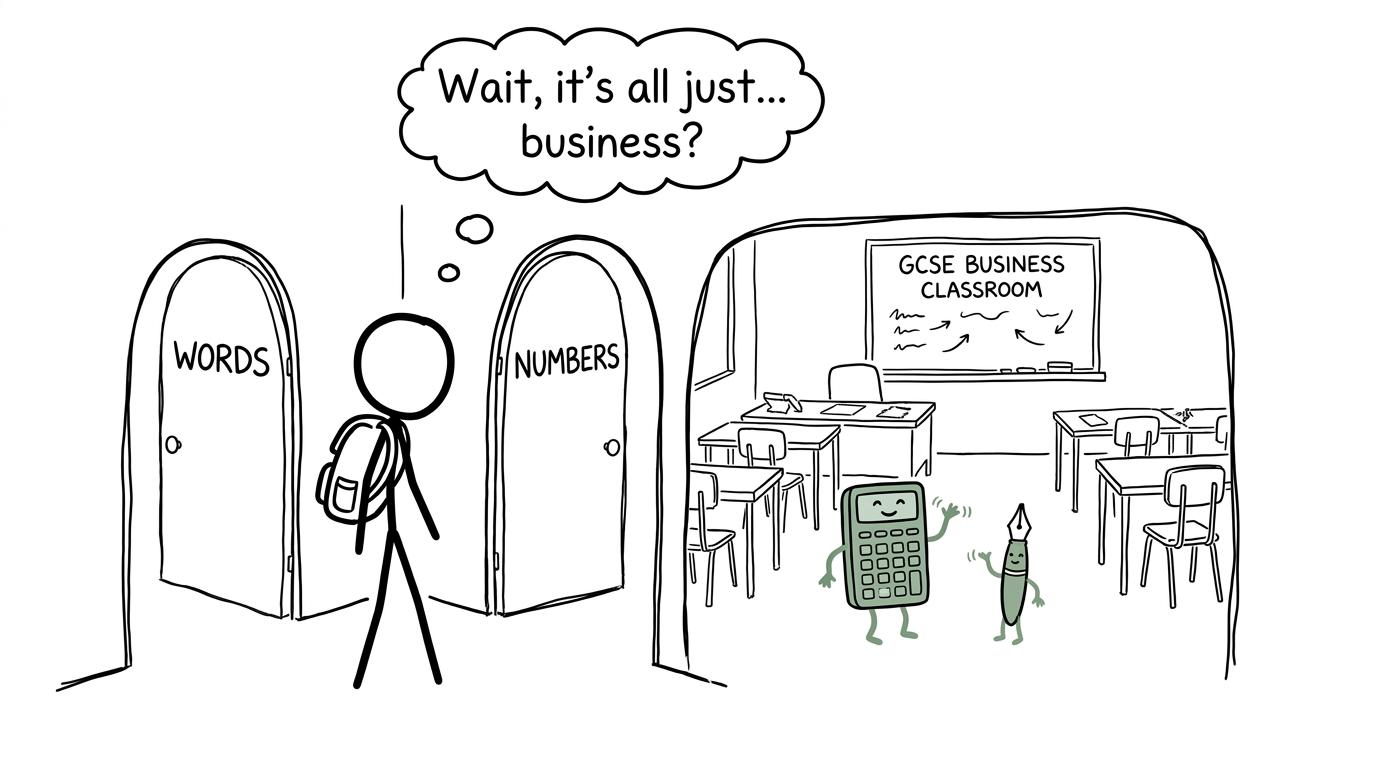 The doors marked Words and Numbers lead to the same Business classroom
Business rewards thinking, not just remembering
Knowing a definition is only the beginning. Strong answers apply knowledge to the business in the question, analyse consequences and reach a justified conclusion.
Suppose a case study describes a small independent business with limited finance. Advice that might suit a large multinational may be unrealistic for it. Context changes the answer.
This is where many students find the subject more interesting than expected. Two options can both have advantages. A lower price might increase demand, but it can reduce the amount earned per sale. Staff training costs money now, yet it could improve productivity or customer service later. Expansion may increase revenue while also increasing risk.
The question is rarely just, “Is this good?” It is closer to, “For this business, under these conditions, is this likely to be the better choice?”
That develops several useful habits:
- separating evidence from assumption;
- tracing short-term and long-term consequences;
- recognising conflicts between stakeholders;
- using numerical and qualitative information together;
- making a judgement that follows from the analysis.
These habits also support subjects such as English, geography and history, where evidence must be selected and connected rather than merely repeated.
The content can feel useful beyond the examination
Students do not need to plan on becoming entrepreneurs to find Business relevant. Most people will work for an organisation, buy from businesses and make decisions involving money.
Understanding revenue and profit helps correct the common belief that every pound of sales is money the owner keeps. Learning about recruitment reveals what employers consider when filling a role. Marketing encourages students to look critically at how products are positioned. Cash flow shows why a business can appear successful yet still struggle to pay bills at the right time.
The course does not turn someone into an accountant, manager or founder. Nor is GCSE Business normally the only possible route towards later business-related study. Its value is more modest and practical: it supplies an organised introduction to how organisations make decisions.
Students considering progression can read what a GCSE Business grade may mean for sixth form. Entry requirements are set by individual schools and colleges, so always check locally rather than assuming one national rule.
The maths has a purpose
For a student preparing for GCSE maths, Business can give familiar skills a second setting. Percentages become market share or profit margins. Averages may summarise research. Graphs communicate sales patterns. Formula substitution produces information that must then be explained.
This transfer is valuable because genuine understanding survives a change of wording. If percentage change only feels comfortable when a question mentions the price of a jumper, a business context may expose the gap. Once the same method works with revenue, costs or market size, the underlying idea is becoming secure.
MathsGenie’s GCSE Statistics revision hub can support work with averages, charts and data. The profit, margin and average rate of return lessons connect numerical methods directly to Edexcel Business contexts.
The calculations are only part of the task. Students should also ask:
- What does the result mean?
- Is the figure improving or worsening?
- What other information would affect the decision?
- Does the data justify the proposed action?
A correct number without interpretation may not complete the argument.
Why choose GCSE Business rather than another option?
The strongest reason is fit, not reputation. Choose it because the course content and assessment style suit you, not because someone calls it easy or difficult.
Business may be a good fit if you enjoy current, recognisable contexts and are comfortable moving between short calculations and structured writing. It may be less suitable if you strongly dislike learning terminology, reading case studies or explaining chains of consequences.
Before deciding:
- Read your school’s option booklet.
- Confirm the exam board and qualification title.
- Look at a specimen or past paper from that board.
- Ask how the subject is taught and assessed at your school.
- Compare it honestly with your other available options.
- Consider enjoyment, usefulness and workload together.
Do not choose solely because a friend is taking it. Timetables, teachers and friendships can change. The course content is what remains.
What GCSE Business examinations demand
Exact paper lengths, mark totals and question styles depend on the exam board. Major GCSE Business qualifications are assessed through written examinations, and case-study or data-response material is central to the way knowledge is tested.
Students should expect some combination of multiple-choice or short-answer items, calculations and longer analytical or evaluative responses. The essential skills are broadly consistent:
- accurate knowledge of business concepts;
- application to the business described;
- analysis of effects and consequences;
- use and interpretation of data;
- supported judgements.
This matters when choosing the subject. Enjoying business stories is helpful, but examinations reward disciplined explanation. An opinion earns strength from evidence and context.
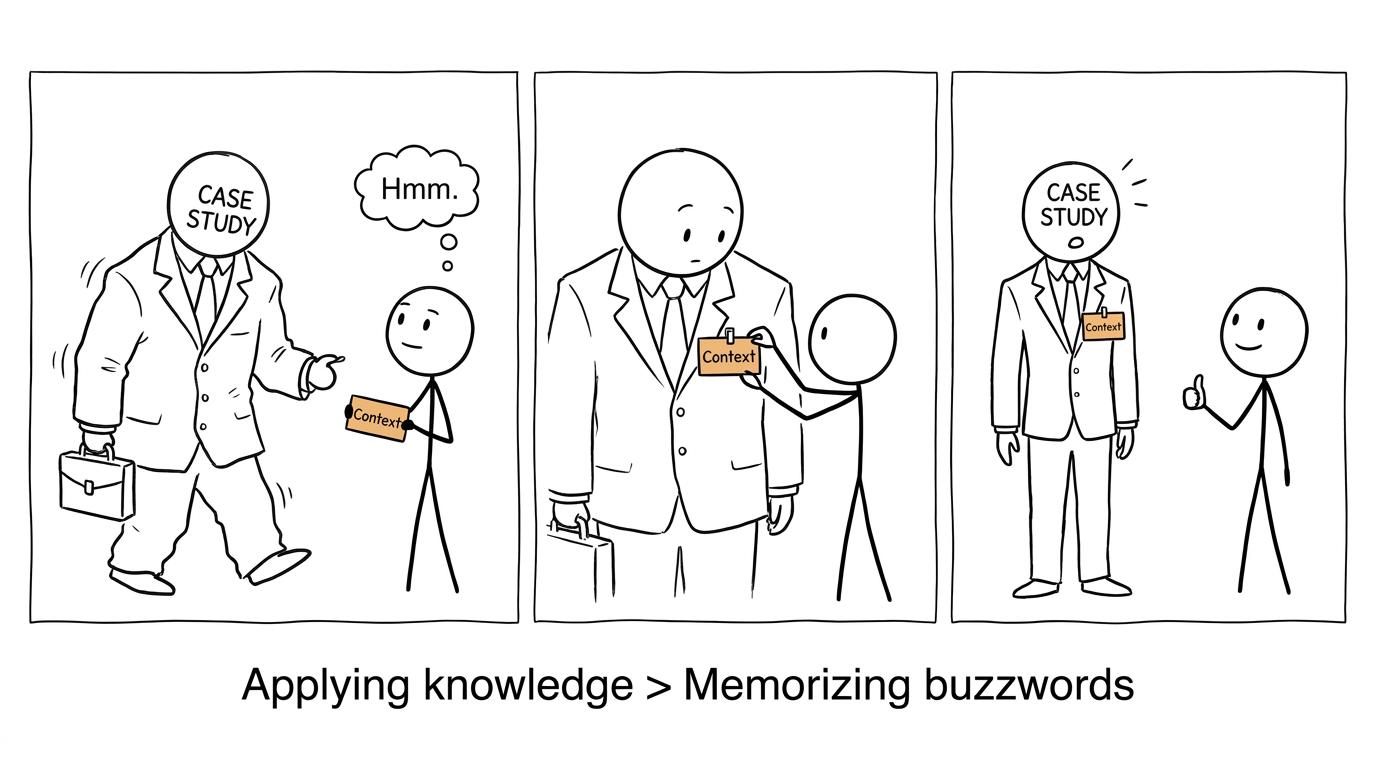 A huge case study becomes manageable when a student applies context
Common mistakes when choosing or revising Business
Assuming it is just common sense
Familiar contexts can make the content approachable, but examiners reward precise terminology and developed reasoning. Everyday intuition is a starting point, not a complete answer.
Treating every business in the same way
A recommendation must fit the size, objectives, market and financial position described. Generic advantages and disadvantages usually miss the most important detail: context.
Avoiding the numerical topics
Finance is not optional background. Practise formulas, percentages, averages and graph interpretation, then explain what each result means for the business.
Memorising model paragraphs
A rigid paragraph may not answer the question actually asked. Learn how to build an argument from the case-study evidence instead.
Choosing it because it sounds easy
No GCSE guarantees an easy grade. Business requires content knowledge, calculation accuracy, application and extended reasoning. Look at real assessment material before making your choice.
Revising by reading alone
Recognition can feel like knowledge until the paper is closed. Use retrieval, practice questions and mark schemes. For your parallel maths preparation, the GCSE maths topics by exam board and tier guide can help you build a structured plan before moving to timed papers.
Make the choice with open eyes
Students who are glad they chose GCSE Business often describe a subject that made familiar organisations more understandable, gave numbers a practical purpose and allowed them to argue towards a decision. Those are good reasons to consider it. They are not promises that every lesson will be easy or that every student will enjoy it.
The best option is the one whose content you are willing to revisit when revision becomes demanding. Inspect the specification, sample the questions and think about how you prefer to learn.
Then build the supporting skills. MathsGenie provides free revision lessons, Business calculation guides, maths practice questions, mark schemes, mini tests, past papers, video solutions and predicted papers. Start with the topic that feels least secure, practise it actively, and let each mistake show you what to do next.











