Whiteboard Revision GCSE History: Does It Work?
Whiteboard revision GCSE history: discover active recall, timelines, source analysis and exam-planning methods that go far beyond copying notes effectively.
Revision can look productive long before it becomes useful. A whiteboard fills with dates, arrows and carefully coloured headings. You stand back. It looks impressive. Yet if most of it came directly from an open textbook, your memory may have done very little work.
So, is whiteboard revision GCSE history genuinely effective? Yes, provided you use the board to retrieve, organise, test and correct knowledge rather than copy notes. Its value is not the glossy surface. It is the freedom to attempt an answer, expose a gap, erase it and try again.
That makes a whiteboard particularly useful for timelines, causal links, comparisons, essay plans, source questions and rapid recall. It should complement written exam practice, not replace it.
The quick whiteboard revision checklist
A productive session should involve most of these actions:
- Choose one precise topic or exam skill.
- Put your notes out of sight before beginning.
- Recall information from memory.
- Organise it around a historical question.
- Check your work against reliable notes or a specification.
- Correct missing, vague or inaccurate material.
- Record the gaps that need revisiting.
- Finish with a written exam question when appropriate.
The crucial distinction is simple: information should initially travel from your memory to the board, not from the textbook to the board.
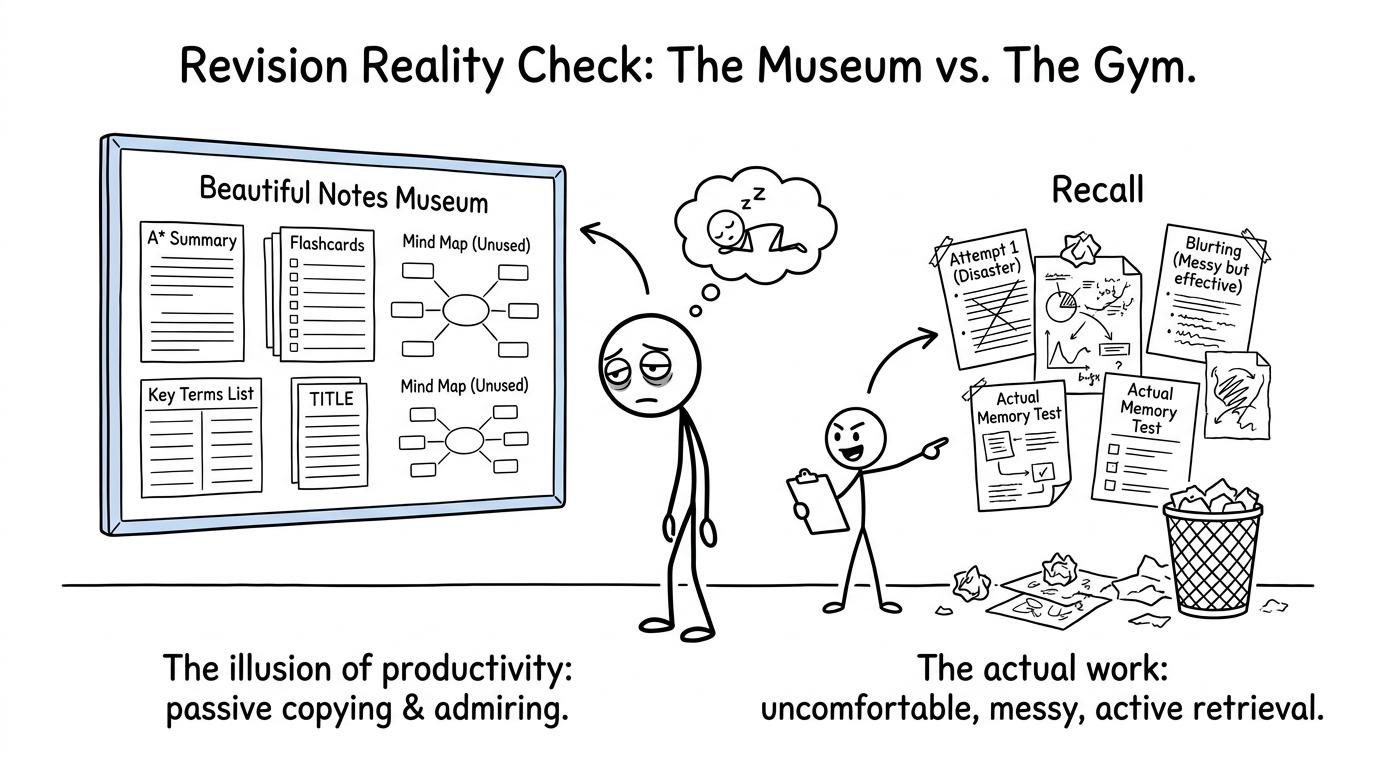 A student discovers that beautiful copied notes belong in a museum while recall does the real revision work
Why a whiteboard can help with GCSE History
Official GCSE History assessment objectives cover more than remembering facts. Across exam boards, students are expected to demonstrate knowledge and understanding, analyse events using concepts such as cause and consequence, evaluate sources and make judgements about interpretations.
The precise papers and question formats differ between AQA, Edexcel, OCR and Eduqas, so always use the current specification and guidance for your board. Nevertheless, the underlying challenge is similar: you need accessible knowledge, but you must also select and use it in response to a question.
A whiteboard can support both stages.
It makes retrieval visible
Retrieval practice means attempting to recall something without first looking at the answer. Educational research supports retrieval as a useful learning strategy, particularly when it is repeated after a delay and followed by feedback.
On a whiteboard, the evidence is difficult to hide. If you cannot reconstruct the main causes of an event, distinguish two policies or place developments in order, the empty spaces reveal what rereading can conceal.
That discomfort is useful. It changes revision from “I recognise this page” to “I can explain this without the page”.
It gives complicated topics a temporary shape
GCSE History contains overlapping people, policies, events and interpretations. A large surface lets you move these elements around before committing to a final structure.
You can separate long-term and short-term causes, connect an event to several consequences, or arrange evidence according to whether it supports or challenges a judgement. Because the writing is temporary, changing your mind feels inexpensive. That encourages genuine thinking rather than loyalty to the first idea you wrote down.
It provides fast feedback
Retrieval without correction can leave errors in place. After attempting a task, check the board against your class materials, textbook, specification or teacher-approved resources. Use another colour to add what was missing and cross out inaccuracies.
Then erase the board and attempt the same task later. The correction matters more than the colourful display that preceded it.
This diagnose-and-retest approach also transfers well between subjects. In maths, for example, finding your weakest GCSE topics is more valuable than repeatedly practising comfortable material.
How to use a whiteboard beyond copying notes
Build a timeline from memory
Write the starting and finishing points of a period, then add significant developments without consulting your notes. Once you have exhausted your memory, check the sequence and identify:
- missing turning points;
- events placed in the wrong order;
- dates you confused;
- links between developments that you could not explain.
Do not judge a timeline only by the number of dates it contains. Ask why the order matters. A secure sequence should help you explain change, continuity, cause and consequence.
On your next attempt, use fewer prompts or mix the timeline with another topic. That delayed return is more demanding than rebuilding it immediately while the corrections remain fresh.
Create a cause-and-consequence web
Put one event or development in the centre. Around it, retrieve relevant causes or consequences and draw labelled connections between them.
The labels matter. An arrow should represent a claim such as “increased opposition”, “weakened authority” or “created an opportunity”, not merely show that two facts appeared in the same chapter.
You can then group factors into categories such as political, economic, social, military or religious. Alternatively, organise them by long-term importance, short-term impact or the strength of available evidence. The categories should fit the topic rather than becoming a rigid template.
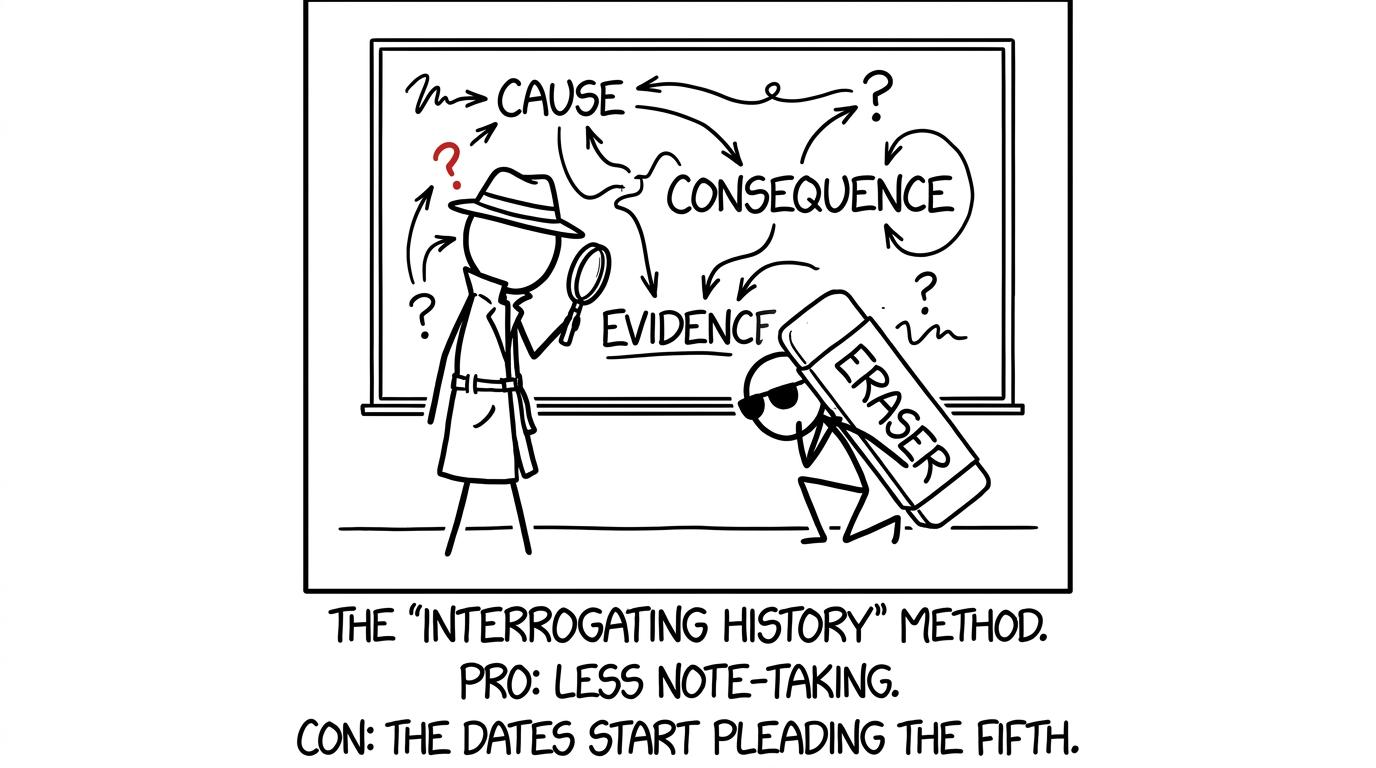 A GCSE history detective interrogates causes, consequences and evidence while a date attempts to hide
Use the board for comparison grids
Comparison questions require more than two separate lists. Divide the board into similarities, differences and an overall judgement. Retrieve material for both sides, then force yourself to complete sentences such as:
- The developments were similar because...
- The more important difference was...
- This difference can be explained by...
- Overall, the stronger comparison is...
This exposes a common weakness: knowing information about both periods but failing to compare them directly.
Practise source analysis aloud
Display a source separately, then use the board to capture your reasoning. Depending on the question used by your exam board, consider:
- the source's explicit message;
- details you can infer;
- relevant contextual knowledge;
- the creator, purpose and intended audience;
- what the source can and cannot support;
- the wording of the actual question.
Avoid treating provenance as a checklist that automatically makes a source reliable or unreliable. Historical evaluation is contextual. A source may be useful precisely because it reveals an attitude, purpose or limitation.
Say your reasoning aloud before writing it. If you cannot explain the connection between a source detail and your judgement, the final paragraph is unlikely to make that connection clearly either.
Construct interpretation debates
For an interpretations question, place the central disagreement at the top of the board. Underneath, separate:
- what each interpretation argues;
- evidence that supports each view;
- contextual knowledge that challenges or qualifies it;
- reasons the interpretations might differ;
- your substantiated judgement.
Do not reduce an interpretation to one quotation. The aim is to understand its overall argument and evaluate it in the context of the period.
Plan answers under a time limit
Write an exam question at the top and give yourself a short planning period. Build a thesis, paragraph claims, selected evidence and a conclusion. Then erase the plan and reconstruct it more concisely.
This is useful preparation, but the exam is written on paper or completed through an approved digital arrangement. You must therefore transfer some plans into full answers and assess them using the current mark scheme.
The same progression matters in maths: learn or recall, practise, mark, repair and retest. The MathsGenie GCSE maths revision hub brings together revision lessons, exam questions, worksheets and papers for this purpose.
A whiteboard revision routine that stays active
A compact session can follow five stages.
Retrieve
Choose one question and work without notes for approximately 101010 minutes. Use keywords, arrows and short claims rather than polished paragraphs.
Check
Compare the board with trustworthy course materials. Mark correct ideas, add omissions in another colour and remove inaccuracies.
Explain
Talk through the structure as though you were teaching it. Explain why each link exists and where the evidence is strongest or weakest.
Convert
Turn part of the board into a written paragraph, timed plan or complete exam response. History marks are awarded for what you communicate in the exam, not for what you could have said beside a whiteboard.
Revisit
Photograph the corrected board only if it will help you check later, then erase it. Schedule another attempt after a delay. A picture is a record, not the revision itself.
If you are balancing History with maths, this routine can sit alongside a broader one-month GCSE maths revision plan. Short retrieval tasks help preserve older knowledge while your main session tackles a current weakness.
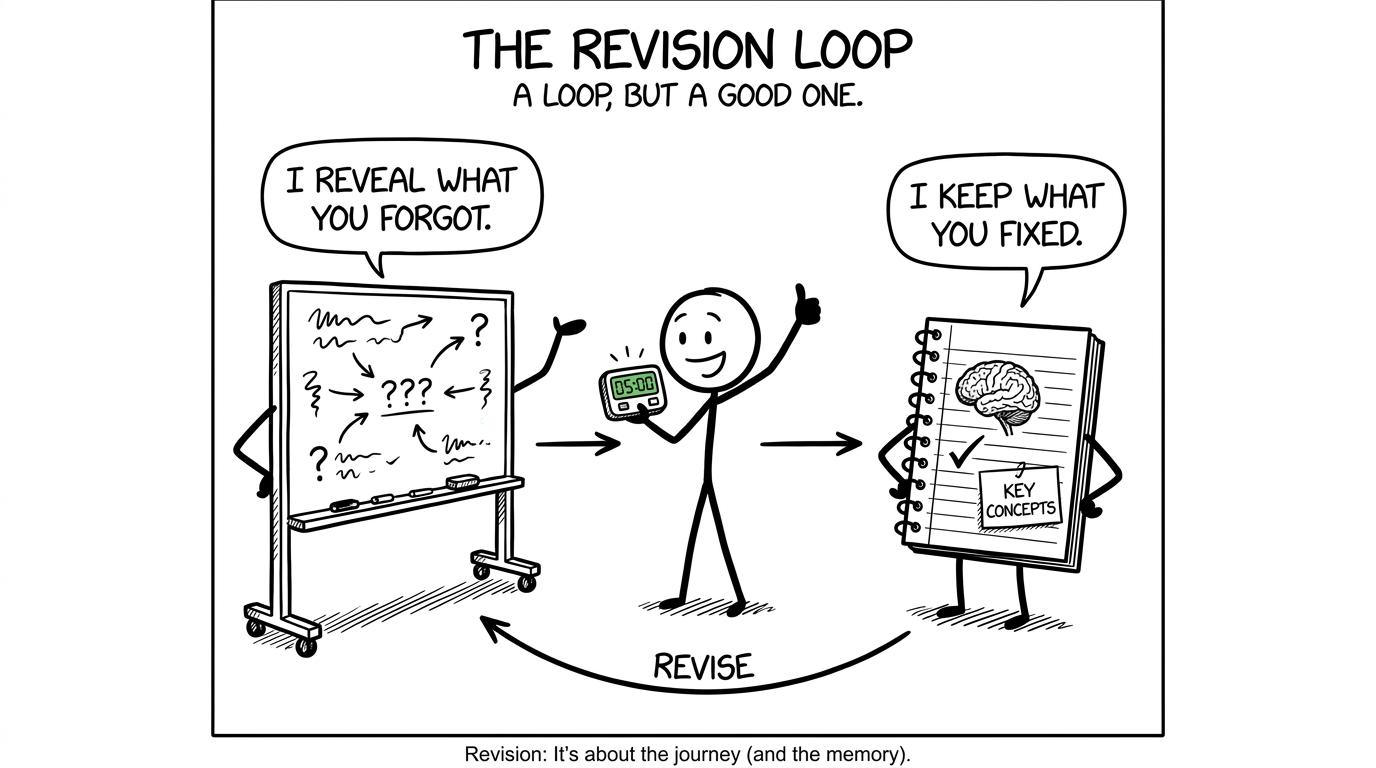 A whiteboard reveals forgotten knowledge while a notebook records the corrections
When a whiteboard is not the right tool
A whiteboard is less useful when you need to:
- write and review a complete extended answer;
- annotate a detailed source closely;
- retain teacher feedback for future reference;
- simulate the physical or digital conditions of the exam;
- practise sustained handwriting and time management.
Use paper for those tasks. The best revision system does not ask one tool to perform every job.
The same principle explains why maths students need both topic practice and full papers. Past papers should begin as diagnosis before becoming timed performance practice. A whiteboard can help recall a method, but only exam questions reveal whether you can apply it accurately.
Common whiteboard revision mistakes
Copying with the notes open
This produces a cleaner version of material you have already seen. Close the book, attempt retrieval first and check afterwards.
Making the board too broad
“Revise the Cold War” is not a manageable task. Choose a specific enquiry, turning point, comparison or exam skill.
Prioritising appearance over thinking
Colour can separate categories, but decoration does not earn marks. If formatting consumes more effort than recalling and explaining, simplify it.
Erasing errors before learning from them
Pause before wiping the board. Identify why each gap appeared and record what needs another attempt.
Avoiding written exam answers
A strong diagram is not automatically a strong essay. Regularly convert ideas into timed writing and use the relevant mark scheme.
Cramming everything into one session
Revisiting a topic after a delay is more informative than repeating it immediately. Plan shorter returns across several days. If time is extremely limited, prioritise active practice rather than creating resources from scratch, an idea also central to MathsGenie's guidance on revising GCSE maths in three days.
Is buying a whiteboard necessary?
No. The method matters more than the object. A laminated sheet, reusable notebook, tablet, scrap paper or plastic wallet containing plain paper can all support recall and correction.
A larger board is helpful for timelines and relationship maps. A small board is often better for quick retrieval because it limits how much you can write. Choose the cheapest format you will use consistently and pair it with specification-led revision and exam questions.
Make the board part of a wider revision system
A whiteboard is genuinely useful for GCSE History when it acts as a testing surface rather than a display surface. Use it to reconstruct knowledge, compare periods, trace causation, interrogate sources and plan arguments. Then check your accuracy and transfer the thinking into written exam practice.
The wider lesson applies across GCSE revision: active effort reveals more than comfortable rereading. When you turn back to maths, use MathsGenie's free GCSE resources to move from revision lessons into practice questions, mini tests, past papers, predicted papers, mark schemes and video solutions. You can also use the GCSE topics that commonly deserve regular practice to organise your next sessions.
Start with one small question. Close the notes. Pick up the pen. Let the empty board show you what to do next.