

Whiteboard Revision for GCSE English Literature
Whiteboard revision GCSE English Literature: recall quotations, connect themes, plan essays and test yourself without simply copying out notes again.
Revision can look productive long before it becomes useful. A clean whiteboard, several coloured pens and an hour spent copying character notes may leave you with something impressive on the wall. But the important question is simpler: what can you remember once it has been erased?
Whiteboard revision for GCSE English Literature is genuinely useful when it forces you to retrieve, organise and apply knowledge without looking at your notes. It is much less useful when it becomes temporary copying. The board itself is not the strategy. Its value comes from what you ask your brain to do on it.
That matters for students balancing English Literature with GCSE maths. Both subjects reward more than recognition. Recognising a quotation or formula is not the same as recalling it independently and knowing when to use it.
The short answer: when is a whiteboard useful?
A whiteboard earns its place in your revision if you use it to:
- retrieve quotations with the book closed;
- connect characters, themes, events and context;
- plan arguments against the clock;
- practise analysing individual words and structural choices;
- compare poems visually;
- expose gaps in your knowledge;
- erase an answer and reconstruct it later;
- explain an interpretation aloud before writing it concisely.
It is not especially effective if you spend most of the session decorating headings, copying paragraphs or reading what is already written.
The distinction is between producing information from memory and merely placing information somewhere else.
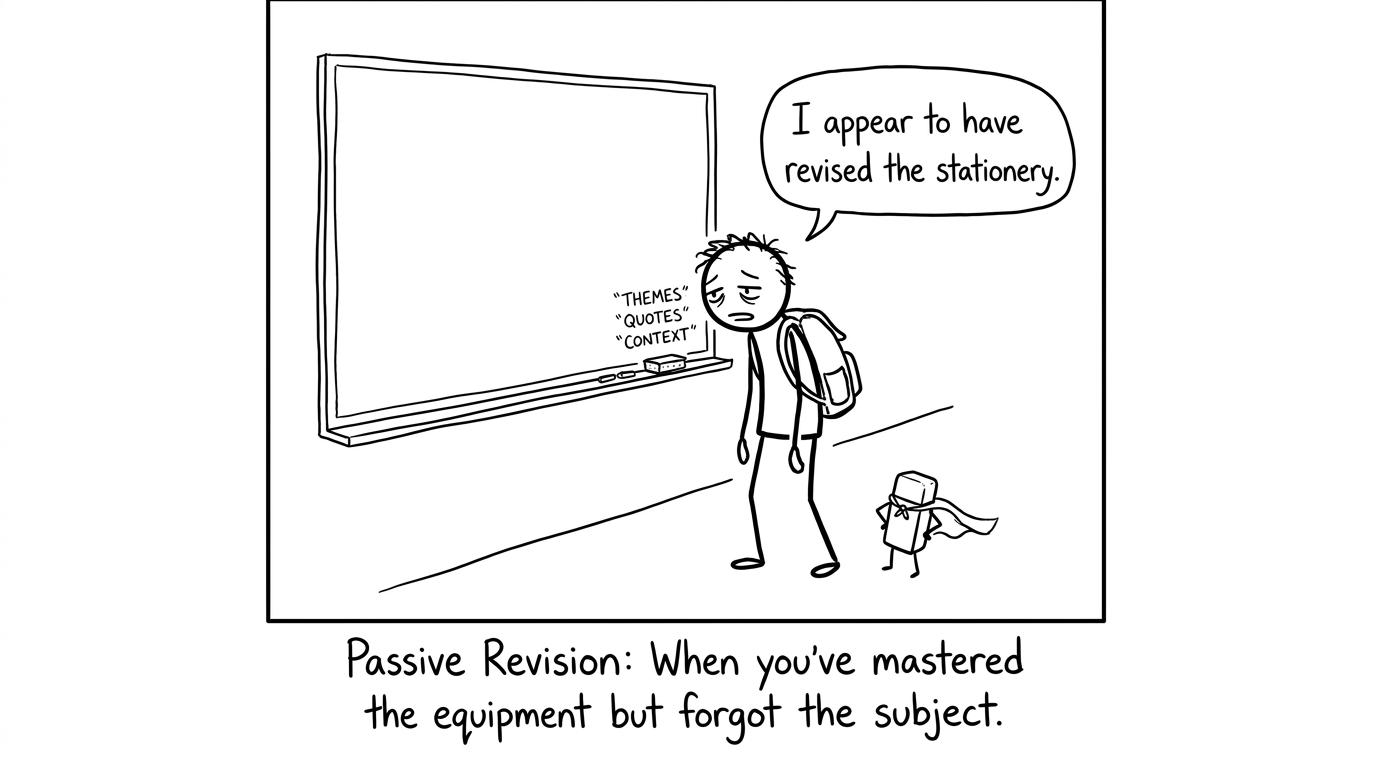 A student discovers that attractive stationery is not the same as revision
Why whiteboard revision can work
Retrieval practice means attempting to bring previously learnt information back to mind. Evidence reviewed by the Education Endowment Foundation supports retrieval as a promising way to strengthen learning, although its success depends on thoughtful implementation, suitable challenge and feedback.
A whiteboard is well suited to this process because it lowers the emotional cost of being wrong. A blank page in a revision book can feel permanent. A whiteboard invites an attempt: write, check, correct, erase and try again.
That cycle matters more than the surface.
It makes weak knowledge visible
Rereading can create familiarity. You see a quotation and think, “I know that.” When the book closes, however, perhaps you remember only half of it, cannot identify who says it or cannot connect it to the question.
A blank whiteboard removes that illusion. If you cannot reconstruct the idea, it is not yet secure enough for an exam.
This is the same principle behind effective maths practice. A method can look obvious while a video solution is playing, but independent questions reveal whether you can actually use it. Maths students can apply that cycle through the GCSE Maths revision hub, where lessons lead into questions, solutions and exam practice.
It encourages organisation rather than accumulation
English Literature requires connected knowledge. GCSE subject content includes critical reading, informed personal responses, textual evidence, analysis of language, form and structure, contextual understanding and comparison.
Those demands are not met by owning the largest pile of notes. They are met by seeing relationships.
A whiteboard gives you enough space to place a theme in the centre, surround it with characters and moments, then add quotations, methods and relevant context. The finished map matters less than the decisions involved in constructing it.
It supports fast correction
Retrieval without checking can preserve errors. After every whiteboard task, compare your response with the text, class materials or a reliable school resource. Correct inaccurate wording, weak links and misplaced context in another colour.
Then erase everything.
The correction becomes useful when you attempt the task again later without looking.
How to use a whiteboard beyond copying notes
The best activities create a small amount of productive difficulty. You should need to think, but the task should remain specific enough to check.
Build quotation constellations
Write one character or theme in the centre. Without opening the text, add a small group of flexible quotations around it. Beside each quotation, record:
- where it appears in the text;
- the idea it could support;
- one language, form or structural feature worth analysing;
- another theme or character it connects to.
This prevents quotation revision from becoming a collection of isolated lines. A short quotation that supports several arguments is often more useful than a long quotation remembered without understanding.
Do not obsess over reproducing every sentence perfectly before you understand it. Accurate quotation matters, but so does selecting evidence that supports an interpretation. Check wording carefully after each attempt.
Create an essay-planning sprint
Choose a genuine question from your exam board or teacher. Give yourself a short, fixed planning period and write only:
- a clear overall argument;
- the main idea for each paragraph;
- relevant textual evidence;
- the writer’s methods;
- context that genuinely develops the interpretation.
Do not write the whole essay on the board. The purpose is to practise making decisions quickly.
Once finished, ask whether every paragraph answers the exact question. If a point could be pasted into almost any essay, it probably needs sharpening.
Use a quotation repair grid
Divide the board into sections for secure, partial and missing recall. Test yourself on quotations selected in advance, then place each one according to the quality of your recall.
Your next session should begin with the missing and partial material, not the secure material. This is simple diagnostic revision: attention follows evidence rather than preference.
Maths revision improves through the same honesty. MathsGenie’s guide to finding weak GCSE topics explains how attempts, marking and retesting can turn mistakes into a focused plan.
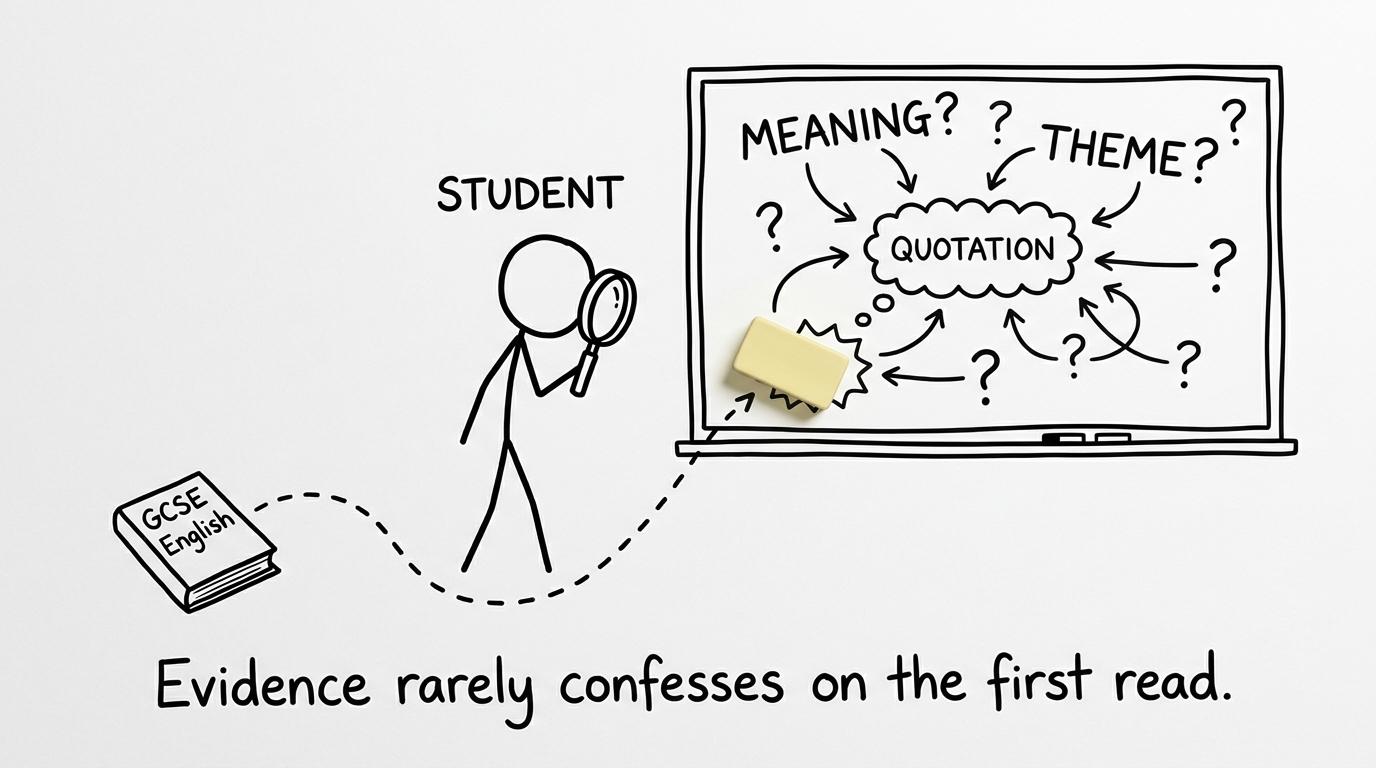 A quotation attempts to evade a determined revision detective
Practise analysis chains
Place a short quotation in the centre. Around it, answer increasingly demanding prompts:
- What does it suggest?
- Which specific word carries the idea?
- What alternative interpretation is possible?
- How does the writer’s method shape meaning?
- Does its significance change elsewhere in the text?
- Which part of the question does this analysis answer?
This moves revision beyond spotting techniques. Naming a metaphor is not the same as explaining why its meaning matters.
Make comparison routes for poetry
For anthology poetry, put one poem on each side of the board. Connect them through theme, viewpoint, tone, imagery, form and structure. Use different line styles for similarity and contrast if that helps you see the relationship.
Then cover or erase one poem and rebuild its links from memory.
Keep the comparison purposeful. Two poems both containing imagery is rarely an insightful connection. A stronger route examines how different choices create related or contrasting perspectives.
Reconstruct a text’s architecture
Draw a simple timeline or sequence of sections from memory. Mark turning points, changes in relationships, recurring images and shifts in power or viewpoint.
This is especially useful because GCSE English Literature assesses whole-text understanding, not just isolated quotations. For extract-based questions, knowledge of what happens before and after the printed passage helps you connect the extract to the wider work.
Teach the board
After constructing a map or plan, stand back and explain it aloud without reading every word. Imagine that the listener keeps asking, “Why?”
If your explanation becomes vague, circle the weak connection. That is your next revision target.
Speaking is not a replacement for timed writing, but it can reveal whether an argument exists before you spend time turning it into an essay.
A repeatable whiteboard revision routine
A useful session does not need to occupy an entire evening. Try this sequence:
- Choose: Set one narrow target, such as a character, poem pairing or theme.
- Retrieve: Complete the task with books and notes closed.
- Check: Compare your board with the text and trusted class materials.
- Correct: Add missing details and repair inaccuracies clearly.
- Explain: Summarise the argument aloud.
- Erase: Remove the comfort of leaving the answer visible.
- Return: Reconstruct it after a delay.
- Apply: Finish with an exam plan or written paragraph on paper.
That final stage is important. Your examination response will be handwritten or typed under formal conditions, not presented as a mind map. The whiteboard prepares the knowledge; written practice prepares the performance.
For students managing several subjects, consistency is easier when every subject follows a similar loop. MathsGenie’s one-month GCSE maths revision plan uses retrieval, focused practice and marking to make revision decisions more manageable.
Match the task to your specification
GCSE English Literature is untiered, unlike foundation and higher tier GCSE maths. However, question formats, set texts, assessment arrangements and mark allocations differ between AQA, Edexcel, OCR and Eduqas.
Check your current specification and teacher guidance before deciding what to practise. Learn which questions require comparison, which provide an extract or poem, where contextual understanding is assessed and where accuracy of spelling, punctuation and grammar contributes to the marks.
The common assessment objectives broadly reward:
- informed responses supported by textual references;
- analysis of language, form and structure;
- understanding of texts and their contexts;
- clear, accurate writing where applicable.
Your whiteboard tasks should therefore lead towards interpretation and analysis, not quotation recall alone.
Lessons GCSE maths students can transfer
English Literature and maths feel different, but effective revision in both follows a similar rhythm: attempt, inspect, repair and retest.
In maths, you might recall a formula, sketch a method, attempt questions and then use the mark scheme. In literature, you recall evidence, construct an argument, test its relevance and improve it using feedback.
Use the whiteboard for low-stakes recall, then use the appropriate exam format for performance practice. For maths, GCSE mini tests provide short checks, while MathsGenie’s past-paper guide explains how to turn lost marks into targeted revision.
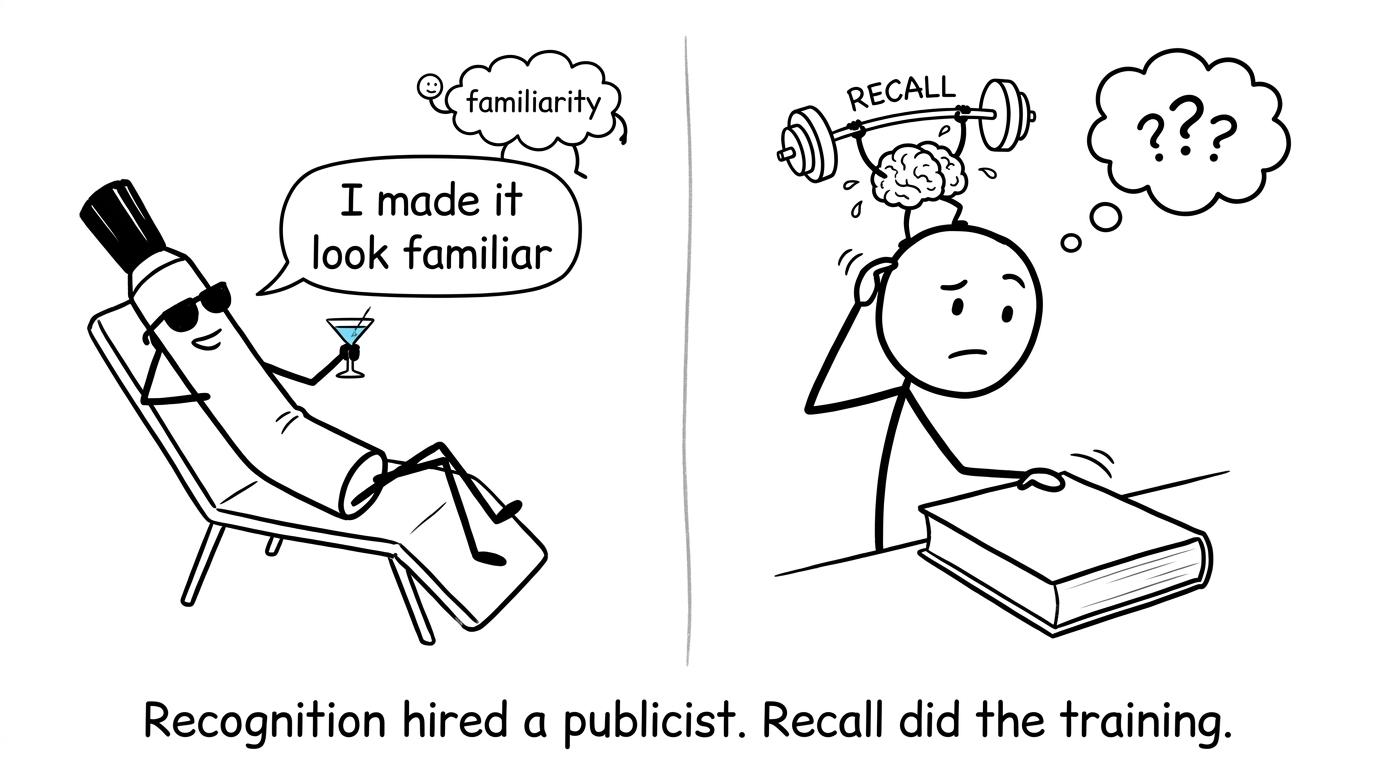 Recognition boasts while recall quietly does the difficult training
Common whiteboard revision mistakes
Copying before attempting recall
Looking at your notes while filling the board removes the main challenge. Close the materials first. Even an incomplete attempt gives you valuable information about what needs attention.
Making beautiful but unusable displays
Colour can clarify categories, but decoration is not evidence of learning. Use colour for a defined purpose, such as separating evidence, analysis and context.
Revising quotations without arguments
Knowing many lines does not automatically produce a strong response. For every quotation, ask what claim it supports and how the writer’s choices create meaning.
Adding context as a detached fact
Historical information should illuminate the text or interpretation. A memorised fact placed at the end of a paragraph does not become relevant merely because it is accurate.
Never practising sustained writing
A whiteboard is excellent for retrieval and planning, but it cannot replace essays, paragraphs and timed responses. Use both tools.
Failing to revisit errors
Correcting a board once may create another moment of recognition. Schedule another closed-book attempt after a delay to find out whether the correction has lasted.
Treating every session as a complete text review
Broad tasks often produce shallow answers. Narrow the focus: one relationship, one structural shift or one comparison route. Depth becomes easier when the target is clear.
Make the whiteboard earn its place
A whiteboard is not a shortcut to knowing a novel, play or poetry anthology. It is a useful testing surface: temporary enough to encourage attempts, spacious enough to reveal connections and unforgiving enough to expose what you cannot yet recall.
Use it to think, not transcribe. Retrieve with notes closed, check accurately, correct visibly, erase and return. Then transfer that knowledge into timed writing.
And when English revision is finished for the day, use the same active cycle for maths. Start at the MathsGenie GCSE Maths hub, rebuild weak methods with free revision lessons and practice questions, then check your progress with mini tests, mark schemes, video solutions, past papers and predicted papers. The subject changes. The productive habit does not.










