Whiteboard Revision GCSE Economics: Is It Useful?
Whiteboard revision GCSE Economics can improve recall, diagrams and calculations. Learn effective methods, common mistakes and a practical routine today.
A whiteboard can create the comforting appearance of revision. There are coloured pens, tidy diagrams and the satisfying sweep of an eraser. Yet none of that guarantees that anything has been learnt.
Used properly, whiteboard revision GCSE Economics is genuinely useful. Its value comes from retrieving ideas without notes, reconstructing diagrams, planning chains of analysis and correcting mistakes quickly. It is far less useful when it becomes another surface for copying the textbook.
A whiteboard should be a testing ground, not a display board. It cannot replace timed exam questions, careful written answers or specification coverage. But combined with those things, it can make Economics revision more active and reveal gaps that passive reading tends to hide.
A quick whiteboard revision checklist
Before starting, check that your session includes the following:
- one narrow topic or question rather than an entire unit;
- closed-book recall before checking notes;
- diagrams drawn and labelled from memory;
- calculations completed without looking at a method;
- chains of economic reasoning explained aloud;
- corrections made in a different colour;
- a permanent record of important mistakes;
- follow-up practice on paper.
That last point matters. Economics exams are written on paper, so your revision eventually needs to look and feel like the real task.
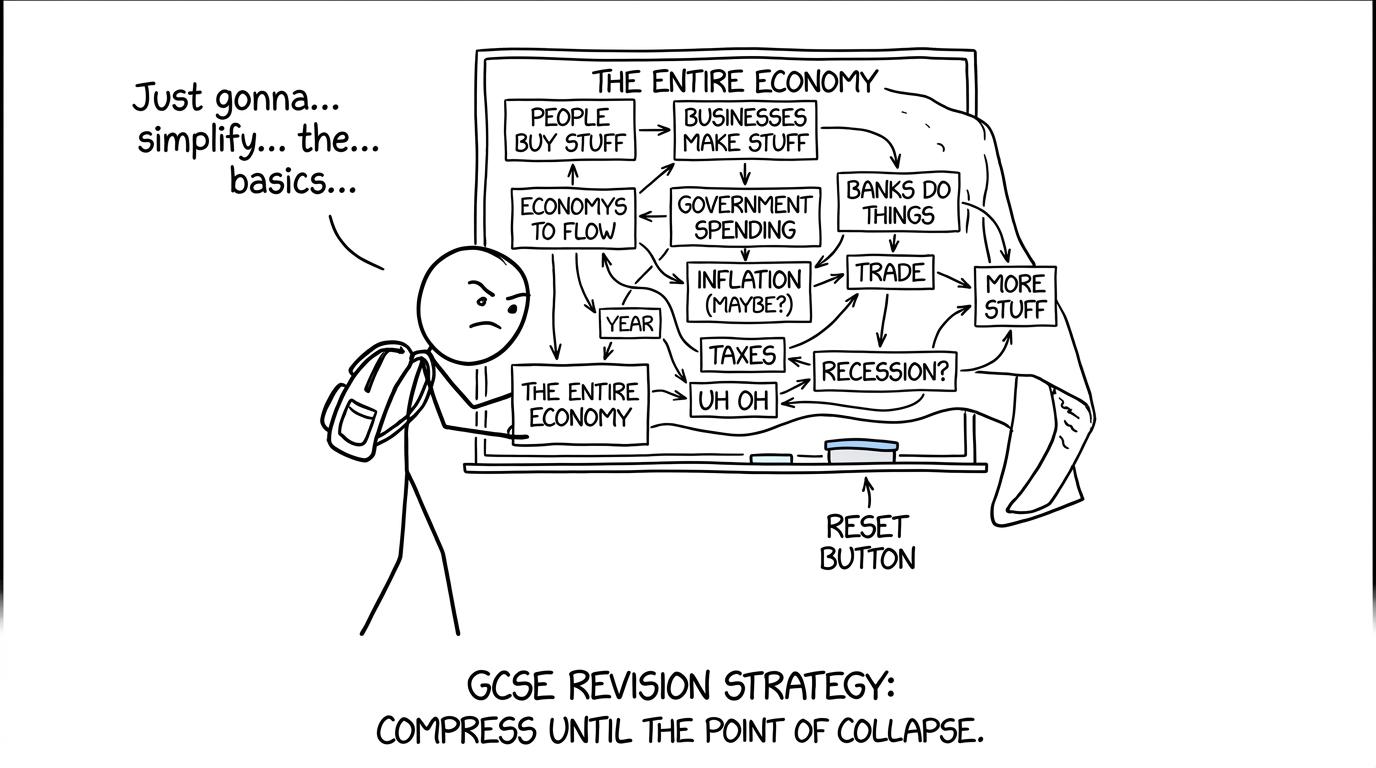 A student trying to fit the entire economy onto a tiny whiteboard
Why a whiteboard can improve Economics revision
The most useful revision often feels slightly difficult. Looking at a completed page feels fluent because the answer is already present. Producing it from memory is harder because your knowledge has to do the work.
Research into retrieval practice broadly supports this distinction: attempting to recall information can strengthen later retention more effectively than repeatedly reviewing the same material. A whiteboard makes that process quick and low-stakes. If an answer is wrong, you can erase it, try again and compare it with the specification or mark scheme.
This suits GCSE Economics because the subject demands several different forms of thinking. You need accurate definitions, connected analysis, correctly labelled diagrams, quantitative skills and balanced evaluation. One revision method will not master all five, but a whiteboard can rehearse each of them.
For GCSE Economics in England, students should follow the requirements of their own exam board, commonly AQA or OCR, rather than assuming every specification uses identical language or assessment structure. Keep the current specification beside you when organising topics, then close it before testing yourself.
Use the whiteboard for retrieval, not transcription
Copying a definition may improve handwriting. It does not show whether you could produce that definition tomorrow.
Instead, write a prompt such as “opportunity cost”, “inflation” or “market failure”, then turn your notes over. Give yourself a short period to record everything relevant. Include the definition, causes, consequences, related diagrams and possible evaluation points.
Only check your materials after the attempt. Add missing ideas in another colour. This creates a visible distinction between what you knew independently and what merely looked familiar when you read it.
A useful sequence is:
- retrieve;
- check;
- correct;
- erase;
- retrieve again later.
The erasing is not a problem. The learning lies in reconstructing the idea. However, photograph important corrections or transfer them to an error log so that the same weakness is revisited.
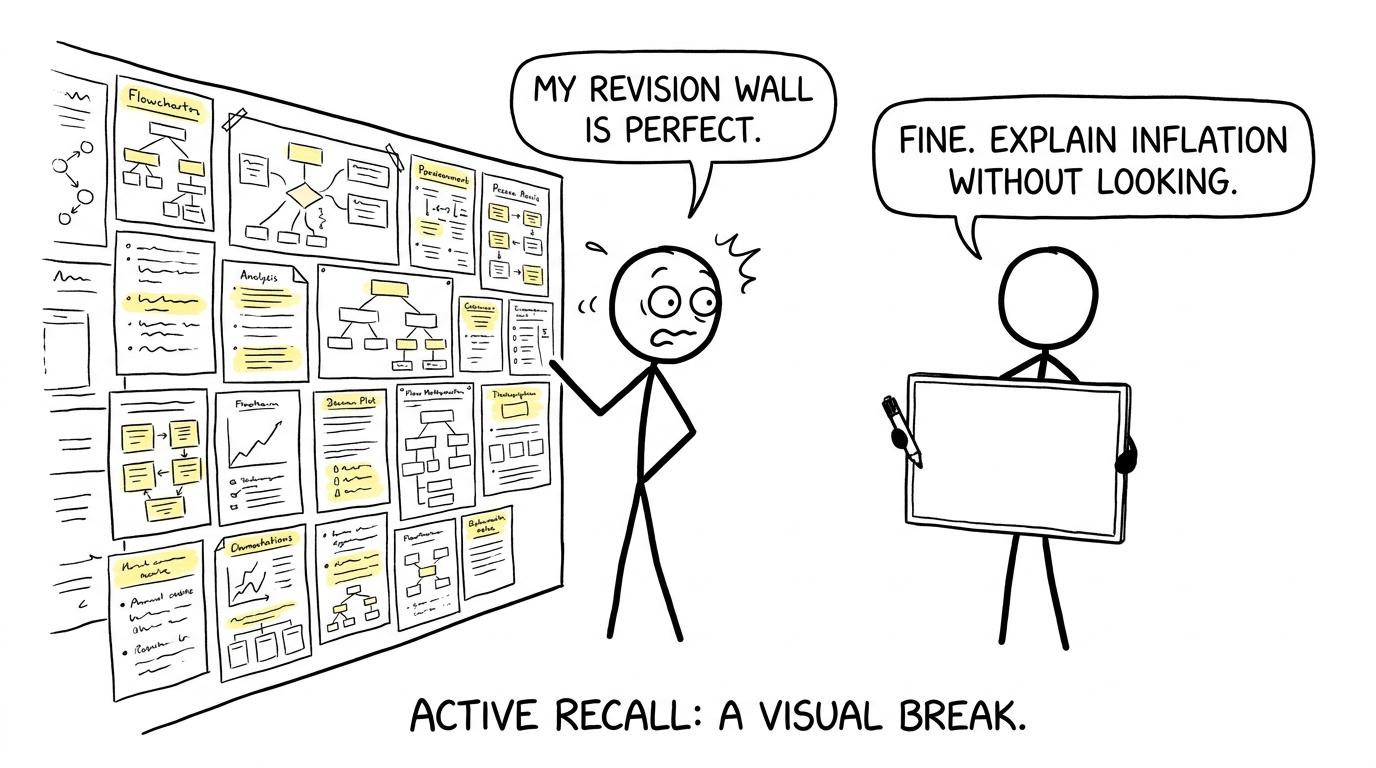 One student challenges another to explain inflation without notes
Build economic diagrams from memory
A blank whiteboard is particularly helpful for diagram practice because it removes the temptation to trace a finished model.
Choose a diagram required by your specification and reconstruct it without support. Check:
- whether both axes are labelled;
- whether curves have the correct names;
- whether the direction of a shift is clear;
- whether the original and new equilibria are identified;
- whether your written explanation matches the change shown.
Do not stop once the picture looks correct. Explain the economic mechanism aloud. A diagram is evidence supporting an argument, not a substitute for one. If demand shifts, identify why it shifts, what happens to equilibrium and how this affects the relevant consumers, workers, firms or government.
You can also divide the board into “diagram”, “analysis” and “evaluation”. This forces the visual model and the written reasoning to support each other.
Turn chains of reasoning into something visible
Longer Economics responses are rarely improved by collecting disconnected facts. Examiners need to see a logical chain.
Begin with a policy, event or change on the left of the board. Use arrows to connect each consequence:
- initial change;
- effect on incentives or costs;
- response by an economic agent;
- effect on a market or objective;
- final consequence for stakeholders.
Then challenge every arrow. Ask, “Why does this follow?” If you cannot justify a connection, the chain contains a gap.
For evaluation, branch the chain. One path might represent the short run and another the long run. Other branches could compare large and small firms, high-income and low-income households, or conditions under which the outcome may change. This makes evaluation part of the analysis rather than a vague sentence added at the end.
Practise the quantitative side of Economics
GCSE Economics includes quantitative skills, so the whiteboard can also be used for short calculation drills. Relevant relationships may include percentage change, revenue, costs and elasticity, depending on your specification.
For example, percentage change is represented by:
Percentage change=new value−original valueoriginal value×100\text{Percentage change}=\frac{\text{new value}-\text{original value}}{\text{original value}}\times 100Percentage change=original valuenew value−original value×100Price elasticity of demand is expressed as:
PED=percentage change in quantity demandedpercentage change in price\text{PED}=\frac{\text{percentage change in quantity demanded}}{\text{percentage change in price}}PED=percentage change in pricepercentage change in quantity demandedRevenue can be represented by:
Total revenue=price×quantity sold\text{Total revenue}=\text{price}\times\text{quantity sold}Total revenue=price×quantity soldAverage cost is:
Average cost=total costquantity produced\text{Average cost}=\frac{\text{total cost}}{\text{quantity produced}}Average cost=quantity producedtotal costThe whiteboard is useful for recalling formulas and selecting a method, but complete some practice on paper too. On a glossy surface, working can become compressed and difficult to review. Paper encourages the clear layout needed to earn method marks where they are available.
If percentages, ratio or graphs are slowing down your Economics answers, use the free GCSE maths revision lessons on MathsGenie to strengthen the underlying skills. Each topic can be supported by videos and exam-style practice rather than formula memorisation alone.
Plan exam answers without writing every sentence
A whiteboard is excellent for planning longer responses because plans are temporary by nature.
Write the question at the top, underline its command word and identify the context. Then create a compact structure containing:
- the relevant economic concept;
- one developed analytical route;
- contextual application;
- a second route or counterargument;
- conditions affecting the judgement;
- a conclusion answering the precise question.
This is not a model answer. It is a map of the argument. Once the structure is sound, write the complete response on paper under timed conditions.
Use your exam board's official past questions and mark schemes for Economics. For quantitative confidence, MathsGenie's GCSE maths past papers help you practise selecting methods when the topic is not announced in advance. That shift from topic practice to mixed papers is important because recognition is part of solving a problem.
Create a short whiteboard revision routine
A productive session does not need to fill the board. Try this repeatable structure:
Recall
Choose one specification heading and write what you know without notes. Keep the scope narrow enough that you can check it accurately.
Reconstruct
Draw the associated diagram or organise a chain of reasoning. Explain each connection aloud rather than relying on arrows alone.
Apply
Plan a response to a contextual question or complete a short calculation. Decide which information actually matters.
Review
Check against trusted notes, the specification and a mark scheme. Circle gaps and correct them in a new colour.
Record
Transfer unresolved errors to a revision list. Decide when you will test them again. For maths weaknesses, the MathsGenie GCSE revision hub provides graded topic practice, while GCSE predicted papers can support realistic maths exam preparation closer to the examination period.
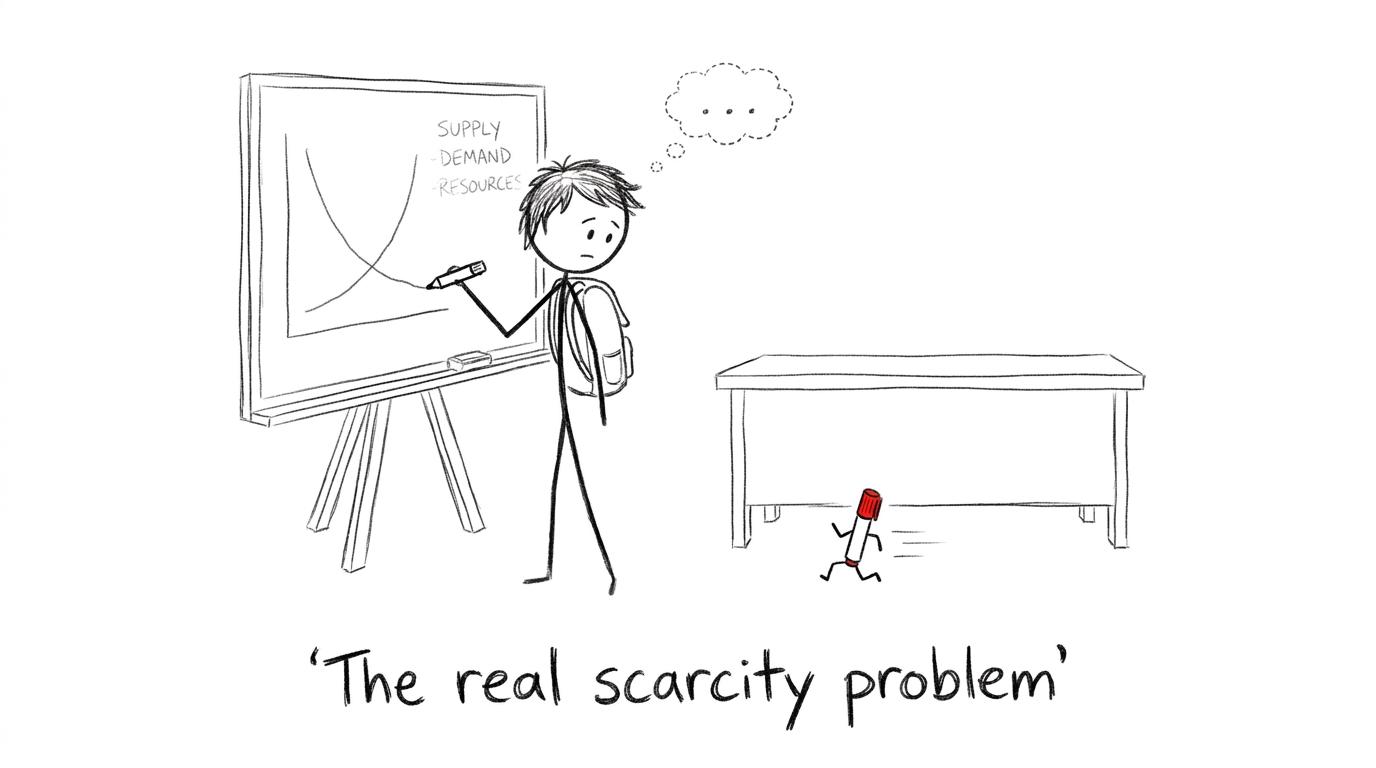 A runaway marker cap demonstrates the real scarcity problem
When a whiteboard is not enough
The whiteboard's greatest advantage is also its limitation: everything feels temporary. Real examinations require sustained handwriting, precise terminology, contextual application and decisions about timing.
Balance whiteboard sessions with:
- handwritten responses completed under time pressure;
- past-paper questions from your Economics exam board;
- systematic use of mark schemes and examiner guidance;
- spaced returns to previously revised topics;
- mixed calculation practice without formula prompts.
MathsGenie should be used for the mathematical foundations rather than as a replacement for subject-specific Economics materials. Start at the free MathsGenie revision homepage and select the skill that is causing difficulty. Students continuing beyond GCSE can also use the A Level maths revision resources and A Level past papers.
Common whiteboard revision mistakes
Copying notes neatly
Neatness can disguise passivity. Begin with the board blank and your notes closed. Presentation matters only when it improves understanding.
Erasing errors too quickly
An error is useful information. Correct it, record it and schedule another attempt before wiping it away.
Drawing diagrams without explaining them
Labels and curves are only part of the answer. Practise explaining the cause, mechanism and consequence represented by the diagram.
Avoiding full written responses
Planning feels faster than writing, so it is easy to overuse. Whiteboard plans must lead to timed answers on paper.
Revising only favourite topics
A reusable board makes it tempting to repeat quick, comfortable tasks. Use your specification or revision planner to rotate between microeconomics, macroeconomics, diagrams, calculations and extended responses.
Treating recall as the final step
Remembering a definition is the beginning. High-quality answers also require application, analysis and justified evaluation.
The verdict: useful when the board stays temporary
A whiteboard is genuinely useful for GCSE Economics when it makes thinking visible. Use it to retrieve definitions, rebuild diagrams, expose missing links, plan arguments and rehearse calculations. Do not use it simply to reproduce polished notes.
The best revision tools do not remove effort. They place effort where it is most valuable. A blank board asks a direct question: what can you produce without help?
Use the answer to guide your next step. Strengthen weak quantitative skills with MathsGenie's GCSE revision lessons, then test them through past papers and mark schemes, practice questions and predicted maths papers. The whiteboard can reveal the gap. Deliberate practice is what closes it.