When to Stop Revising GCSE Economics the Night Before
When to stop revising GCSE Economics the night before: set a calm cut-off, use a short recall check and protect the sleep you need to think clearly.
There comes a point the night before an exam when revision stops building confidence and starts consuming tomorrow's energy. The difficult part is noticing when you have reached it.
If you are wondering when to stop revising GCSE Economics the night before, the practical answer is this: finish intensive revision around 606060 to 909090 minutes before you intend to sleep, leaving enough time to wind down and give yourself the recommended 888 to 101010 hours of sleep opportunity for teenagers. For many students with a morning exam, that means stopping at roughly 8:308{:}308:30-9:30 pm9{:}30\text{ pm}9:30 pm, depending on when they must wake.
The goal is not to cover the entire specification in one evening. It is to arrive rested enough to retrieve, apply and evaluate what you already know.
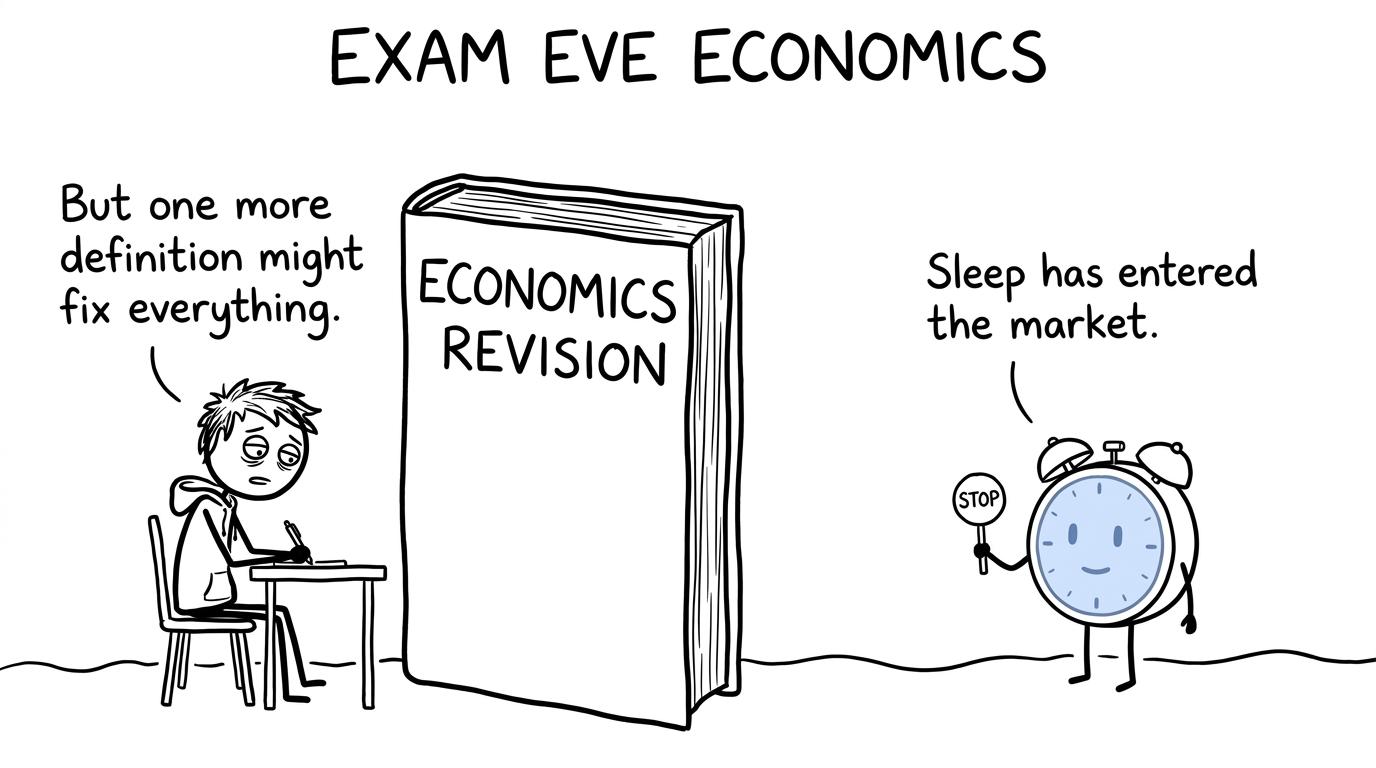 A tired GCSE student negotiates with an alarm clock about one more economics definition
Your night-before revision checklist
A sensible final evening should be deliberately limited. Aim to:
- choose your stopping time before opening your notes;
- check the exact paper, start time and required equipment;
- complete one short active-recall session;
- review a small number of weak definitions or diagrams;
- revisit command words and your exam board's expectations;
- avoid beginning a full paper late in the evening;
- pack your bag, set an alarm and put your phone away;
- protect enough time for sleep.
This is a finishing routine, not a rescue mission. If Economics is one of several exams in your week, use a broader plan rather than allowing the nearest paper to consume the whole evening. Maths students can organise their remaining topics through the free MathsGenie GCSE revision resources, keeping the night before each exam light and focused.
Set your cut-off time backwards from the morning
There is no universally correct bedtime. Travel, breakfast, medication, family routines and the time at which you naturally settle all matter. Work backwards from when you genuinely need to wake up.
A useful planning relationship is:
revision cut-off=wake-up time−sleep opportunity−wind-down time.\text{revision cut-off}=\text{wake-up time}-\text{sleep opportunity}-\text{wind-down time}.revision cut-off=wake-up time−sleep opportunity−wind-down time.Your wind-down period might include packing your bag, washing, changing and reading something undemanding. It should not quietly become another hour of economics videos in bed.
Current UK health guidance generally recommends around 888 to 101010 hours of sleep for teenagers. Treat that as a meaningful part of exam preparation, not spare time left over after revision. Sleep supports attention, memory and decision-making, all of which matter when you must interpret a source, construct a chain of reasoning or judge which argument is strongest.
If your planned session would push bedtime later, shorten the revision rather than automatically shortening sleep. One more tired hour is not always one more useful hour.
Signs that you should stop revising now
A clock provides a boundary, but your concentration provides evidence. Stop early if you notice that you are:
- rereading the same paragraph without being able to explain it;
- copying notes mechanically rather than retrieving information;
- repeatedly making mistakes on ideas you normally understand;
- becoming more anxious with each new topic;
- jumping between resources without a clear purpose;
- telling yourself that you must cover everything before sleeping.
These signs do not prove that you know nothing. They usually show that the quality of the session is falling. Economics demands more than recognition. You need enough mental space to select relevant knowledge, respond to the context and develop a coherent judgement.
Stopping is therefore not giving up. It is deciding that tomorrow's concentration has become more valuable than tonight's extra page.
What to revise in the final short session
The night before is best used for retrieval and reassurance. It is a poor time for building an entire topic from the beginning.
Recall essential vocabulary
Without looking at your notes, say or write concise definitions for a carefully chosen group of terms from the paper you are sitting. Then check them against your specification-approved materials.
Focus on distinctions that are easy to blur, such as a movement along a curve compared with a shift, or economic growth compared with economic development where these appear in your course. Accurate vocabulary makes later explanation easier, but do not spend the evening memorising polished sentences word for word.
Check chains of reasoning
For a small selection of topics, ask yourself:
- What changes first?
- Who is affected?
- What is the likely consequence?
- What factor could weaken or reverse the effect?
That sequence reflects the thinking needed in many GCSE Economics responses. The precise assessment language and mark allocation vary between exam boards and questions, so use your own specification, past papers and mark schemes rather than relying on a universal answer template.
Review diagrams and quantitative skills
Check that you can label the relevant axes, curves and equilibrium points required by your specification. Also remind yourself to show workings when answering quantitative questions involving percentages, averages, index numbers or data interpretation.
This is where regular maths practice quietly helps. During the wider exam season, MathsGenie revision lessons and practice questions can strengthen the numerical fluency that supports both GCSE Maths and data-heavy questions elsewhere.
Revisit command words
Briefly check what your exam board expects when it asks you to calculate, explain, analyse, assess or evaluate. Read the whole question, including the context and number of marks available.
Do not assume that every longer question needs an identical number of paragraphs. Strong answers respond to the actual wording, use relevant evidence and reach a supported judgement when one is requested.
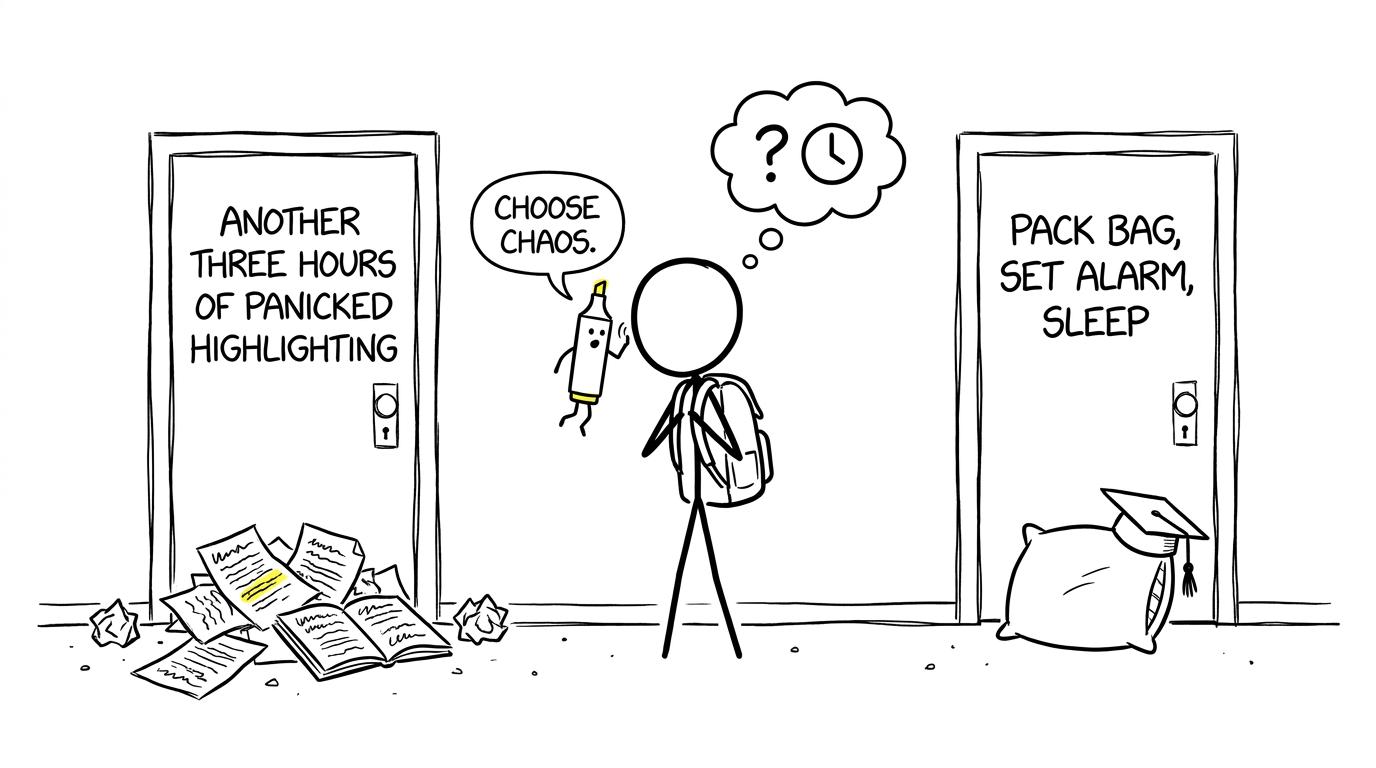 A GCSE student chooses between panicked highlighting and a calm bedtime routine
Use a final recall check, not a late mock exam
A full paper can be useful earlier in your revision because it exposes gaps and helps with timing. Late on the final evening, however, it may create problems that you no longer have sensible time to address.
Use a short closed-book check instead. Give yourself a limited set of prompts covering definitions, diagrams, reasoning and evaluation. Afterwards, check only what you missed. The purpose is to activate familiar knowledge, not to generate a frightening list of everything that could appear.
For Maths exams later in the timetable, save full papers for earlier planned sessions. MathsGenie provides exam-board collections including Edexcel GCSE Maths past papers, AQA GCSE Maths past papers and OCR GCSE Maths past papers. Past papers have their greatest value when you still have time to mark them, understand errors and practise the weak topics they reveal.
The same principle applies to predicted papers. They are practice materials, not a guarantee of what an exam will contain. Use MathsGenie predicted papers as part of planned revision rather than as a last-minute forecast.
What to do after you stop
A stopping time only works if revision genuinely ends. Close the book, rather than moving from written notes to anxious searching on your phone.
Prepare the practical details of the morning:
- check the exam date, start time and location using information from your school;
- pack permitted equipment;
- place any required identification or documents in your bag;
- decide how and when you will travel;
- set an alarm and, if useful, a backup;
- prepare breakfast and water where practical.
Follow your school's instructions and the current exam rules about permitted equipment. Economics papers may require a calculator, but requirements depend on the qualification and paper, so check rather than assume.
If anxious thoughts continue, write down the few things you want to remember in the morning. Once they are on paper, you do not need to keep rehearsing them in bed. Avoid trying to extend revision with caffeine if it is likely to interfere with your sleep.
Common mistakes the night before an Economics exam
Trying to relearn the whole course
A specification is designed to be taught over a substantial period, not compressed into one evening. Prioritise familiar but fragile knowledge. Completely unfamiliar content is unlikely to become secure through rushed reading at midnight.
Highlighting instead of retrieving
Highlighting can feel productive because the page changes colour. Your memory may not. Close the notes and attempt to recall the idea before checking it.
Sacrificing sleep to reduce anxiety
Staying awake can create the comforting feeling that you are still taking action. Yet it can leave you less able to concentrate, interpret wording and control your time in the exam. Anxiety often asks for more revision when what your brain needs is a boundary.
Comparing your cut-off with somebody else's
Messages about who is still revising tell you little about the quality of their preparation. A classmate's timetable, sleep needs and journey may be different. Follow the plan that allows you to function well.
Checking unofficial predictions repeatedly
No prediction can remove uncertainty from an exam. Concentrate on the published specification, your teacher's guidance, relevant past questions and official mark schemes.
Turning the final check into self-criticism
Forgetting one term does not erase everything you know. Correct it, test it once more and move on. The final evening should reduce avoidable errors, not produce a verdict on your ability.
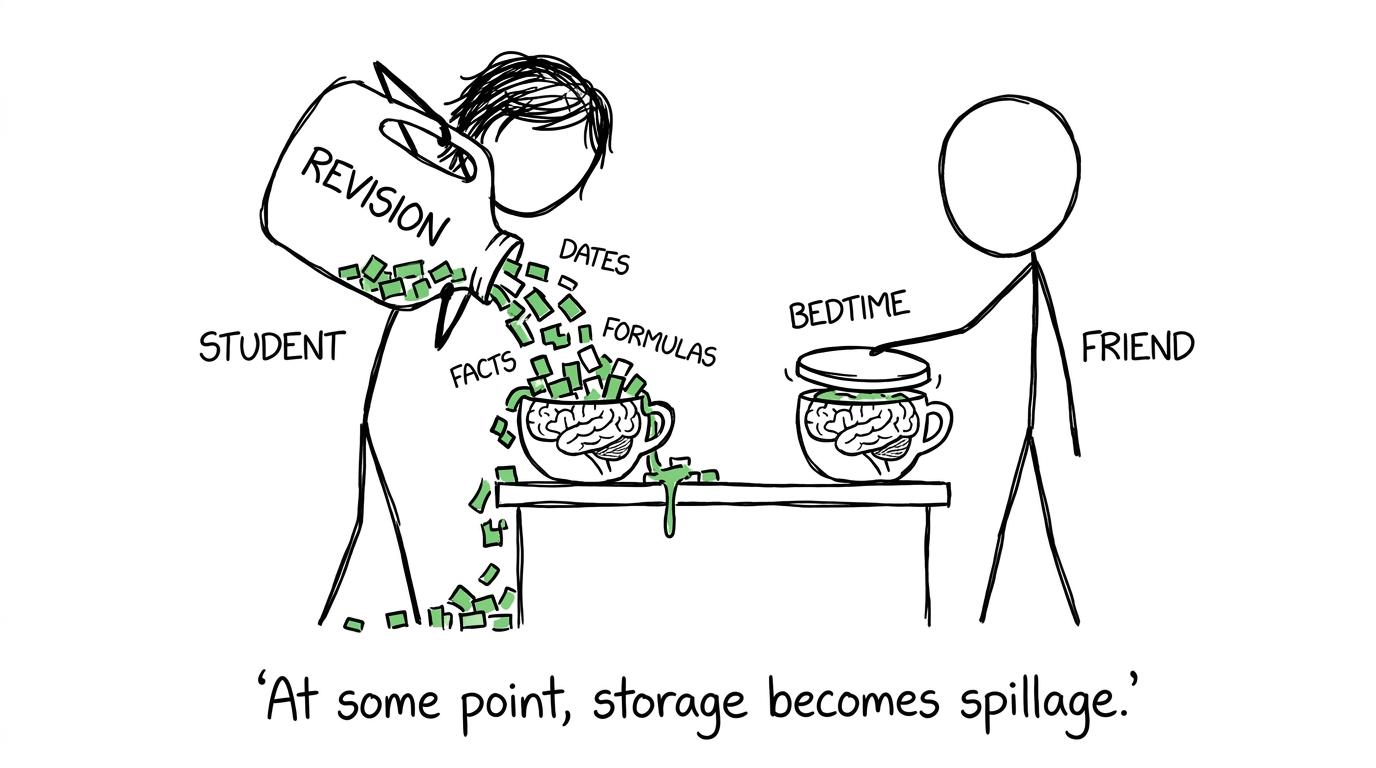 Revision facts overflow from a brain-shaped cup until bedtime provides a sensible lid
A calmer rule for the whole exam season
The best night-before routine is created several days earlier. Spread demanding work across the week, complete papers while there is still time to respond to mistakes, and reserve the final evening for light retrieval.
This matters especially when GCSE Economics sits close to Maths, English or Science in your timetable. Borrowing sleep for one paper can affect the next morning and the revision that follows. Protecting your energy across the entire exam series is usually wiser than treating every evening as an emergency.
MathsGenie can provide the structure for the mathematical side of that plan. Use its free GCSE Maths revision hub to select topics by grade, then combine revision lessons, videos, practice questions and mini tests with properly timed past papers. Students considering their next stage can also explore the MathsGenie A Level Maths revision resources.
Stop while tomorrow still benefits
A good stopping point is not the moment when every possible fact feels secure. That moment may never arrive. It is the point when another session is likely to cost more concentration than it creates knowledge.
Set your cut-off in advance, complete one focused recall check and leave time for a calm routine and sufficient sleep. Then trust the work already done.
For the rest of your exam timetable, make MathsGenie your free GCSE Maths revision base. Choose a revision lesson, practise the topic, mark your answers carefully and use past or predicted papers before the final night. Preparation works best when it is repeated calmly, and when it knows when to stop.