When to Stop Revising GCSE Astronomy the Night Before
When to stop revising GCSE Astronomy the night before: set a firm cut-off, protect 8-10 hours of sleep and use a calm final review plan.
The strange thing about revising astronomy is that the subject itself encourages you to stay awake. There is always another planet, observation method or calculation that feels worth checking.
But if you are wondering when to stop revising GCSE Astronomy the night before, the practical answer is simple: stop at least 303030 minutes before bed and choose a bedtime that gives you 888 to 101010 hours of sleep. For many students, that means ending revision between 8:30 pm8{:}30\text{ pm}8:30 pm and 9:30 pm9{:}30\text{ pm}9:30 pm, depending on when they must wake up.
That cut-off is not surrender. It is the final part of your preparation. Sleep supports concentration and memory, while an anxious late-night cram can leave familiar facts feeling strangely distant the next morning.
Your night-before checklist
Use this as your stopping rule:
- Work backwards from the time you need to wake up.
- Protect 888 to 101010 hours for sleep.
- Allow at least 303030 minutes to wind down.
- Complete one short, focused review rather than starting a full paper.
- Check a few important facts, definitions and mathematical skills.
- Pack your calculator, ruler, pens and exam information.
- Stop when the planned time arrives, even if revision feels unfinished.
The MathsGenie GCSE night-before plan applies the same principle to maths: make a small number of useful decisions, then protect your rest.
Set your cut-off by working backwards
A sensible stopping time is personal because wake-up times differ. The rule can be written as:
revision cut-off=wake-up time−sleep allowance−wind-down time\text{revision cut-off} = \text{wake-up time} - \text{sleep allowance} - \text{wind-down time}revision cut-off=wake-up time−sleep allowance−wind-down timeYour sleep allowance should normally be between 888 and 101010 hours. The NHS advises that most teenagers need this amount and recommends allowing roughly half an hour to wind down between revision or screen use and bed.
If travel, breakfast and getting ready require an early alarm, your revision must finish earlier too. Do not choose a bedtime first and then hope the morning works. Begin with the non-negotiable wake-up time and count backwards.
Treat the resulting cut-off as a boundary, not a suggestion. A stopping time loses its value if it moves by another 202020 minutes whenever you notice one more page.
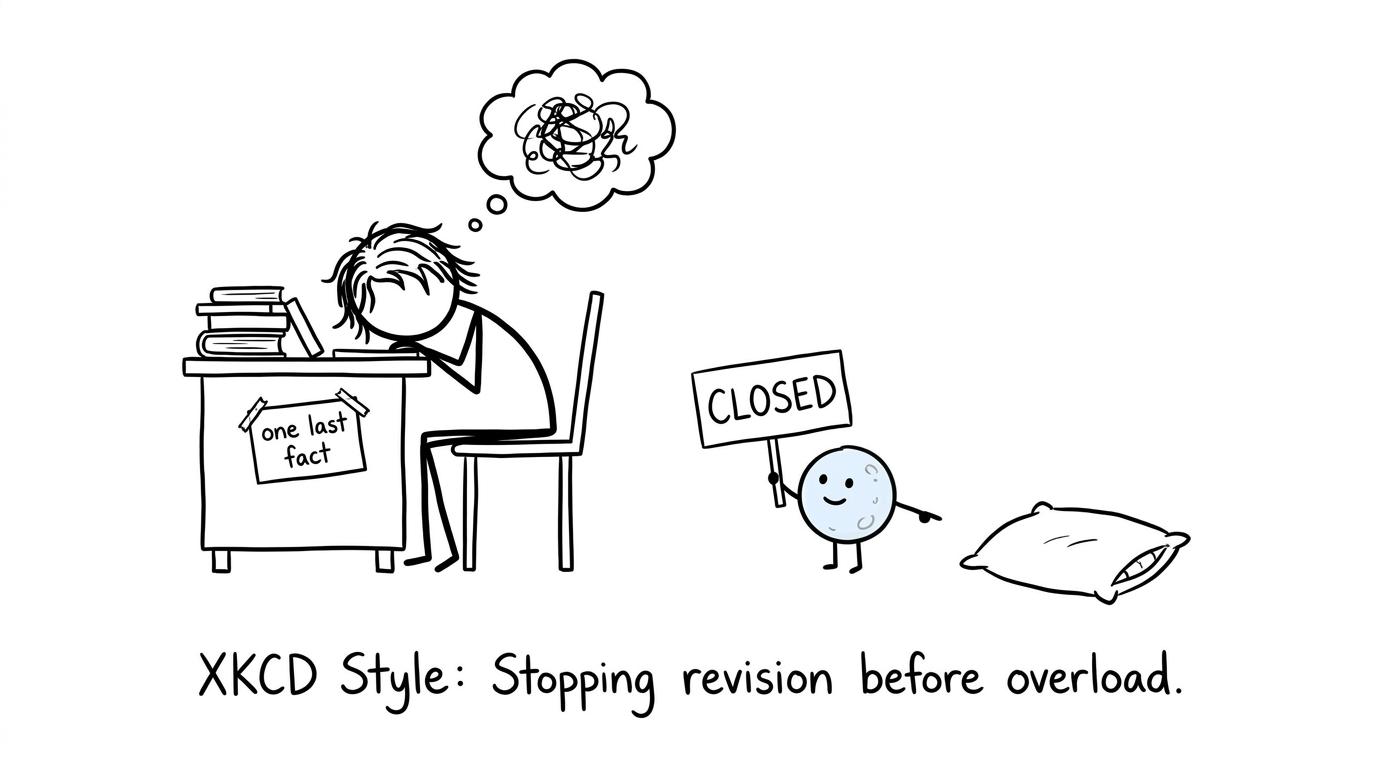 A tired student is reminded by the Moon that revision has closed for the night
Why more revision can become less useful
Late in the evening, the visible measure of revision is time. You can see that you have worked for another hour. What you cannot see as easily is the declining quality of that hour.
Once you are repeatedly rereading sentences, forgetting what a question asked or making basic calculator errors, you are no longer getting the same return from your effort. Continuing may feel disciplined, but the feeling is not reliable evidence that learning is still happening.
Sleep is not empty time after revision. Research on adolescent learning indicates that insufficient sleep can impair attention and recall, particularly when information has been crammed into a short period. Spaced revision completed earlier is more resilient than a final overloaded session.
This is why a structured plan matters before exam week. The GCSE one-month revision plan and GCSE one-week revision plan show how retrieval, practice questions and mark-scheme review can be spread across several days. The earlier work removes pressure from the final evening.
What GCSE Astronomy actually asks you to do
The current Pearson Edexcel GCSE Astronomy specification is untiered. Unlike GCSE Maths, there is no foundation or higher tier, and every student follows the same grades 999-111 qualification.
Assessment consists of two externally examined papers:
| Paper | Main content | Length | Marks |
|---|---|---|---|
| Paper 111 | Naked-eye Astronomy | 111 hour 454545 minutes | 100100100 |
| Paper 222 | Telescopic Astronomy | 111 hour 454545 minutes | 100100100 |
Each paper contributes 50%50\%50% of the qualification. Questions can include multiple-choice items, short answers, calculations, graphs and extended open responses. A calculator may be used, and the papers include a formula and data sheet.
Mathematical skills account for at least 20%20\%20% of the qualification. Observational knowledge matters too: the specification requires students to undertake at least one unaided and one aided observation during the course, while understanding of observational techniques is assessed in the written papers.
That breadth explains why trying to ‘finish everything’ in one evening is unrealistic. Astronomy is not a list you can read once. It asks you to recall knowledge, apply it, interpret evidence and evaluate methods.
What to revise in your final session
The final session should consolidate material you have already met. It should not become an emergency attempt to learn an untouched topic.
Recall a small set of high-value ideas
Choose topics that your teacher, mock papers or error log have identified as uncertain. Use closed-book recall first, then check your notes. Suitable final tasks include:
- naming and explaining essential processes;
- recalling differences between easily confused terms;
- reviewing common observational limitations and improvements;
- checking units and astronomical distance measures;
- practising how command words change the required response;
- reading your own short error list.
Keep the list narrow. Three fragile areas reviewed properly are more useful than sixteen topics skimmed in rising panic.
Refresh the mathematical skills
Astronomy calculations draw on standard form, ratios, percentages, inverse-square relationships, significant figures, algebra, graphs, angular measures and basic trigonometry. The final evening is a good time to check procedures you already understand, especially calculator entry and units.
For example, standard form must have the structure
a×10n,1≤a<10,a \times 10^n, \qquad 1 \leq a < 10,a×10n,1≤a<10,where nnn is an integer. If large astronomical distances make this notation feel uncertain, use the MathsGenie standard form revision guide earlier in your revision period.
Angular and geometrical questions can also depend on confident use of trigonometric relationships. The MathsGenie SOHCAHTOA topic page provides focused support for that underlying GCSE maths skill.
Do not spend the night memorising every astronomical equation. Pearson supplies key equations and astronomical data in the examination. Your priority is knowing what the quantities mean, selecting an appropriate relationship and substituting values with consistent units.
End with exam readiness
Use your final 101010 minutes for practical preparation:
- confirm whether you are sitting Paper 111 or Paper 222;
- check the start time and room arrangements provided by your centre;
- pack permitted equipment;
- make sure your calculator works;
- prepare water and anything else your school allows;
- set an alarm with enough time for an unhurried morning.
These actions are modest, but they remove preventable decisions from exam morning.
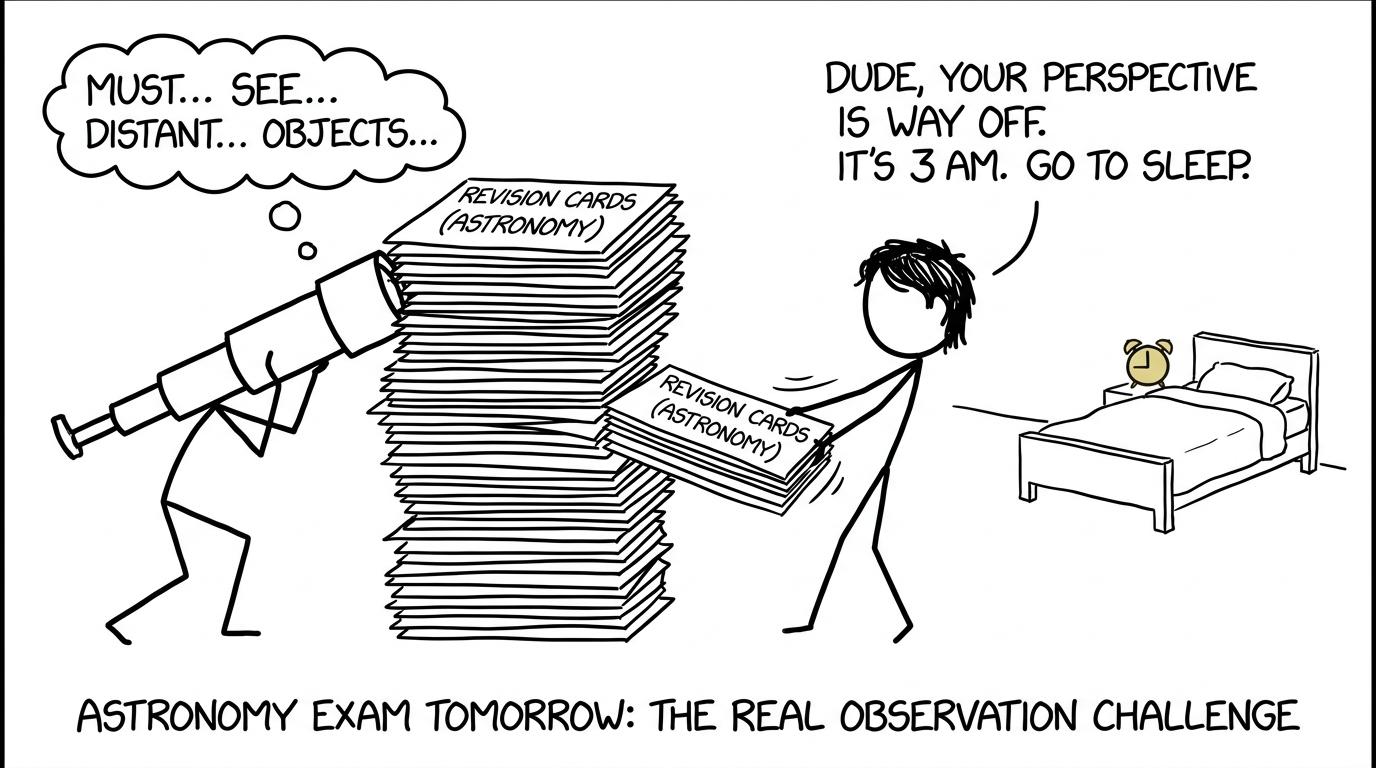 A student clears revision cards from a telescope and discovers that sleep is in view
Signs that you should stop immediately
A planned cut-off is best, but sometimes your concentration disappears earlier. Stop if you notice several of these signs:
- you read the same paragraph without being able to summarise it;
- familiar terms suddenly appear unfamiliar;
- simple calculator inputs need repeated correction;
- you are jumping rapidly between topics;
- your revision is being driven by panic rather than a clear task;
- you are sacrificing the sleep window you planned to protect.
At that point, another page is unlikely to repair the problem. Write down the concern if necessary, close the materials and begin winding down.
What to do after you close your notes
Finishing revision does not mean immediately replacing an astronomy screen with an hour of social media. Give your attention time to slow down.
Pack your desk away, dim the room, wash, read something undemanding or follow another calm routine. Avoid beginning a conversation that turns into a comparison of how many hours everyone has revised. Other students’ schedules do not change what your brain needs.
If a missing fact enters your mind, write a brief prompt for the morning rather than reopening the entire topic. The purpose is to reassure yourself that the thought has not been lost, without restarting the revision cycle.
Common mistakes the night before GCSE Astronomy
Attempting a complete past paper too late
A full paper lasts 111 hour 454545 minutes before marking and review. Starting one near bedtime creates a choice between abandoning it midway and losing sleep. Full papers belong earlier in the revision process, just as the MathsGenie guide to starting GCSE past papers recommends.
Revising only favourite topics
Comfortable topics can create the pleasant illusion of progress. Use your mock feedback or error log to select a few genuine weaknesses instead.
Memorising the formula sheet without application
The examination provides key equations and data. Learn to recognise the relevant quantities, rearrange relationships and use units rather than trying to reproduce the sheet from memory.
Treating tired mistakes as evidence that you know nothing
Fatigue can make secure knowledge harder to retrieve. Do not respond by extending the session indefinitely. A sudden cluster of careless errors may be evidence that it is time to stop.
Using predicted material as certainty
No predicted paper can guarantee exact examination questions. For GCSE Maths, MathsGenie predicted papers are designed as exam-style practice, not promises. Apply the same judgement to any Astronomy prediction: use it to practise, but keep your revision aligned with the full specification.
Stop calmly, then trust the work already done
The night before an exam has a peculiar emotional weight. Because time is nearly gone, every unused minute can feel wasted. Yet the goal is not to arrive having revised for the greatest possible number of minutes. It is to arrive able to think.
Set your cut-off by counting backwards from the morning, protect 888 to 101010 hours of sleep and leave at least 303030 minutes to wind down. Use the final session for recall, familiar mathematical skills and practical preparation. Then stop.
For your wider exam preparation, make MathsGenie’s GCSE Maths revision hub your free base for revision lessons, practice questions, mini tests, past papers, predicted papers, mark schemes and video solutions. Build the knowledge before the final evening, use the revision planner to spread the work, and let the night before be what it should be: a calm final check, not an attempt to restart the course.