What to Revise in May of Year 13 Maths
What to revise in May of Year 13 maths: prioritise weak topics, balance pure and applied maths, and build a weekly revision plan around your exam dates.
May can make every unfinished topic feel equally urgent. If you are deciding what to revise in May of Year 13 maths, prioritise weaknesses exposed by exam questions, keep pure maths, statistics and mechanics in your weekly routine, and practise completing papers under timed conditions. Your exact exam dates should determine how that balance changes through the month.
Imagine a Year 13 student opening their revision folder on the first Monday in May. There are notes everywhere, but no obvious starting point. The useful question is smaller than “How do I revise everything?” It is: “Which mistakes should I work on this week?”
Your May revision checklist
Before building your timetable:
- Confirm your exam board, paper dates and what each paper assesses.
- Review a recent mock or attempt an unseen paper.
- Identify three weaknesses that repeatedly cost you marks.
- Reserve weekly sessions for pure maths, statistics and mechanics.
- Leave time to mark, correct and revisit your work.
For the broader scheduling principles, MathsGenie’s revision timetable guide provides a useful foundation. Its examples focus on GCSE, so adapt the structure to your A Level papers and other subjects.
Where May fits into Year 13 maths revision
Earlier in Year 13, much of your effort went into learning new content. Easter may have provided space to revisit larger sections of the course. May is the bridge between knowing individual methods and choosing them independently in an examination.
That means your revision should gradually become more mixed and more timed. You still need topic lessons when something is unclear, but every lesson should lead back to questions you attempt without help.
Remember Year 12 content too. Algebra, trigonometry, exponentials and logarithms support later work. If integration repeatedly breaks down because of rearranging or factorising, repair that earlier skill alongside the integration technique.
Use your own specification rather than somebody else’s timetable. Start with MathsGenie’s A Level maths exam-board hub to locate the relevant resources.
What to revise in May of Year 13 maths
Pure maths: repair the skills that unlock other topics
Prioritise algebraic manipulation, functions, trigonometry, differentiation and integration when your work shows weaknesses there. These skills connect across the course, so one unresolved gap can affect several questions.
Then check coverage of sequences and series, numerical methods, vectors, proof and other specification content. Avoid interpreting “prioritise” as permission to abandon topics that feel less familiar.
For an Edexcel student, the A Level revision resources provide a place to move between topic practice and wider preparation. Choose the equivalent resources for your own board.
Statistics: practise interpretation alongside calculation
Review probability, statistical distributions, hypothesis testing, sampling and interpreting data, according to your specification. Practise using your calculator efficiently, then explain what the answer means in context.
A correct calculation can still leave a question unfinished if you omit the conclusion. Include your board’s large data set in revision: understand its variables, units and context, using the current material supplied by your board or teacher.
Mechanics: make the model clear
Revisit kinematics, forces, Newton’s laws, moments and variable acceleration where required by your specification.
Focus on the decisions before the calculation: drawing a diagram, choosing a positive direction, resolving forces and identifying assumptions. When a solution goes wrong, ask whether the problem began with the model or the subsequent algebra. Those need different repairs.
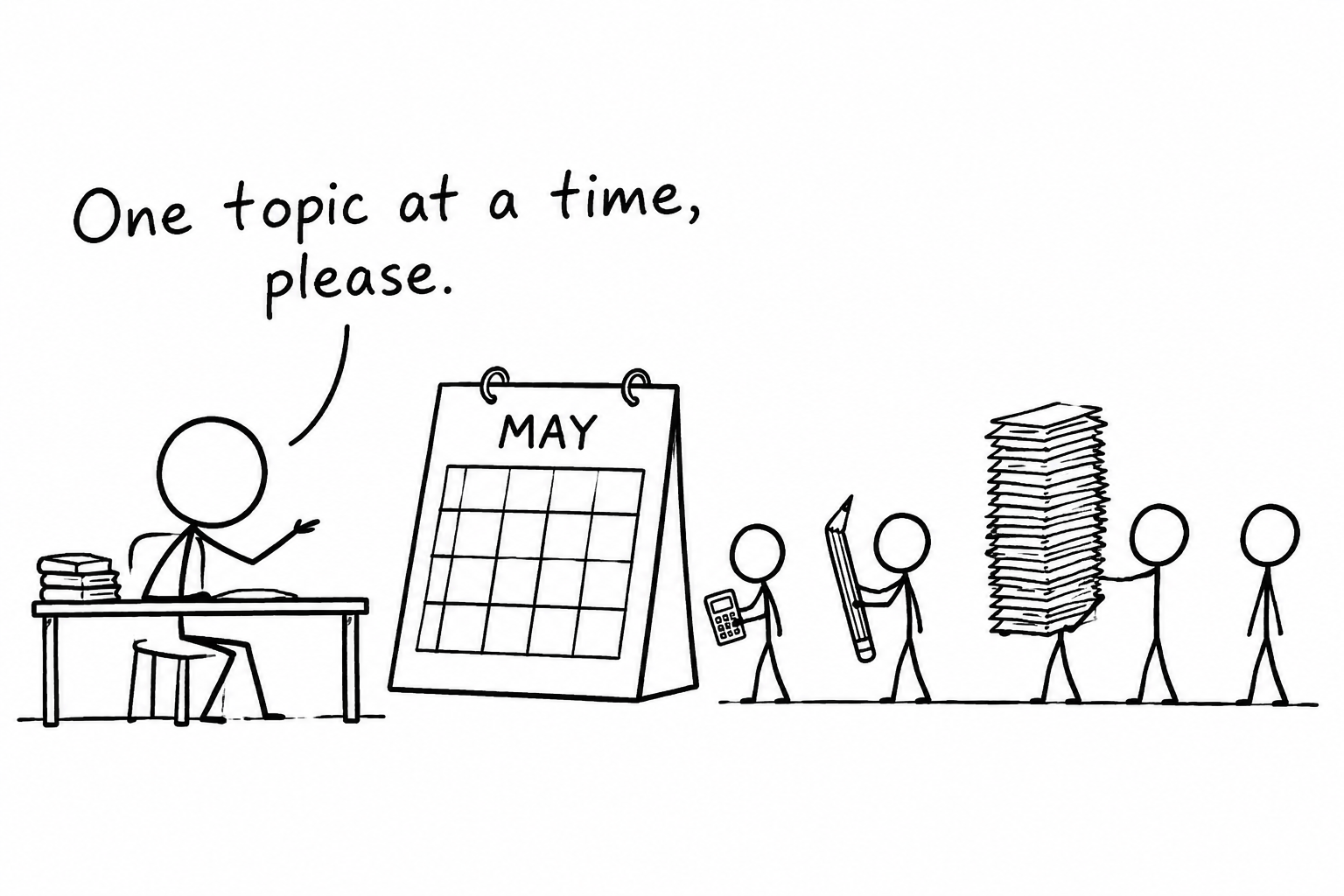 A stick-figure student asks a queue of revision tasks to approach one topic at a time
A May revision plan you can adapt
Our hypothetical student starts with a modest structure, then changes it as marked work reveals what needs attention. Use these weekly priorities flexibly around your actual examinations.
| Stage of May | Main priority | Evidence to collect |
|---|---|---|
| First week | Diagnose gaps and repair essential methods | A marked paper and three specific weaknesses |
| Second week | Combine topic repair with mixed questions | Independent solutions to previously difficult question types |
| Third week | Increase timed practice | Clearer evidence of pacing and recurring errors |
| Final week | Prepare for the next scheduled paper | Corrected mistakes and secure familiar methods |
Within each week, try this template:
| Day | Suggested maths session |
|---|---|
| Monday | Pure maths weakness: brief recap, then independent questions |
| Tuesday | Statistics practice and written interpretations |
| Wednesday | Timed mixed questions, followed by marking |
| Thursday | Mechanics practice with diagrams and modelling decisions |
| Friday | Reattempt earlier mistakes without notes |
| Saturday | A full paper when your timetable allows, with correction time reserved |
| Sunday | Review the week, adjust priorities and protect some rest |
Fit these sessions around lessons, your other A Levels and realistic energy levels. A shorter session can replace a longer one on a crowded day; the important part is completing and reviewing a defined task.
Build this May structure into your own schedule in the Revision Planner, so your topic repairs and paper practice have a clear place in the week.
Make every paper change the next session
A paper is useful twice: first when you attempt it, then when you investigate the marks you lost.
Use papers from your board. For example, MathsGenie’s Edexcel A Level past papers and mark schemes support that cycle. The broader advice in when to start past papers also helps explain how topic practice and whole papers fit together.
After marking, classify each error: missing knowledge, wrong method, algebra, interpretation or timing. Write a specific next task, such as “practise selecting an integration method”, rather than “revise calculus”. Reattempt the question a few days later without the solution beside you.
Predicted papers can provide additional practice, but they cannot tell you what will appear. Keep your specification and marked work at the centre of your decisions.
Common mistakes in May
Only doing comfortable questions. Keep familiar topics moving through mixed practice, but give focused time to weaknesses you can improve.
Completing papers without correcting them. Reserve correction time before scheduling another paper. Otherwise, the same misunderstanding can survive several attempts.
Watching solutions too soon. Make a serious attempt first. After using a lesson or video solution, close it and reproduce the reasoning independently.
Dropping applied maths until later. Even if pure papers come first, maintain contact with statistics and mechanics. Shift the balance towards the next examination without letting everything else disappear.
Planning beyond your available time. On busy school days, the principle behind a short revision routine still applies: choose one manageable task and finish it properly.
Give the rest of May a clear structure
Your goal is to reach each paper with practised methods, corrected mistakes and a realistic sense of timing. The remaining gap is turning those priorities into sessions you can follow alongside your other subjects. Build your May Year 13 maths schedule in the Revision Planner.