What to Do After Your GCSE Maths Mocks
What to do after your GCSE Maths mocks: review mistakes, plan December revision and build a targeted practice paper with MathsGenie's Mock Exam Builder.
November mocks finish, and for a moment the main feeling is relief. Then the marked papers come back. Suddenly, one grade seems to crowd out everything else.
If you are wondering what to do after your GCSE Maths mocks, start with the questions behind that grade: identify where marks were lost, choose a few priority skills, practise them, and check your progress with fresh questions. Your mock is a diagnostic, not a verdict on your ability.
Imagine a Year 11 student opening their paper in late November. December could become a month of worrying about the result. With a clear plan, it can become a month of acting on it. The same approach works for Year 10, with priorities matched to the content already taught.
What to do after your GCSE Maths mocks: your checklist
Before starting another paper, work through these steps:
- Collect your marked papers and teacher feedback.
- Identify the reason for each lost mark.
- Choose three manageable priorities.
- Relearn each skill, then answer questions independently.
- Revisit it several days later.
- Use a targeted practice paper to check what has improved.
Keep this list beside your papers. It gives your revision a direction when the result still feels disappointing, confusing or surprisingly good.
Late November: look beyond the grade
Our hypothetical student first notices the grade on the front. The useful information sits inside: a correct method abandoned halfway through, a blank question, a calculation slip repeated twice.
Read your paper when you feel ready to look carefully. Include questions where you earned some marks and questions you answered correctly but guessed.
Ask your teacher about any marking you do not understand. If papers must stay in school, request a topic breakdown or time to review them in class.
Also ask how the mock grade was calculated. Official GCSE grade boundaries vary with paper difficulty and are set after exams. Your school's mock grade needs to be understood in the context of the papers and boundaries it used. Avoid treating a percentage found online as a universal grade threshold.
The result shows your performance on those questions, under those conditions, at that stage of the course. It gives you a starting point.
Turn lost marks into useful feedback
A list headed “revise algebra” is difficult to act on. A note saying “I can solve equations until brackets appear” tells you where to begin.
Create a short error log:
| What happened? | What to do next |
|---|---|
| I did not know the method | Revisit the lesson and practise the basic skill |
| I knew the topic but could not start | Practise recognising which method a question needs |
| My method was correct but my calculation failed | Slow down and check the precise step that went wrong |
| I missed a unit or instruction | Build a final check into practice |
| I left the question because time ran out | Retry it untimed before working on pacing |
Be cautious with the word “careless”. Repeated negative-number errors may reveal a skill that needs attention. A blank answer might reflect unfamiliar wording rather than missing knowledge.
Use MathsGenie's GCSE Maths revision resources to find the relevant material for your exam board. Match your practice to your foundation or higher tier and check uncertain topic choices with your teacher.
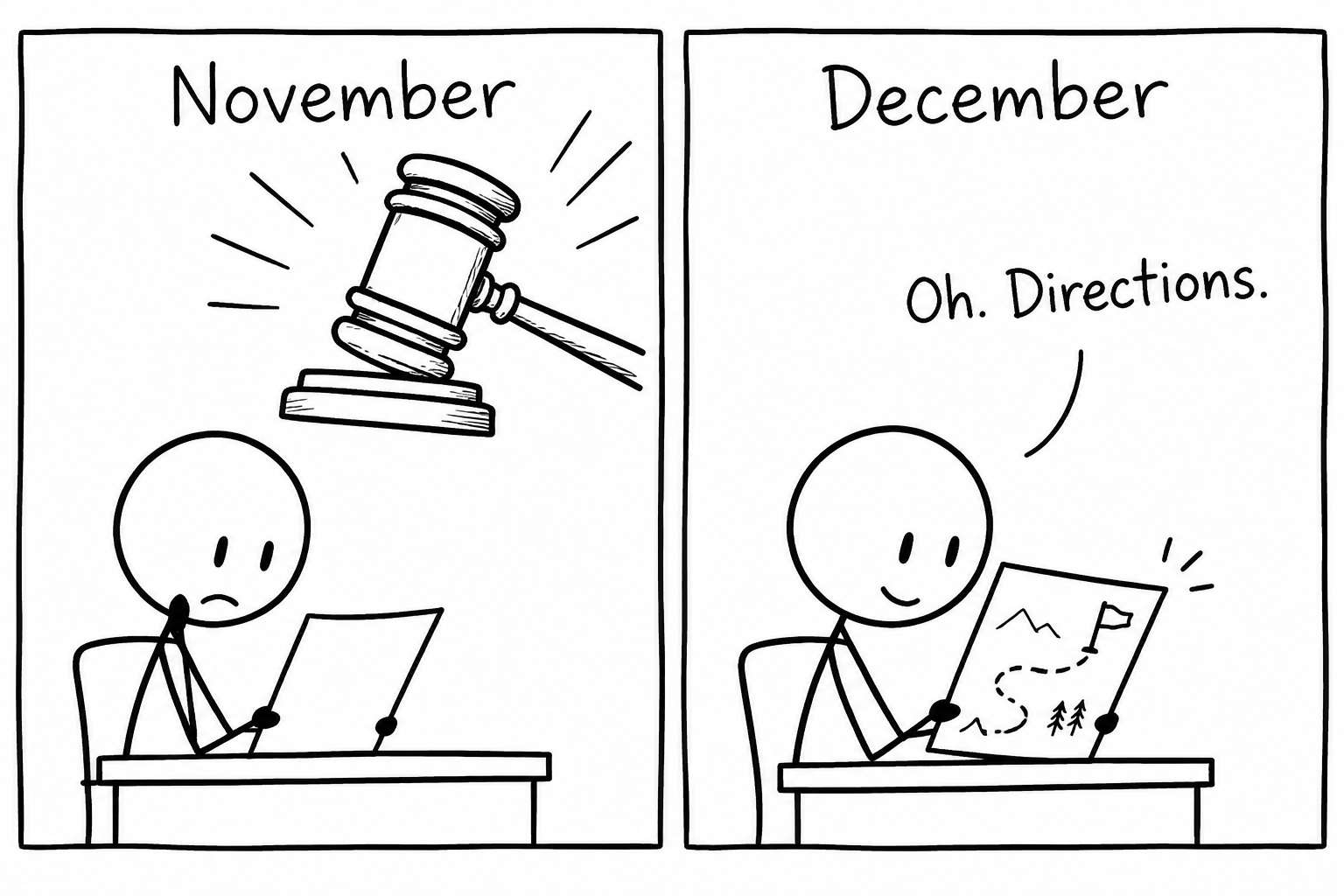 Stick-figure comic showing a student turning November mock anxiety into a December revision route
Choose three priorities for early December
By early December, our student has a more useful description of the problem: a few specific weaknesses, rather than “everything”.
Choose three priorities to begin with. Look for skills that appeared repeatedly, support other topics, or were nearly secure. Fractions, percentages, ratio and equation solving may deserve attention before a particularly difficult question at the end of a paper.
For each priority, write an action you can complete: “Answer percentage-change questions without notes” is clearer than “Get better at percentages”.
If your mock went well, examine your uncertain answers and incomplete reasoning. Your next step might involve explaining methods more clearly or recognising familiar mathematics in unfamiliar problems.
MathsGenie's scheme of learning offers a structured route through GCSE Maths lessons and tests. Ask your teacher where to start if several gaps depend on an earlier skill.
Practise in a way that reveals understanding
Watching someone solve a question can feel reassuring. Independent practice tells you whether you can reproduce the method.
For each priority, follow a simple cycle:
- Review a revision lesson or video explanation.
- Close the explanation and attempt practice questions.
- Mark your work and identify the first incorrect step.
- Correct the mistake, then try a fresh question unaided.
Use video solutions after making a serious attempt. Pause before each next step and consider what you would do. When using a mark scheme, look at the working that earns credit as well as the final answer.
Return to the skill several days later. If you need the explanation again, give it another practice session. MathsGenie's Edexcel GCSE Maths mini tests provide short checks, with mark schemes and worked solutions where available.
Make December manageable
A useful December plan leaves room for other subjects, school commitments and rest.
Try three short maths sessions across the week: one to revisit a weak skill, one to practise another priority, and one to mix recent topics with older material. Adjust the workload to your circumstances and your teacher's advice.
Put specific tasks into the MathsGenie Revision Planner. Include time to mark and correct answers. Otherwise, a timetable can look busy while leaving mistakes untouched.
Once individual skills feel steadier, use GCSE past papers for mixed practice. Follow the stated time and calculator rules when practising exam conditions. Review unfinished questions afterwards to separate timing problems from knowledge gaps.
Common mistakes after GCSE Maths mocks
Starting another full paper immediately. First repair some of the gaps the mock revealed. Then use fresh questions to test those repairs.
Revising only favourite topics. Keep familiar skills ticking over, but give your main effort to the priorities in your error log.
Copying corrections. After reading a solution, put it away and attempt a similar question independently.
Trying to predict every future question. Predicted papers can provide extra practice when available. Continue revising across the specification rather than treating any prediction as a guarantee.
Making a tier decision alone. Discuss foundation or higher tier entry with your teacher, using evidence from your work and your goals.
Turning December into a punishment. Choose a routine you can sustain. If exam anxiety is affecting sleep or daily life, speak to a trusted adult or your school's pastoral team.
How parents can support the next step
Ask your child which skill they are working on and what help would be useful. A quiet space, a manageable routine and interest in their corrections may help more than repeatedly asking about the grade.
Notice specific progress: starting a previously blank question, explaining a method, or spotting an old mistake. Agree when to review the plan together so revision does not become a daily negotiation.
Finish December with evidence of progress
Return to that student holding their November paper. By December, the aim is to see clearer working, fewer repeated errors and more questions attempted independently.
Choose one recurring weakness today. Revisit the lesson, practise, and mark your work. Then build a targeted practice paper in Mock Exam Builder to check the skills you have been working on.
MathsGenie's free revision resources help turn feedback into practical next steps. Your mock has given you information. Now you can use it.