

Congruence Proofs GCSE Maths: Mock Revision
Congruence proofs GCSE maths revision made clear with four tests, two worked exam questions, common mistakes and a focused December mock plan.
December mocks can make familiar topics feel less familiar. You recognise the triangles and remember letters such as SSS and RHS. But when the question says “prove”, knowing where to begin feels harder.
Congruence proofs GCSE maths questions follow a reliable structure: identify matching facts, justify each one, choose the correct congruence condition and name corresponding vertices in the right order. Treating a proof as a chain of evidence makes the task more manageable.
Your congruence proof checklist
Before attempting exam questions, check that you can:
- recognise SSS, SAS, ASA and RHS
- identify equal sides and angles
- give a reason for every equality
- match corresponding vertices correctly
- use congruence to establish a further result.
Start with the MathsGenie Congruent Triangles revision lesson, which brings together explanations, questions and solutions. Alternatively, use the AQA congruent triangles lesson or OCR congruent triangles revision page.
What congruent triangles mean
Congruent triangles have exactly the same size and shape. Rotation, reflection or a different position on the page does not change this.
Similar triangles have the same shape but can have different sizes. For congruent triangles, the scale factor is 111.
The four congruence conditions
- SSS: all three sides equal the corresponding sides in the other triangle.
- SAS: two corresponding sides and their included angle are equal. The angle must lie between the known sides.
- ASA: two corresponding angles and their included side are equal. Two angles and another corresponding side also suffice, since the third angles must match.
- RHS: both triangles are right-angled, their hypotenuses are equal and another pair of corresponding sides is equal.
AAA establishes similarity, but cannot establish congruence because the side lengths could differ.
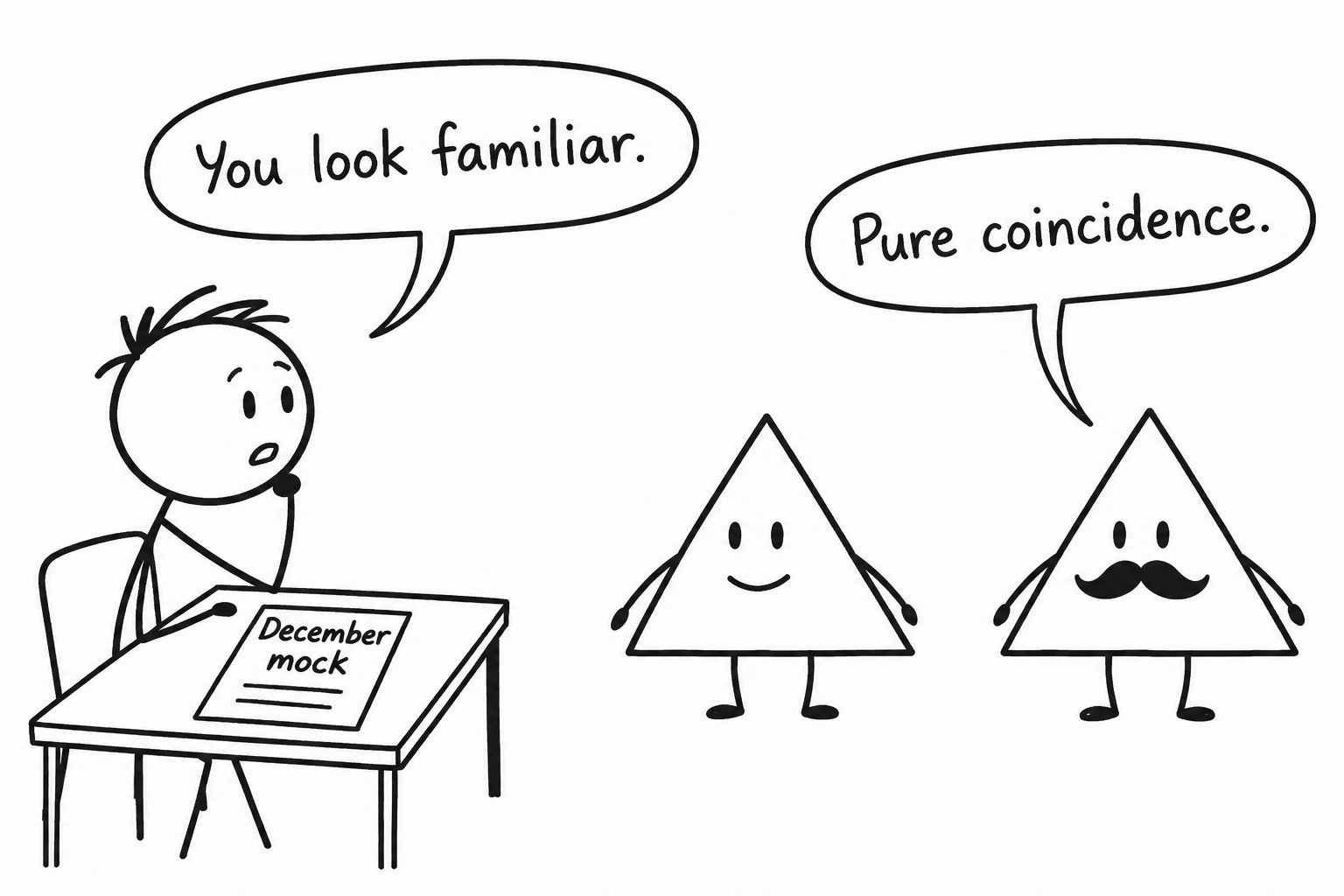 Two identical triangle characters attempt to disguise their congruence before a December mock
How to choose the correct condition
Do not decide on a condition before examining the evidence. Instead, mark every known side and angle, then look for a complete combination.
If three pairs of sides are known, use SSS. If you have two sides, inspect the angle between them for SAS. When two angles are available, find a corresponding side and consider ASA. If both triangles contain a right angle, check whether the equal side is the hypotenuse and whether another pair of sides is equal before selecting RHS.
Some diagrams provide more information than you need. A proof using SSS does not become stronger because you also mention an angle. Choose the shortest complete argument and make every statement relevant. This keeps your reasoning clear and reduces the chance of accidentally using an unsupported equality.
A dependable method for congruence proofs
First, identify the two triangles. Collect the facts needed for a congruence condition, checking where each comes from: given information, diagram markings, angle rules or geometric properties.
A shared side can supply an equality even when it has no matching marks. Overlapping triangles are often easier to compare if you sketch them separately, preserving the labels and marking only facts you can justify.
Arrange your evidence around one valid condition. Then name the triangles in corresponding order. If AAA matches DDD, BBB matches EEE and CCC matches FFF, write:
△ABC≅△DEF\triangle ABC \cong \triangle DEF△ABC≅△DEFCheck first vertex against first, second against second and third against third. Naming a condition alone is insufficient: show which sides and angles satisfy it, with reasons.
Worked question: proving congruence using SAS
Lines ACACAC and BDBDBD intersect at EEE. Given AE=CEAE=CEAE=CE and BE=DEBE=DEBE=DE, prove that △AEB\triangle AEB△AEB and △CED\triangle CED△CED are congruent.
Record the given side equalities:
AE=CE,BE=DEAE=CE,\qquad BE=DEAE=CE,BE=DEThe angles at the intersection are vertically opposite, so:
∠AEB=∠CED\angle AEB=\angle CED∠AEB=∠CEDThis angle lies between the equal sides in each triangle. Therefore:
△AEB≅△CEDby SAS\triangle AEB \cong \triangle CED \quad \text{by SAS}△AEB≅△CEDby SASEach equality has a reason. The conclusion also preserves correspondence: AAA matches CCC, EEE matches EEE, and BBB matches DDD. The proof depends on these facts, regardless of how the diagram looks.
Worked question: proving congruence using RHS
A circle has centre OOO, with AAA and BBB on its circumference. The line OMOMOM meets chord ABABAB at a right angle. Prove that △OMA\triangle OMA△OMA and △OMB\triangle OMB△OMB are congruent.
The radii of the same circle are equal:
OA=OBOA=OBOA=OBBoth triangles are right-angled at MMM, making those radii their hypotenuses:
∠OMA=∠OMB=90∘\angle OMA=\angle OMB=90^\circ∠OMA=∠OMB=90∘They also share a common side:
OM=OMOM=OMOM=OMTherefore:
△OMA≅△OMBby RHS\triangle OMA \cong \triangle OMB \quad \text{by RHS}△OMA≅△OMBby RHSCorresponding sides of congruent triangles are equal, so:
AM=BMAM=BMAM=BMThis final deduction matters: harder questions often ask you to use congruence to prove another length or angle equality. Explain that connection explicitly.
Practise this structure with the Congruent Triangles exam booklet.
Common mistakes in congruence proofs
Giving facts without reasons
An equality such as OA=OBOA=OBOA=OB needs justification, here that both lengths are radii of the same circle. Include reasons alongside your statements.
Confusing SAS with SSA
Two sides and a non-included angle do not generally determine a unique triangle. Check that the angle you use for SAS lies between the two known sides.
Trusting the diagram
Do not assume symmetry, equal lengths or a right angle from appearance. Use information supplied in the question or facts you can prove.
Missing a common side or correspondence
If triangles share an edge, state its equality explicitly. Before finishing, check that matching vertices occupy matching positions in your conclusion.
A focused plan before December mocks
Begin with a few untimed questions. Mark them immediately, looking for missing reasons as well as incorrect conclusions. The MathsGenie Edexcel mini tests provide a manageable way to practise individual skills.
Next, attempt the topic booklet under light time pressure. Keep an error list using specific descriptions: “angle not included”, “missing common side” or “vertices mismatched”. Use those entries to choose your next revision task.
When checking solutions, compare the evidence rather than copying the wording. A differently phrased proof can still be correct if every equality is justified and the condition applies. Afterwards, cover the solution and rebuild the argument yourself.
Then move to mixed questions. Recognising congruence without a topic heading is part of exam preparation. Use the GCSE Maths revision hub to revisit angle reasoning, similarity and geometric proof where needed.
A December mock gives you evidence about what to practise next. Build a targeted paper with the MathsGenie Mock Exam Builder, include your weaker topics and complete it under timed conditions. Use your marked answers to plan the next session, turning an uncertain proof into a method you can explain.















