What to Bring: GCSE Old Maths Exam Checklist
What to bring GCSE old maths exam: a clear checklist of allowed equipment, calculator rules and banned items for a calm, organised exam morning.

The smallest uncertainties can feel surprisingly loud on exam morning. Is your calculator allowed? Should your compass be in a clear case? Can you wear a watch? If you searched what to bring GCSE old maths exam, the short answer is: take black pens, pencils, an eraser, a ruler, a protractor, compasses and, for a calculator paper, a compliant calculator. Keep them in a transparent pencil case and leave phones, watches, notes and other unauthorised items outside the exam room.
There is one important qualification. The instructions on your question paper and from your school or college are always decisive. Exam boards and centres can specify particular materials, so check your timetable and candidate information before the day.
Your GCSE maths exam checklist
Pack your equipment the evening before. A sensible core kit is:
- At least two working black ballpoint pens
- Two sharpened pencils
- An eraser
- A ruler marked in centimetres and millimetres
- A protractor
- A pair of compasses
- A compliant scientific calculator when calculators are permitted
- Spare calculator batteries if your model uses replaceable batteries
- A transparent pencil case
- Any candidate card or identification specifically requested by your centre
- A clear, label-free water bottle only if your centre permits one
You normally complete written answers in black ink. Pencils are useful for constructions, diagrams and graphs, where you may need to make accurate adjustments. Taking a spare pen and pencil is a small precaution that removes a needless source of stress.
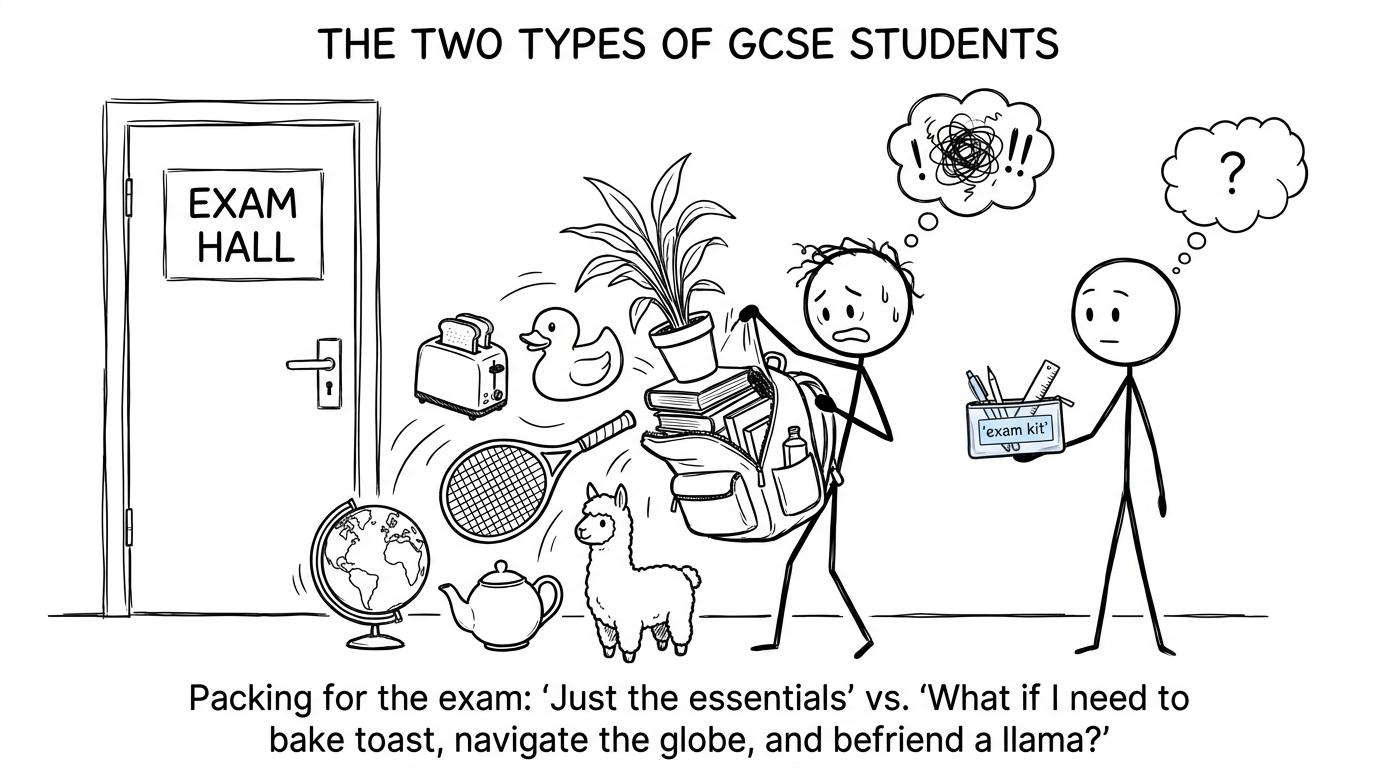 A student discovers that a tiny exam kit is more useful than an enormous overpacked bag
What each piece of equipment is for
A maths paper moves between different kinds of thinking. Your equipment should make those transitions easy rather than becoming another problem to solve.
| Item | Why you may need it |
|---|---|
| Black ballpoint pens | Writing answers and showing clear working |
| Pencils | Drawing graphs, constructions and diagrams |
| Eraser | Correcting pencil work cleanly |
| Ruler | Measuring and drawing straight lines or axes |
| Protractor | Measuring and constructing angles |
| Compasses | Loci, constructions and accurate arcs |
| Scientific calculator | Calculator papers only, subject to the printed instructions |
| Transparent pencil case | Allows invigilators to see your equipment easily |
Do not rely on your centre having spare equipment. An invigilator may be able to provide a replacement item, but that is not guaranteed and you cannot borrow equipment from another candidate once the examination has begun.
Pens, pencils and drawing instruments
Use a black ballpoint pen unless the front of the paper says otherwise. Avoid pale ink because scanned scripts must remain readable. Gel pens, erasable pens and correction fluid or tape should not be used for answers under JCQ exam guidance.
A standard pencil is suitable for diagrams. Bring it already sharpened, but include a small sharpener if your centre allows one. Your ruler should have clear centimetre and millimetre markings. Check that your protractor is not cracked and that your compasses hold their position rather than slowly opening as you draw.
These details can seem mundane. Yet practising with the same instruments you will use in the examination makes constructions and graphs feel familiar. Use them while completing GCSE maths revision lessons and questions, not for the first time when the clock is running.
Calculator rules for GCSE maths exams
The front of the question paper states whether a calculator is allowed. Do not infer the rule from another exam board or a paper you completed in class. Edexcel, AQA, OCR and Eduqas do not all organise their papers in precisely the same way.
Where calculators are allowed, JCQ rules place responsibility on the candidate to ensure that the calculator is compliant. During the examination, it must not provide:
- Symbolic algebra manipulation
- Symbolic differentiation or integration
- Language translation
- Communication with another device or the internet
- Access to previously stored text, formulae or databanks
A normal school scientific calculator is often appropriate, but there is no universal list covering every model. If you are unsure, ask your maths teacher or examinations officer well before the exam.
Before a calculator paper:
- Check that the calculator switches on reliably
- Replace weak batteries
- Clear stored information as instructed
- Remove any lid, cover or case containing printed instructions or formulae
- Check that the angle mode is correct for the question, usually degrees when angles are given in degrees
- Practise using the exact model you intend to take
Some graphical calculators are compliant only when an appropriate examination mode is activated. Phones, tablets and calculator apps are not substitutes for an approved calculator because they can communicate, store unauthorised information or access the internet.
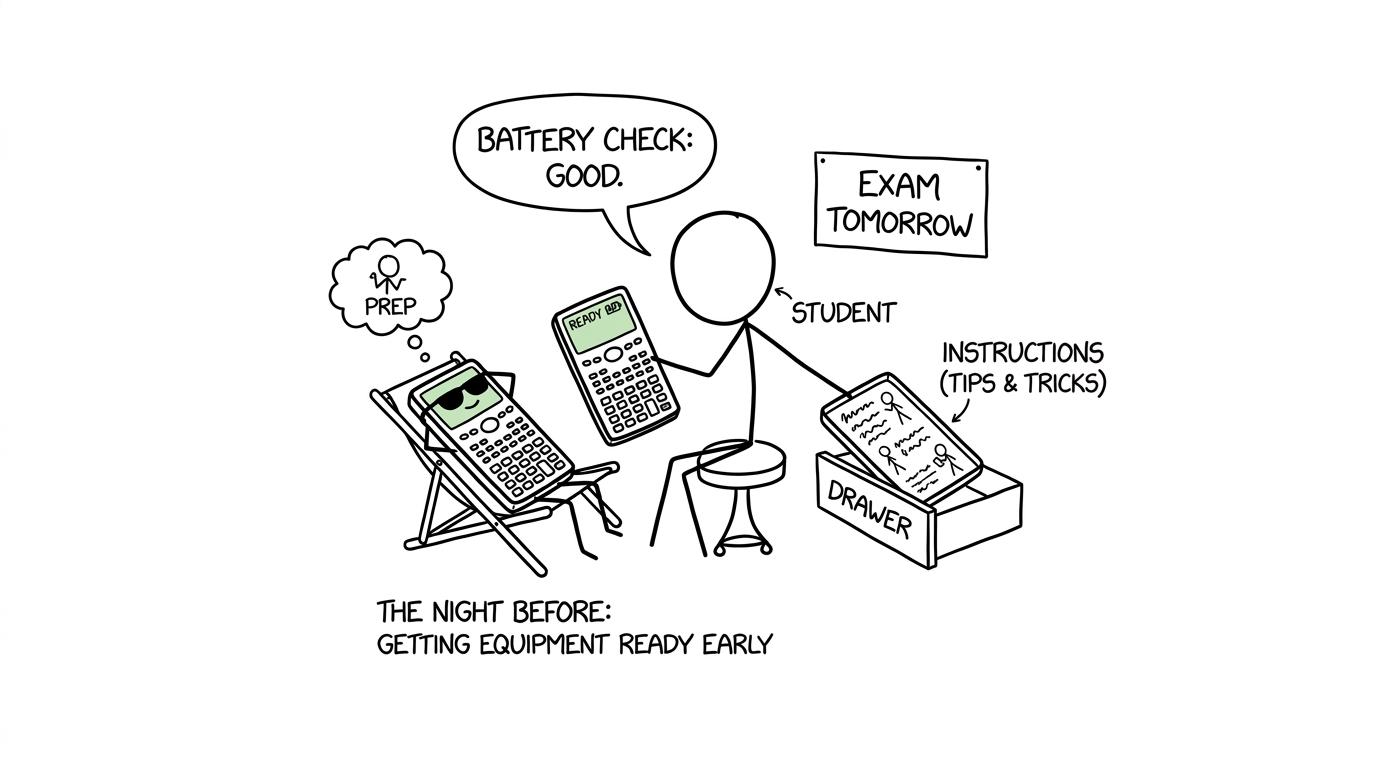 A calculator enjoys a suspiciously relaxing evening after its battery check
The strongest preparation is practical. Complete GCSE maths past papers using your real calculator, ruler and drawing instruments. Mark the paper afterwards and note whether an error came from the maths or from unfamiliar equipment.
What to leave at home or outside the exam room
Only authorised materials should enter the examination room. Possessing an unauthorised item can be treated as breaking the rules even if you never intended to use it.
Leave these items at home, in your bag outside the room or wherever your centre directs:
- Mobile phones, including switched-off phones
- Watches of every kind, including ordinary analogue watches
- Earphones, earbuds and headphones
- Smart glasses, tablets, music players and other smart devices
- Revision notes, formula cards and written reminders
- Calculator instructions or prepared programs
- Dictionaries unless expressly authorised
- Loose paper or your own rough-work paper
- Calculator cases containing printed formulae or instructions
- Correction fluid, correction tape and erasable pens
Do not write reminders on your hands, stationery, calculator or clothing. Avoid bringing anything that could reasonably be treated as a note.
Highlighters require care. JCQ guidance permits their use to highlight questions, words or phrases in the question paper, but not in your answers. The simpler approach is to write all assessed work in black ink and follow any additional instructions printed on the paper.
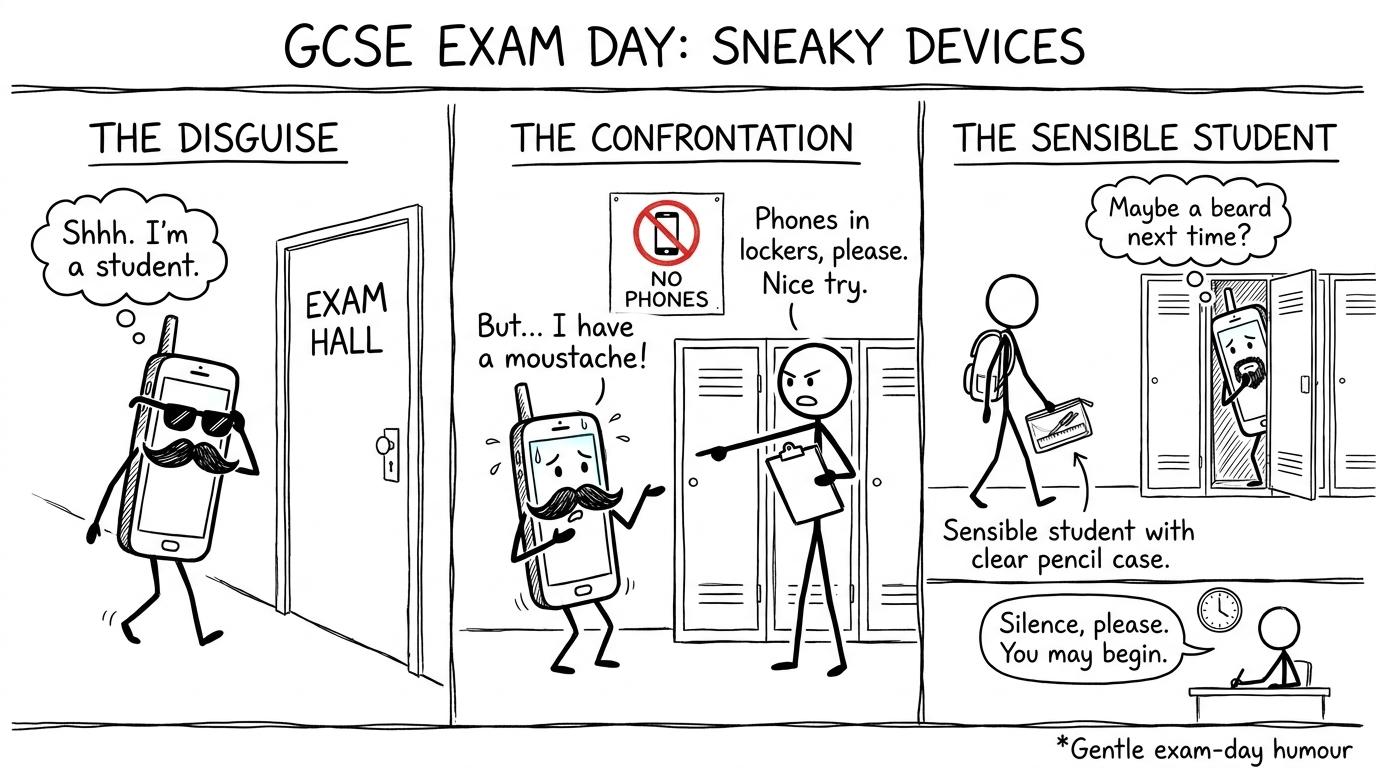 A disguised mobile phone makes an unsuccessful attempt to enter the exam hall
Does an old GCSE maths paper change the rules?
The phrase “old maths exam” can mean different things. You might be sitting a school mock based on an old paper, practising a previous exam at home or taking a formal resit.
An old question paper does not automatically bring back the rules that applied when it was originally published. For a mock, follow your school's current instructions. For a live GCSE examination or resit, follow the current centre guidance and the front cover of the paper you are actually sitting.
Older papers remain valuable because the mathematics still develops useful fluency. However, specifications can change, so use them alongside current Maths Genie predicted papers and your exam board's present specification. Never bring an old formula sheet, data sheet or annotated paper into an exam unless it has been officially supplied or authorised.
A calm routine for the evening before
Exam readiness is often less dramatic than students imagine. It is a sequence of small checks completed early enough that none becomes urgent.
Check the paper
Confirm the exam board, tier, date, starting time and whether it is a calculator paper. Make sure you know whether you are entered for foundation or higher tier. Do not rely on a friend's timetable.
Test the equipment
Write briefly with both pens. Sharpen your pencils. Draw a straight line with the ruler, check that the compasses remain fixed and confirm that the calculator works.
Pack only what is needed
Place authorised stationery in a transparent pencil case. Put prohibited technology somewhere you will not accidentally carry it into the room. Follow your centre's arrangements for bags and valuables.
Stop changing your method
The night before is not the moment to learn a different calculator or replace familiar techniques with shortcuts. If you want a final structured review, revisit the appropriate grade 555 GCSE revision topics or higher-grade GCSE maths topics, then give yourself time to rest.
Common exam-day equipment mistakes
Assuming every maths paper permits a calculator
Read the paper's front cover. A calculator stored in your bag is not permission to use it, and the arrangement of calculator and non-calculator papers varies between qualifications.
Bringing a phone that is switched off
A switched-off phone is still an unauthorised item if it is in your possession. Hand it in or store it exactly as your centre instructs before entering the room.
Wearing an ordinary watch
The restriction is not limited to smartwatches. JCQ guidance prohibits watches in the examination room, so remove yours before entering.
Using correction fluid or an erasable pen
Corrections can become unclear when scripts are scanned. Cross out an incorrect answer neatly with a single line and write the replacement clearly.
Leaving calculator preparation until the morning
A weak battery, unfamiliar mode or formula-covered lid is easier to fix at home than beside the examination room. Prepare the calculator the previous evening.
Expecting to borrow equipment
Candidates must not borrow from one another during the exam. Pack spares, especially a second black pen and pencil.
Walk in prepared, then focus on the maths
Good preparation rarely feels heroic. It feels quiet: a checked timetable, a transparent pencil case, a working calculator and no prohibited device hiding in a pocket. Once those decisions have been made, your attention can return to the only thing that earns marks: clear mathematical thinking.
Use MathsGenie to make that preparation complete. Work through free revision lessons, practice questions and mini tests, then use past papers, predicted papers, mark schemes and video solutions to identify what needs attention. Add those priorities to your revision planner, pack your equipment the night before, and arrive ready to show what you know.