What to Bring to the GCSE Modern Hebrew Exam
What to bring GCSE Modern Hebrew exam day: the exact equipment checklist, banned items, dictionary rules and paper-specific advice for AQA students.

The smallest uncertainties often feel loudest on an exam morning. You may know your vocabulary and have practised your translations, yet suddenly find yourself wondering whether your pencil case is allowed or whether you need a dictionary. If you searched what to bring GCSE Modern Hebrew exam, the short answer is: take at least two black ink pens in a clear pencil case, your school’s required identification, and an unlabelled transparent water bottle if your centre permits one. Leave your phone, watch, notes, dictionary and electronic devices outside the exam room.
For the current AQA GCSE Modern Hebrew specification, dictionaries are not permitted in the listening, speaking, reading or writing assessments. Your school supplies the question papers, listening materials and any official sheets required for the speaking test.
This guidance is based on the current AQA specification and the latest published JCQ exam-room regulations available at the time of writing. Your exam centre’s instructions and the front of the question paper always take priority.
Your GCSE Modern Hebrew exam checklist
Pack these items the evening before:
- At least two working black ink ballpoint pens
- A transparent pencil case, if you use one
- A pencil and eraser for permitted notes or planning, while completing final answers in black ink
- Any identification or candidate card required by your school
- A transparent water bottle with every label removed, if your centre allows drinks
- Glasses or other ordinary medical equipment that you need
- Details of the correct date, arrival time, room and tier
Leave these items at home or hand them in before entering:
- Mobile phones
- All watches, including analogue, digital and smart watches
- Earphones, earbuds and AirPods
- Smart glasses, tablets and other connected devices
- Revision notes, vocabulary lists and prepared speaking notes
- Dictionaries, phrasebooks and electronic translators
- Correction fluid, correction tape and erasable pens
- Gel pens for answers
- Calculator cases or unrelated equipment
- Food unless your centre has approved it
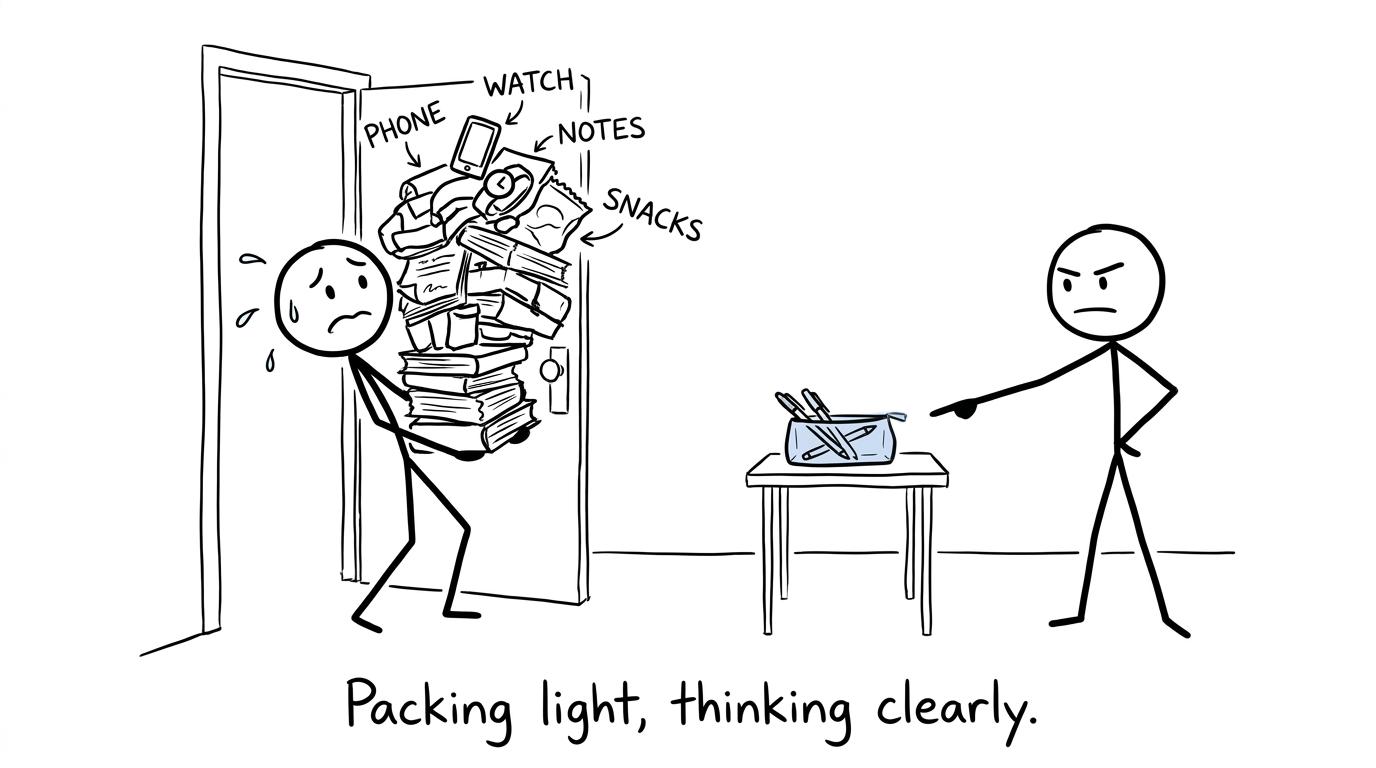 A student discovers that two black pens beat a mountain of exam-day clutter
What you are allowed to bring
Black ink pens
JCQ instructions require candidates to write clearly in black ink. Take at least two ordinary black ballpoint pens so a failed pen remains a minor inconvenience rather than a crisis.
Avoid gel pens and erasable pens. Gel ink can be unsuitable for scanned scripts, while erasable writing is explicitly prohibited. Your final answers should not be written in pencil unless the question paper specifically tells you otherwise.
A pencil can still be useful for permitted planning or notes. However, anything you want the examiner to mark should be clear and permanent in black ink.
A transparent pencil case
Any pencil case brought into the exam room must be see-through. A simple transparent case containing only necessary stationery makes inspection quick and removes doubt.
You do not need the geometry equipment normally packed for GCSE maths. A ruler may help you keep writing or crossings-out neat, but compasses, a protractor and a calculator serve no meaningful purpose in Modern Hebrew. Take only the equipment you genuinely need and follow the paper’s front-page instructions.
For maths exams later in the season, requirements will be different. The GCSE Maths revision hub helps you select the correct board, tier and resources before practising under realistic conditions.
Water, identification and medical items
JCQ allows centres to decide whether food and drink may enter the room. Where water is permitted, the bottle must be transparent and all labels must be removed. Transparent reusable plastic bottles are acceptable under the general rules, subject to your centre’s policy.
Some schools ask candidates to bring a student card or another form of identification. That is a centre requirement rather than a universal AQA equipment rule, so check your exam timetable or school guidance.
Approved access arrangements and necessary medical equipment are different from ordinary stationery. If you use a word processor, supervised rest breaks, extra time or another arrangement, confirm the details with your SENCo or exams officer before the assessment. Do not assume you must provide specialist equipment yourself.
The dictionary rule for GCSE Modern Hebrew
This is the rule most likely to cause confusion: AQA does not permit dictionary access during any of the four GCSE Modern Hebrew assessments.
That includes:
- Paper 1: Listening
- Paper 2: Speaking, including supervised preparation time
- Paper 3: Reading
- Paper 4: Writing
Do not bring a Hebrew-English dictionary, an English-Hebrew dictionary, a monolingual dictionary, a phrasebook or an electronic translator into the exam room. General JCQ provisions sometimes allow bilingual dictionaries in other qualifications or as an access arrangement, but they do not override a specification that prohibits them. AQA’s Modern Hebrew specification is explicit.
This is also why practising without vocabulary support matters. Exam conditions should not first appear on exam day. The principle is familiar from using GCSE past papers properly: reproduce the real rules, mark honestly, repair weaknesses and retest.
What changes between the four assessments
AQA GCSE Modern Hebrew is assessed through listening, speaking, reading and writing. Each contributes 25%25\%25% of the qualification, and students take all four components at the same tier. Foundation tier covers grades 111 to 555, while higher tier covers grades 444 to 999.
Listening
Bring your normal permitted stationery. The centre provides the question paper and plays the official recording. You may make notes during the test, but you must not use a dictionary or your own paper.
Listen carefully to the invigilator’s instructions, especially if there is a technical problem. Do not call out or attempt to fix equipment yourself. Raise your hand immediately.
Speaking
The speaking assessment is organised by your centre, so follow the arrival and waiting-room instructions given by your teacher. The role-play and photo-card materials are supplied securely. During supervised preparation, you may write notes on the additional answer sheet provided by the centre and take that sheet into the test.
Those notes must be produced during the official preparation period. You cannot bring prepared notes, vocabulary cards or a script from home. The notes are handed to the teacher-examiner immediately before the general conversation begins. Dictionary access is prohibited during both preparation and the test.
Reading
Take black pens and the other basic permitted items. The paper includes responses in English and Modern Hebrew, plus translation from Modern Hebrew into English. The question paper and any official additional answer sheets are supplied by the centre.
Do not bring spare paper for rough work. If you require more writing space, raise your hand and ask an invigilator for an official continuation sheet.
Writing
The writing paper requires answers in Modern Hebrew, including an English-to-Hebrew translation. Despite the natural temptation to pack a dictionary for this component, AQA explicitly prohibits one.
Write in black ink, keep alterations unambiguous and ask for an additional answer sheet if necessary. Do not use correction fluid or erasable ink. A clean crossing-out is safer: draw a single line through unwanted text and write the replacement clearly.
What must stay outside the exam room
Phones and watches are not merely items you promise not to use. You must not possess them in the exam room. JCQ warns that possession of unauthorised material can be treated as malpractice even when there was no intention to use it.
The safest approach is to leave devices at home. If that is impossible, switch them off and hand them in exactly as your centre instructs. Silent mode is not enough. Watches of every kind are prohibited, including ordinary analogue watches.
The same principle applies to notes. Check your pockets, blazer, pencil case and water bottle before entering. A forgotten vocabulary card is still unauthorised material.
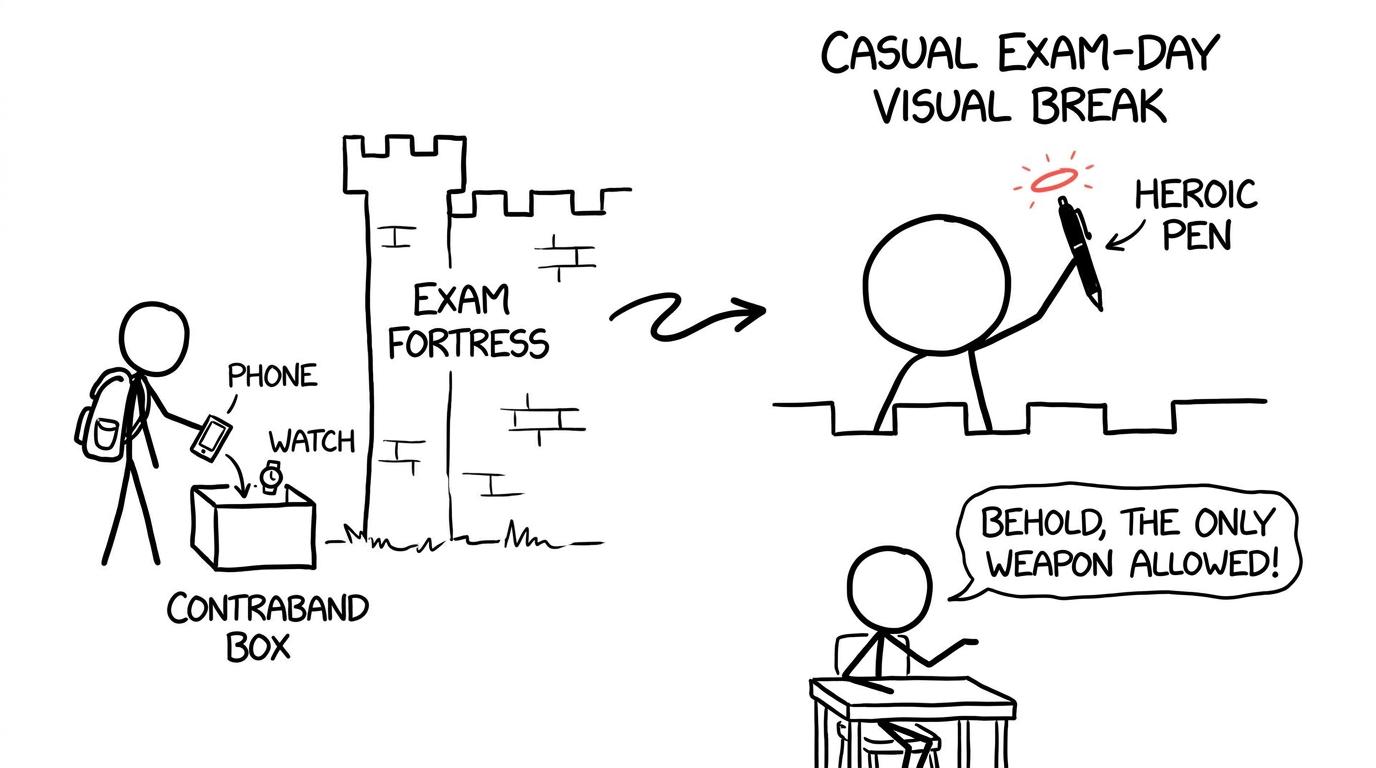 A phone and watch remain outside while a black pen enters the exam like a hero
Highlighters require a little nuance. Current JCQ rules allow them for highlighting questions, words or phrases in the question paper, but not for writing answers. You can avoid confusion by leaving them out unless you have practised using one appropriately.
A calm plan for the evening before
Preparation works best when decisions are made early. The night before, place your clear pencil case, two black pens and unlabelled water bottle beside your exam timetable. Confirm your arrival time and transport. Then stop packing.
If you also have GCSE maths papers approaching, use the GCSE maths night-before plan rather than attempting a late revision marathon. For a wider schedule, the GCSE one-week revision plan turns revision into manageable daily decisions.
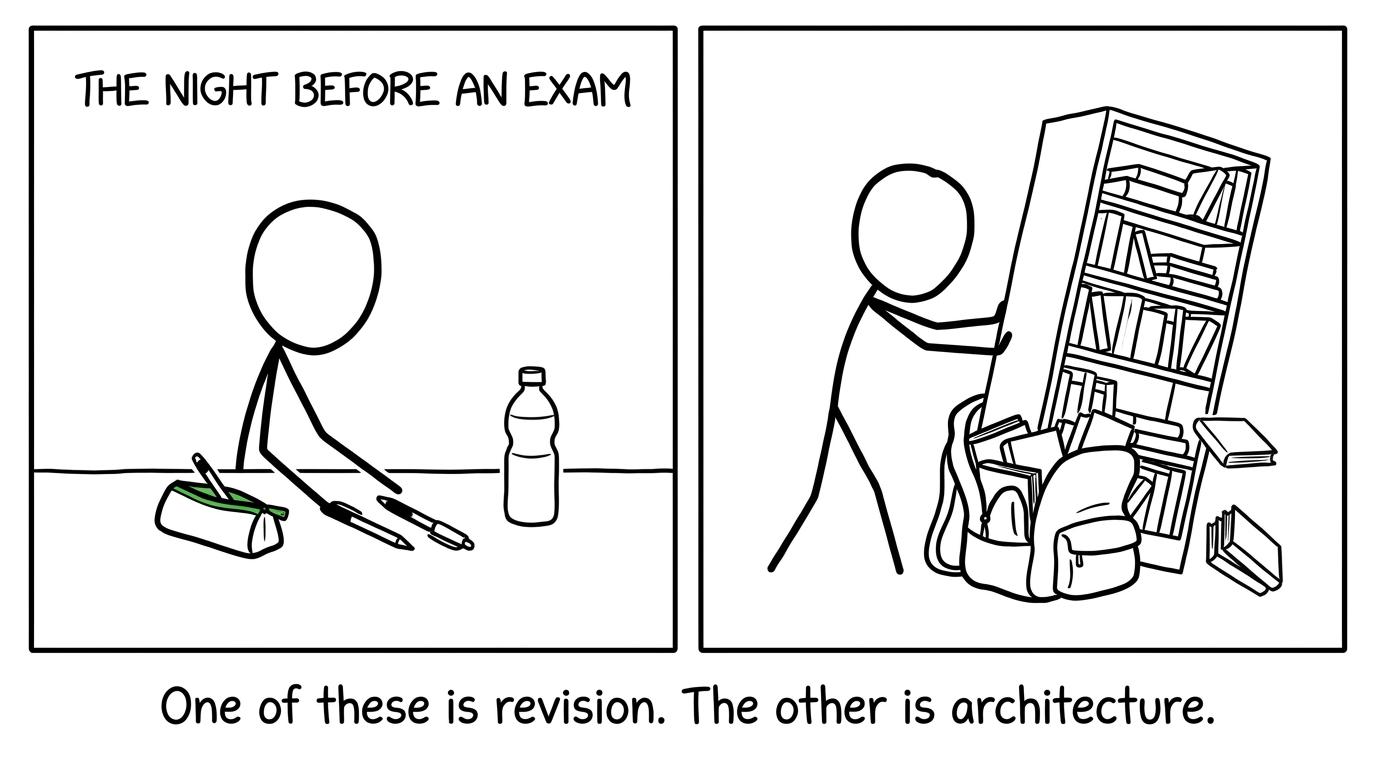 One student calmly packs while another attempts to fit a bookshelf into a bag
The goal is not to feel perfectly calm. It is to remove avoidable uncertainty. Knowing where to go, what to carry and what to leave behind gives your attention one less place to wander.
Common mistakes to avoid
Assuming writing means dictionaries are allowed
They are not. The current AQA specification prohibits dictionaries in the writing paper and every other component.
Bringing a watch because it is not smart
All watches are prohibited under JCQ rules. Exam rooms should provide a clock visible to candidates.
Keeping a switched-off phone in a pocket
A switched-off device is still an unauthorised item in your possession. Leave it outside or surrender it according to your centre’s process.
Writing final answers in pencil or gel ink
Use black ballpoint pen for answers. Keep a spare beside you.
Taking prepared notes into the speaking test
Only notes created on the official sheet during supervised preparation may enter the speaking assessment. They must later be handed in when instructed.
Bringing your own rough paper
Your centre supplies authorised paper. Ask an invigilator if you need an additional sheet and complete the required candidate details.
Treating every GCSE exam as if it needs the same equipment
Modern Hebrew does not require the calculator and geometry equipment used in GCSE maths. Read each paper’s front cover and pack for that subject. When preparing for maths, use MathsGenie past papers to rehearse the correct equipment, timing and tier.
Walk in with fewer decisions to make
A good exam kit is deliberately uninteresting: two black pens, a transparent pencil case, permitted water and any centre-required identification. Everything else should either be supplied by the school or left safely outside.
Pack once, check once and turn your attention back to what earns marks. For your maths papers, MathsGenie brings free revision lessons, practice questions, mini tests, mark schemes and video solutions together in one place. Start with the GCSE Maths revision resources, test yourself using past papers, and use Edexcel GCSE Maths predicted papers for fresh exam-style practice where relevant.
The bag should be simple. The preparation behind it is where the real work lives.